Listen to this Post
Introduction:
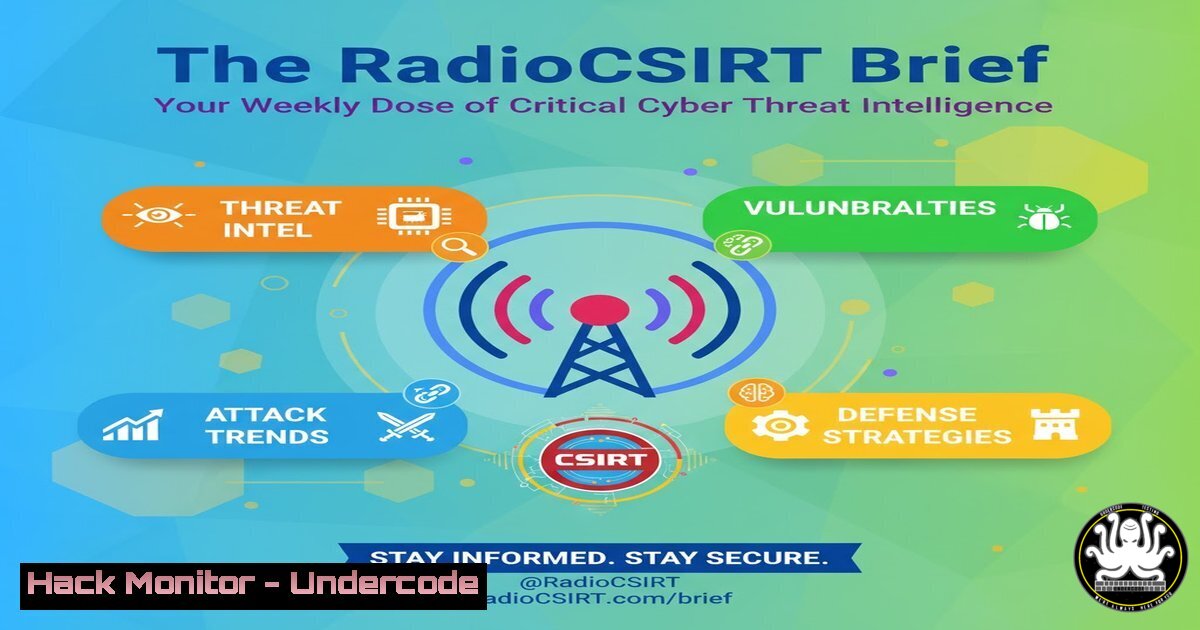
In the relentless landscape of cybersecurity, staying ahead of adversaries requires a constant flow of curated, actionable intelligence. The RadioCSIRT newsletter, as highlighted by industry veteran Marc-Frédéric Gomez, serves as a critical briefing for security professionals, distilling the week’s most significant threats, vulnerabilities, and adversary campaigns into an essential strategic resource for CERTs, SOCs, and threat intelligence teams.
Learning Objectives:
- Understand the key components of an effective Cyber Threat Intelligence (CTI) briefing and how to operationalize them.
- Learn to identify and mitigate emerging critical vulnerabilities and attacker TTPs (Tactics, Techniques, and Procedures).
- Develop practical skills for hunting threats and hardening systems based on current threat actor activity.
You Should Know:
1. Decoding APT Campaigns: From IOCs to TTPs
Modern security operations have shifted from solely tracking Indicators of Compromise (IOCs) to understanding the underlying Tactics, Techniques, and Procedures (TTPs) of Advanced Persistent Threat (APT) groups. A CTI newsletter provides the context behind the malware hashes and IP addresses.
Step‑by‑step guide explaining what this does and how to use it.
Step 1: Identify the Adversary’s Goals. When a new APT report is published, first determine their objective (e.g., data exfiltration, espionage, destruction). This frames your defensive posture.
Step 2: Map TTPs to the MITRE ATT&CK Framework. This common taxonomy allows you to translate report findings into specific techniques. For example, if a report mentions “use of legitimate scripting engines,” you would map it to T1059.005 (Command and Scripting Interpreter: Visual Basic).
Step 3: Hunt for Activity in Your Environment. Use the mapped techniques to craft hunting queries. For instance, to hunt for suspicious `rundll32` activity (a common LOLBin):
Linux (Auditd): Search for execution of scripting interpreters like python, perl, or `bash` with unusual parameters from unexpected parent processes.
Windows (PowerShell): `Get-WinEvent -Path C:\Windows\System32\winevt\Logs\Microsoft-Windows-Sysmon/Operational.evtx | Where-Object {($_.Message -like “rundll32” -and $_.Message -like “scrobj.dll”)}`
Step 4: Implement Mitigations. Use the MITRE ATT&CK framework’s mitigation recommendations, such as applying application whitelisting or restricting PowerShell execution policies.
2. Prioritizing Critical Vulnerabilities for Patching
A CTI briefing highlights which CVEs are being actively exploited in the wild, moving beyond a raw CVSS score to real-world risk. This enables a risk-based patch management strategy.
Step‑by‑step guide explaining what this does and how to use it.
Step 1: Correlate with Your Asset Inventory. When a critical vulnerability is announced (e.g., a new Microsoft Exchange zero-day), immediately cross-reference it with your asset management system to identify all affected systems.
Step 2: Verify Exposure. Use scanning tools to confirm the vulnerability. Never assume a system is patched.
NMAP NSE Script: `nmap -p 443 –script http-vuln-cve2025-xxxx –script-args=unsafe=1
Windows (PowerShell): Use the `Test-NetConnection` cmdlet to check if a vulnerable service port is open.
Step 3: Apply Compensating Controls. If immediate patching is impossible, implement temporary mitigations. For a web application vulnerability, this might involve deploying a virtual patch via your WAF.
3. Operationalizing Threat Feeds with SIEM and EDR
Raw intelligence is useless unless it is integrated into your security tools. This process involves translating newsletter findings into active detections.
Step‑by‑step guide explaining what this does and how to use it.
Step 1: Extract IOCs. Pull the list of malicious IPs, domains, and file hashes from the intelligence report.
Step 2: Ingest into Security Tools.
SIEM (e.g., Splunk): Create a lookup table of IOCs and write correlation searches that alert on any network connection or file execution matching these indicators.
EDR (e.g., CrowdStrike, SentinelOne): Use the custom IOC management feature to upload the hashes and domains, which will trigger a block or alert if encountered.
Step 3: Create YARA Rules. For more sophisticated malware families, craft YARA rules to detect variants based on code patterns, not just static hashes.
Example YARA Rule Snippet:
rule APT_Novel_Stealer {
meta:
description = "Detects novel stealer malware from APT report"
author = "Your_CERT"
date = "2025-11-16"
strings:
$a = "SuperSecretC2Domain.com" nocase
$b = { 48 8B 05 ?? ?? ?? ?? 48 89 44 24 ?? 33 C0 }
condition:
any of them
}
4. Enhancing Cloud Security Posture Against Emerging TTPs
Attackers are rapidly adapting their TTPs to target cloud infrastructure. CTI reports often detail new cloud-specific attack vectors, such as role assumption attacks or vulnerable container configurations.
Step‑by‑step guide explaining what this does and how to use it.
Step 1: Harden Identity and Access Management (IAM). Enforce the principle of least privilege. Regularly audit IAM roles and policies.
AWS CLI: `aws iam get-account-authorization-details` to export and review all IAM policies.
Azure CLI: `az role assignment list –output table` to list all role assignments.
Step 2: Secure Container Registries and Orchestration. Ensure no sensitive data is baked into container images and that Kubernetes clusters are properly configured.
Command to scan a local Docker image for secrets: `docker save
Use `kube-bench` to check Kubernetes clusters against the CIS Benchmarks.
Step 3: Monitor for Unusual Cloud API Activity. Use cloud-native logging (AWS CloudTrail, Azure Activity Log) to detect anomalous actions, such as `AssumeRole` from an unfamiliar IP or region.
5. Building a Proactive Threat Hunting Program
A CTI newsletter is the primary fuel for a proactive threat hunt. It provides the hypotheses needed to search for hidden adversaries already in your network.
Step‑by‑step guide explaining what this does and how to use it.
Step 1: Formulate a Hypothesis. Based on the newsletter, create a testable statement. E.g., “Threat group FIN7 is using XLL Excel add-ins for initial access. We will hunt for `excel.exe` spawning `rundll32.exe` or cmd.exe.”
Step 2: Craft and Execute Hunting Queries.
Windows (via EDR or Sysmon): Query for processes where the parent is `excel.exe` and the child is rundll32.exe.
Sigma Rule (for SIEMs): Utilize the open-source Sigma project to find and deploy detection rules aligned with the latest TTPs.
Step 3: Document and Refine. Whether you find something or not, document the hunt. A null result can help refine your hypothesis and improve your logging configuration for future hunts.
What Undercode Say:
- Context is King: The true value of a specialized CTI feed like RadioCSIRT is not the list of IOCs, but the expert context that tells you why a threat matters and how it’s being used. This transforms raw data into actionable defense strategy.
- Proactivity is a Force Multiplier: Consistently applying the insights from these briefings moves a security team from a reactive “alert fatigue” posture to a proactive “threat hunter” stance, significantly reducing the adversary’s dwell time.
The analysis suggests that for security leaders, subscribing to and systematically operationalizing a high-quality CTI newsletter is no longer a luxury but a fundamental component of modern cyber defense. It bridges the gap between the theoretical threat landscape and the practical, daily decisions of a SOC analyst or incident responder. By dedicating time each week to digest and act on this intelligence, organizations can align their defenses with the actual tactics of their most likely adversaries, creating a dynamic and informed security posture.
Prediction:
The convergence of AI-powered attack automation and the expanding attack surface of hybrid cloud environments will lead to a future where threat intelligence briefings will become even more hyper-specialized and real-time. We will see a shift from weekly newsletters to dynamic, API-driven intelligence platforms that integrate directly with security orchestration (SOAR) tools, allowing for automated mitigation and patching in response to newly published threats within minutes, not days. The role of the human analyst will evolve to focus on strategic interpretation and complex threat hunting, while automated systems handle the tactical application of intelligence.
🎯Let’s Practice For Free:
IT/Security Reporter URL:
Reported By: Marcfredericgomez Newsletter – Hackers Feeds
Extra Hub: Undercode MoN
Basic Verification: Pass ✅


