Listen to this Post
Introduction:
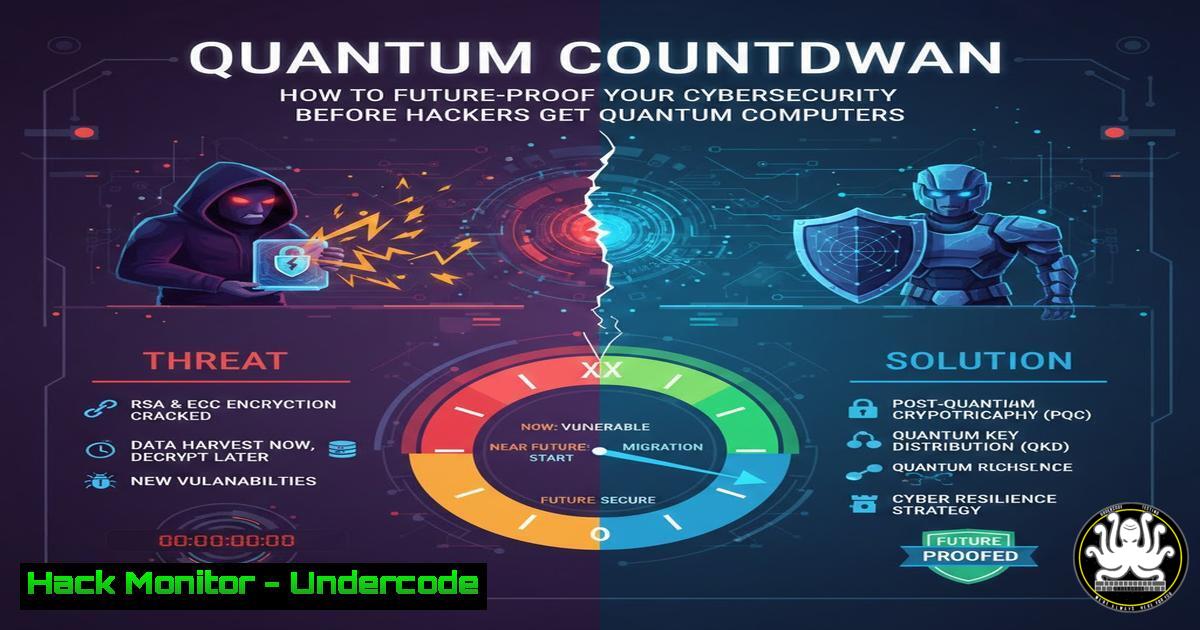
The partnership between the Dubai Electronic Security Center (DESC) and The Quantum Innovation Summit 2026 underscores a critical, imminent shift in global cybersecurity. While quantum computing promises breakthroughs in medicine and materials science, it also poses an existential threat to the public-key cryptography that secures virtually all digital communications, financial transactions, and government secrets today. This article provides a technical survival guide for IT professionals, detailing the actionable steps to begin the transition to Post-Quantum Cryptography (PQC) and build resilient systems for the quantum era.
Learning Objectives:
- Understand the specific cryptographic systems (RSA, ECC, DH) that quantum computers will break and the timeline for this threat.
- Learn how to inventory your organization’s cryptographic assets and dependencies to assess quantum risk.
- Gain hands-on experience with new PQC algorithms, integration methods, and cloud security tools to start building quantum-resistant infrastructure.
You Should Know:
- The Looming Cryptopocalypse: Why Your Encryption is Already at Risk
The threat isn’t about quantum computers being on every hacker’s desk tomorrow; it’s about “harvest now, decrypt later” attacks. Adversaries are already intercepting and storing encrypted data (e.g., state secrets, intellectual property, personal health records) with the expectation that a future quantum computer will crack it. The migration to new standards is a massive, multi-year undertaking for global IT infrastructure. Starting your inventory and planning now is not premature—it’s essential for maintaining long-term confidentiality.
Step-by-Step Guide: Conducting a Cryptographic Inventory
- Objective: Discover all systems using vulnerable public-key algorithms (RSA, DSA, ECC).
- Tool Selection: Use a combination of network scanners, certificate analyzers, and code dependency checkers.
- Network Scanning: Use `nmap` with scripts to identify services and their supported cipher suites.
nmap --script ssl-cert,ssl-enum-ciphers -p 443,22,465,993,995 <your_domain_or_IP>
- Certificate Analysis: For web servers, use `openssl` to examine certificates and their signing algorithms.
openssl s_client -connect <your_domain>:443 | openssl x509 -noout -text | grep "Public Key Algorithm"
- Code & Dependency Audit: In your application codebases, use tools like `grep` or SAST (Static Application Security Testing) tools to find calls to cryptographic libraries (OpenSSL, Bouncy Castle, etc.) and list their dependencies to identify uses of vulnerable algorithms.
-
Navigating the PQC Standardization Race: NIST’s Finalists and Alternates
The U.S. National Institute of Standards and Technology (NIST) is leading the global effort to standardize PQC algorithms. The process has selected winners for general encryption (CRYSTALS-Kyber) and digital signatures (CRYSTALS-Dilithium, FALCON, SPHINCS+). These algorithms are based on hard mathematical problems believed to be resistant to both classical and quantum attacks, such as structured lattice problems and hash-based signatures.
Step-by-Step Guide: Experimenting with PQC Algorithms Using the Open Quantum Safe (OQS) Project - Objective: Compile and run a test program using a NIST-standardized PQC algorithm.
- Environment Setup: Use a Linux VM or container. Clone the liboqs library and build it.
git clone https://github.com/open-quantum-safe/liboqs.git
cd liboqs
mkdir build && cd build
cmake -DCMAKE_INSTALL_PREFIX=/usr/local ..
make
sudo make install
- Write a Test Program: Create a simple C program (
test_kyber.c) that uses the OQS API to generate a Kyber key pair, encapsulate, and decapsulate a secret.include <stdio.h> include <oqs/oqs.h> int main() { OQS_KEM kem = OQS_KEM_new(OQS_KEM_alg_kyber_512); uint8_t public_key[bash]; uint8_t secret_key[bash]; uint8_t ciphertext[bash]; uint8_t shared_secret_e[bash]; uint8_t shared_secret_d[bash]; OQS_KEM_keypair(kem, public_key, secret_key); OQS_KEM_encaps(kem, ciphertext, shared_secret_e, public_key); OQS_KEM_decaps(kem, shared_secret_d, ciphertext, secret_key); // Verify the shared secrets match if (OQS_MEM_secure_equal(shared_secret_e, shared_secret_d, OQS_KEM_kyber_512_length_shared_secret)) { printf("Kyber KEM successful!\n"); } OQS_KEM_free(kem); return 0; } -
Compile and Run: Compile the program linking against liboqs and execute it.
gcc -o test_kyber test_kyber.c -loqs
./test_kyber
-
The Hybrid Approach: Bridging the Gap Between Today’s Security and Tomorrow’s
A sudden, full cutover to PQC is too risky. The recommended strategy is hybrid cryptography, which combines classical and post-quantum algorithms. This ensures security even if one of the algorithms is later broken. For TLS, this means a connection must establish a shared secret using both an ECDH key exchange and a Kyber KEM, and authenticate with both an ECDSA and a Dilithium signature.
Step-by-Step Guide: Configuring a Hybrid TLS Test Server with OpenSSL (OQS Provider) - Objective: Set up a local web server that negotiates hybrid PQC/classical TLS 1.3 connections.
- Prerequisites: Build OpenSSL 3.0+ with the OQS provider. Detailed instructions are on the OQS-OpenSSL provider GitHub wiki.
- Generate Hybrid Certificates: You need a certificate signed with both ECDSA and Dilithium. Use the `openssl` commands provided by the OQS provider to generate a composite key and certificate signing request (CSR).
- Configure `nginx` or
apache: In your web server’s SSL configuration file, specify the hybrid cipher string to enable both classical and PQC algorithms.Example nginx snippet ssl_protocols TLSv1.3; ssl_ciphers TLS_AES_256_GCM_SHA384:TLS_CHACHA20_POLY1305_SHA256; Enable hybrid key exchange ssl_ecdh_curve X25519:kyber512;
-
Test the Connection: Use a specialized test client (like the `openssl s_client` built with the OQS provider) to connect and verify that the hybrid handshake completes successfully, observing the use of PQC algorithms in the negotiation.
-
Quantum-Safe Key Management and Hardware Security Modules (HSMs)
Cryptographic keys are the crown jewels, and their lifecycle management becomes even more critical in the PQC transition. Storing new PQC private keys in software alone is insufficient for high-assurance environments. Modern HSMs and Key Management Services (KMS) are beginning to offer PQC algorithm support, providing FIPS-validated, hardware-protected key generation, storage, and operations.
Step-by-Step Guide: Exploring PQC Options in Cloud KMS (AWS & Azure) - Objective: Learn how to create and manage quantum-resistant keys in major cloud platforms.
- AWS KMS: As of early 2026, AWS KMS may offer key spec `RSA_3072` or `ECC_NIST_P256` for classical keys. Check the latest AWS CLI or console for any `ML_KYBER_` key spec. Create a key and inspect its metadata.
Check for supported key specs (hypothetical future command)
aws kms describe-key --key-id alias/my-pqc-key --query 'KeyMetadata.KeySpec'
- Azure Key Vault: Azure’s managed HSM may offer preview support for PQC algorithms. Use Azure CLI to check the `–kty` (key type) parameter for creating a key. Look for values like `PQ-KYBER` or
DILITHIUM.List supported key types (hypothetical) az keyvault key create --vault-name <vault> --name MyPQKey --kty KYBER --size 512
- Application Integration: Update your application code to use the Cloud KMS API for signing or decryption operations with the new PQC key, ensuring keys never leave the hardened cloud HSM.
5. Building Your Quantum-Ready Migration Roadmap
Technical experimentation must evolve into an organizational strategy. This involves creating a phased plan that prioritizes assets based on sensitivity, regulatory requirements, and expected lifespan. The roadmap must encompass people (training from institutions like Vernewell Academy), processes (crypto-agility policies), and technology (dependency upgrades).
Step-by-Step Guide: Drafting a Phase 1 Action Plan
1. Form a Working Group: Assemble a cross-functional team (Security, Infrastructure, App Dev, Legal/Compliance).
2. Categorize Data & Systems: Classify data by sensitivity (e.g., “Top Secret,” “Public”) and systems by their crypto-dependency (e.g., “TLS termination,” “code signing,” “document signing”).
3. Set Prioritization Criteria: Score systems based on: Data sensitivity, System exposure (internet-facing?), Data longevity (>25 years?), and Compliance drivers (e.g., CNSA suite mandate).
4. Create a Pilot Project: Select a low-risk, high-visibility system (e.g., an internal VPN gateway or a public-facing website’s TLS) for your first hybrid PQC implementation. Use the lessons learned from the technical steps above.
5. Establish Crypto-Agility: Mandate that all new system designs and procurements must support cryptographic algorithm updates without requiring a full system redesign. This is the ultimate goal of the entire migration.
What Undercode Say:
- The Threat is Current, Not Futuristic: The “harvest now, decrypt later” attack model means data transmitted today is vulnerable. Procrastination on PQC planning is an active security risk for long-lived sensitive data.
- Hybrid is the Only Pragmatic Path: A “big bang” cutover to PQC is impossible for complex enterprises. A deliberate, phased hybrid approach mitigates risk while allowing for integration and testing of new algorithms within existing security paradigms.
The analysis is clear: the partnership between DESC and the Quantum Innovation Summit is a strategic signal to the region’s critical infrastructure and government bodies. It moves the conversation from theoretical academic discussion to institutional readiness and operational execution. The technical steps outlined here are the foundational exercises every security team must now undertake. Waiting for final standards or vendor solutions to be perfect is a losing strategy; the winners in the quantum era will be those who built crypto-agility into their DNA early on.
Prediction:
By 2030, hybrid post-quantum cryptography will be the default requirement for all new government systems and critical infrastructure procurement requests globally, driven by mandates similar to the U.S. CNSA 2.0 framework. The focus will rapidly shift from algorithm selection to the immense challenges of ecosystem integration, performance optimization, and legacy system remediation. Furthermore, as quantum computing hardware matures, we will see the emergence of entirely new, quantum-native security protocols (like Quantum Key Distribution for specialized links) that complement PQC, leading to a layered, defense-in-depth approach for the quantum age. Events like the Quantum Innovation Summit 2026 will serve as the crucial nexus where policy, research, and operational technology leaders converge to accelerate this complex transition.
▶️ Related Video (82% Match):
🎯Let’s Practice For Free:
IT/Security Reporter URL:
Reported By: Quantum Innovation – Hackers Feeds
Extra Hub: Undercode MoN
Basic Verification: Pass ✅


