Listen to this Post
Introduction:
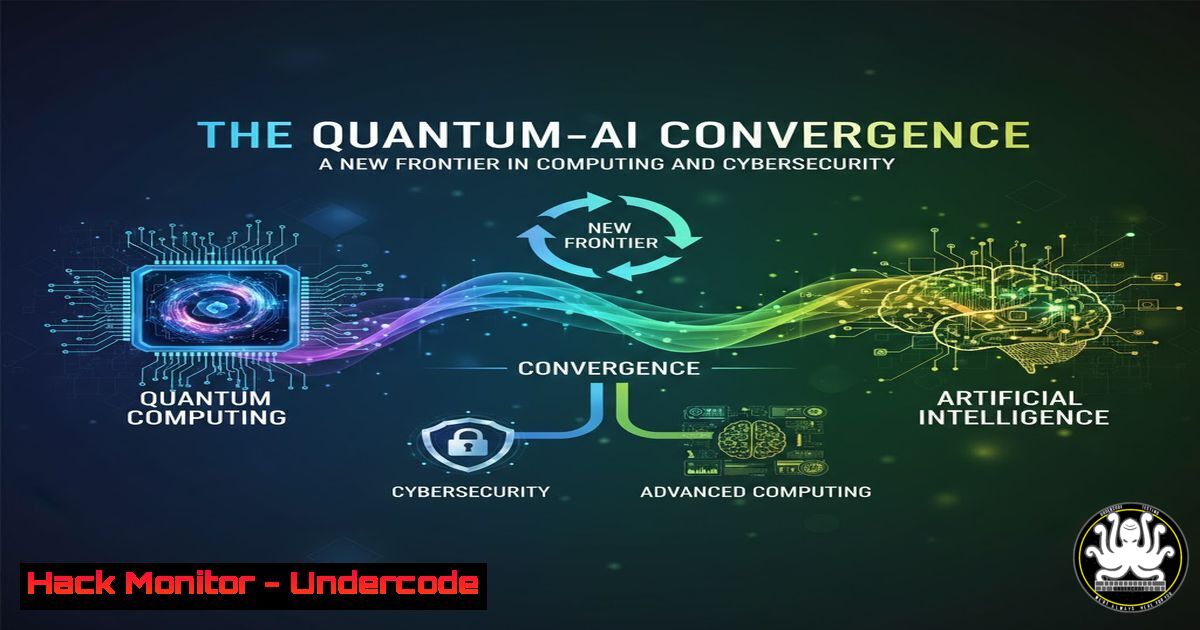
The convergence of Artificial Intelligence and Quantum Computing is forging a new technological paradigm. This synergy promises to revolutionize fields from drug discovery to cryptography, but it also introduces a novel and complex threat landscape where AI-driven quantum attacks could dismantle current security models. Understanding this intersection is no longer futuristic; it is a pressing imperative for cybersecurity professionals.
Learning Objectives:
- Understand the core concepts of Quantum Computing and its symbiotic relationship with AI.
- Identify the emerging cybersecurity threats and opportunities presented by quantum-AI systems.
- Learn practical commands and techniques for simulating quantum processes and securing systems in a post-quantum world.
You Should Know:
1. Simulating a Quantum Circuit with Qiskit
Quantum circuits are the foundational building blocks of quantum algorithms. Simulating them allows us to understand quantum behavior on classical hardware.
 Qiskit Quantum Circuit Simulation
from qiskit import QuantumCircuit, transpile
from qiskit_aer import AerSimulator
from qiskit.visualization import plot_histogram

Create a 2-qubit quantum circuit
qc = QuantumCircuit(2, 2)

Apply a Hadamard gate to create superposition on qubit 0
qc.h(0)
 Apply a CNOT gate to create entanglement between qubit 0 and 1
qc.cx(0, 1)
 Measure both qubits
qc.measure([0, 1], [0, 1])

Use Aer's simulator
simulator = AerSimulator()
compiled_circuit = transpile(qc, simulator)
job = simulator.run(compiled_circuit, shots=1000)
result = job.result()
counts = result.get_counts(qc)
print(counts)
 Expected output: {'00': 500, '11': 500} approximately
plot_histogram(counts)
Step-by-step guide:
This code creates a basic quantum circuit that demonstrates superposition and entanglement—two phenomena that give quantum computers their power. The Hadamard gate (h(0)) puts the first qubit into a state of 0 and 1 simultaneously. The CNOT gate (cx(0,1)) entangles the two qubits, meaning the state of one directly influences the other. When measured, the qubits will collapse into a correlated state, showing either `00` or `11` with roughly equal probability, a signature of a Bell state. This simulation is the first step in prototyping quantum algorithms that could break current encryption.
- Installing and Using Open Quantum Safe (OQS) Libraries
Preparing for post-quantum cryptography involves integrating algorithms that are resistant to quantum attacks. The Open Quantum Safe project provides a toolkit for this.
 Linux/macOS - Clone and build the OQS OpenSSL library
git clone https://github.com/open-quantum-safe/openssl.git
cd openssl
./Configure linux-x86_64 -shared
make -j$(nproc)

Generate a post-quantum key pair using the Kyber algorithm
./apps/openssl genpkey -algorithm kyber768 -out kyber_private.key
./apps/openssl pkey -in kyber_private.key -pubout -out kyber_public.key
Step-by-step guide:
These commands compile a version of OpenSSL that includes post-quantum cryptographic (PQC) algorithms. After cloning the repository, the `Configure` and `make` commands build the library. The `genpkey` command then generates a private key using the Kyber-768 algorithm, a leading candidate for key establishment in the NIST PQC standardization process. The subsequent command extracts the public key from the private key file. This is a critical step in transitioning TLS handshakes and VPN configurations to be quantum-resistant.
3. Configuring Nginx with Hybrid Post-Quantum TLS
To maintain compatibility while transitioning to PQC, a hybrid approach that combines classical and quantum-safe algorithms is essential.
 Obtain the OQS-enabled OpenSSL build as above.
 Configure Nginx with PQC support (add to your nginx configure command)
./configure --with-openssl=/path/to/oqs-openssl [...other flags]

Example Nginx server block configuration snippet
server {
listen 443 ssl;
server_name your_domain.com;

Classical RSA Certificate
ssl_certificate /etc/ssl/certs/nginx-classical.crt;
ssl_certificate_key /etc/ssl/private/nginx-classical.key;

Post-Quantum Certificate (e.g., Dilithium)
ssl_certificate /etc/ssl/certs/nginx-pqc.crt;
ssl_certificate_key /etc/ssl/private/nginx-pqc.key;

Hybrid Key Exchange
ssl_ecdh_curve X25519:prime256v1;
ssl_conf_command Ciphersuites @OQS_KEM_DEFAULT_CIPHERSUITES;
}
Step-by-step guide:
This configuration demonstrates a hybrid TLS setup for an Nginx web server. It first requires building Nginx against the OQS OpenSSL library. The server block then specifies both a traditional (e.g., RSA) certificate and a post-quantum (e.g., Dilithium) certificate. The `ssl_conf_command` directive tells the server to offer post-quantum key exchange algorithms during the TLS handshake. This ensures that even if the quantum algorithm is later broken, the classical key exchange remains secure, providing a robust migration path.
- AI-Driven Anomaly Detection for Quantum Compute Job Logs
AI can be used to monitor and secure the classical infrastructure that supports quantum computers, detecting malicious activity.
 Python script using Scikit-learn for simple anomaly detection on job logs
import pandas as pd
from sklearn.ensemble import IsolationForest
from sklearn.preprocessing import StandardScaler

Sample log data: timestamp, job_duration, circuit_depth, qubit_count, error_rate
data = pd.read_csv('quantum_job_logs.csv')
features = ['job_duration', 'circuit_depth', 'qubit_count', 'error_rate']

Preprocess data
scaler = StandardScaler()
scaled_features = scaler.fit_transform(data[bash])

Train an Isolation Forest model for anomaly detection
model = IsolationForest(contamination=0.01, random_state=42)
data['anomaly'] = model.fit_predict(scaled_features)

Filter and view anomalies (anomalies are labeled as -1)
anomalies = data[data['anomaly'] == -1]
print(anomalies)
Step-by-step guide:
This script uses an unsupervised machine learning model, Isolation Forest, to find unusual patterns in quantum computer usage logs. After loading the data, it scales the numerical features to normalize them. The `IsolationForest` model is trained to identify the 1% of jobs that are most dissimilar from the rest. Anomalies could indicate anything from a hardware fault to an attacker running specialized circuits aimed at finding vulnerabilities in the quantum processor’s control system or extracting sensitive data from other users’ jobs.
5. Windows PowerShell Query for Post-Quantum Cipher Support
System administrators must audit their environments for readiness against quantum threats.
 PowerShell command to check TLS cipher suites, including potential PQC ones
Get-TlsCipherSuite | Format-Table Name, Certificate, Cipher, CipherLength, MaximumVersion

Check for specific cryptographic providers related to PQC algorithms
Get-CimInstance -Namespace root/CIMV2/Security/MicrosoftTpm -ClassName Win32_Tpm | Where-Object {$_.IsEnabled_InitialValue -eq $true}

Script to audit .NET for PQC algorithm support
$Algorithms = [System.Security.Cryptography.CryptoConfig]::CreateFromName("Kyber768")
if ($Algorithms -eq $null) {
Write-Host "PQC Algorithm Kyber768 not available. Consider updating .NET."
} else {
Write-Host "PQC Algorithm support found."
}
Step-by-step guide:
These PowerShell commands help assess a Windows system’s cryptographic posture. `Get-TlsCipherSuite` lists all available cipher suites, which can be checked for known PQC names. The TPM query verifies if a hardware security module is present and enabled, which will be crucial for storing PQC keys securely. The .NET script attempts to instantiate a Kyber768 algorithm object; failure indicates the framework lacks built-in PQC support, a critical finding for application security teams developing quantum-resistant software.
6. Exploiting and Mitigating Harvest-Now-Decrypt-Later Attacks
Adversaries are already conducting “Harvest-Now-Decrypt-Later” (HNDL) attacks, stealing encrypted data today to decrypt it when a powerful quantum computer is available.
Mitigation via Data Classification and Encryption Policy:
 Use OpenSSL to re-encrypt long-term sensitive archives with a hybrid scheme.
 Assume 'sensitive_data.tar' is the file to protect.

First, encrypt with a strong classical algorithm (AES-256-GCM)
openssl enc -aes-256-gcm -salt -in sensitive_data.tar -out sensitive_data.tar.aes -k $(openssl rand -base64 32)

Then, encrypt the AES key with a post-quantum algorithm using OQS OpenSSL
/path/to/oqs-openssl/apps/openssl pkeyutl -encrypt -inkey kyber_public.key -in aes_key.bin -out aes_key.bin.kyber.enc

The final secure package consists of:
 - sensitive_data.tar.aes (classically encrypted data)
 - aes_key.bin.kyber.enc (quantum-safe encrypted key)
Step-by-step guide:
This two-step process mitigates the HNDL threat for archived data. The data itself is encrypted using the well-vetted, high-performance AES-256-GCM algorithm. The critical step is that the symmetric AES key is then encrypted using a post-quantum public key (Kyber). Even if an attacker harvests this encrypted package, they cannot decrypt the AES key without the private key, and that encryption is designed to be secure against future quantum attacks. To access the data, one would decrypt the AES key with the Kyber private key and then use that key to decrypt the archive.
What Undercode Say:
- The quantum-AI convergence is not a distant theory but an active engineering problem with immediate security consequences. The development cycle is accelerating, leaving a shrinking window for mitigation.
- The most significant near-term threat is cryptographic collapse due to HNDL attacks. Organizations handling data with a long shelf-life (e.g., government archives, medical records, intellectual property) are already vulnerable.
Analysis: The commentary from the LinkedIn post, particularly the note on “real-time error correction,” highlights a critical bottleneck. The classical computing systems required to manage quantum processors are a lucrative target. If AI can optimize error correction, it brings functional quantum computers closer. However, this same AI could be weaponized to find weaknesses in the control logic or the PQC algorithms themselves, creating an offensive arms race. The cybersecurity community must shift from a reactive to a proactive stance, integrating PQC and quantum-aware monitoring now, before the threat fully materializes. The tools and commands outlined provide a starting point for this essential preparation.
Prediction:
Within the next 5-7 years, the first successful cryptanalytic attack on a widely used public-key algorithm (like RSA-2048) using a hybrid quantum-classical system, likely accelerated by AI, will occur. This will not be a full-scale fault-tolerant quantum computer but a specialized, Noisy Intermediate-Scale Quantum (NISQ) device tuned by AI for a specific mathematical problem. The result will be a “quantum Pearl Harbor,” triggering a global, panicked scramble to replace digital certificates and secure communications, disproportionately impacting organizations that delayed their PQC migration plans.
🎯Let’s Practice For Free:
IT/Security Reporter URL:
Reported By: Trey Rutledge – Hackers Feeds
Extra Hub: Undercode MoN
Basic Verification: Pass ✅


