Listen to this Post
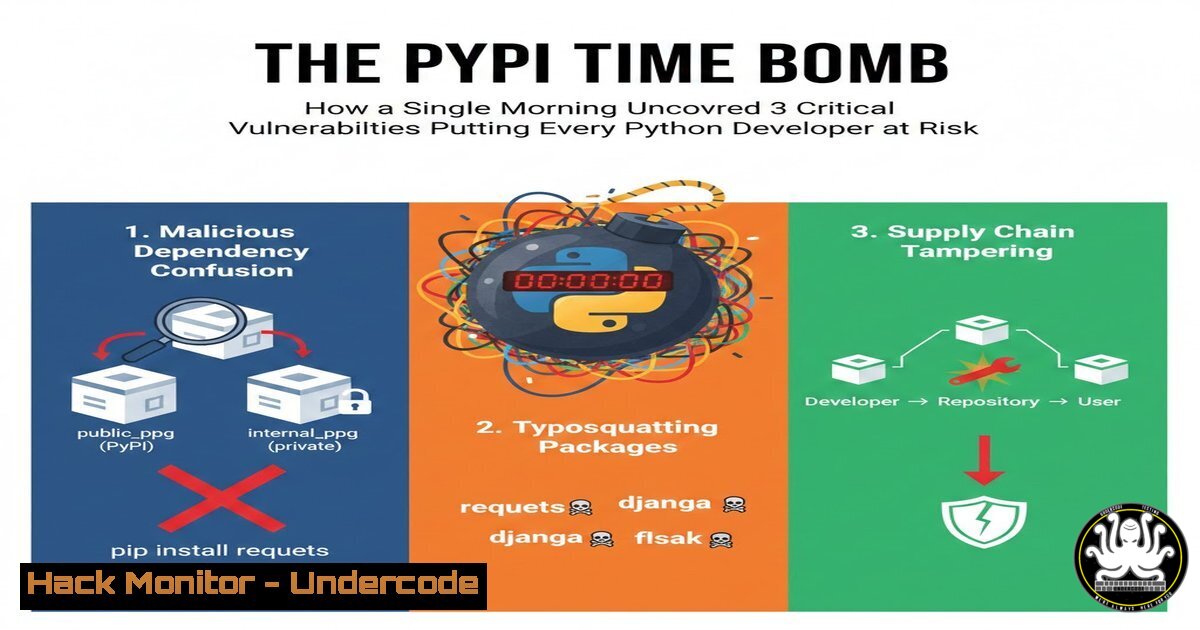
Introduction:
A routine security assessment of a Python Package Index (PyPI) library recently unearthed three severe vulnerabilities, including one critical flaw with a maximum CVSS score of 10. This incident underscores the ever-present dangers within software supply chains and highlights the critical importance of proactive dependency management and collaborative responsible disclosure between security researchers and open-source maintainers.
Learning Objectives:
- Understand the systemic risk posed by vulnerable dependencies in open-source ecosystems like PyPI.
- Learn the step-by-step process for responsible vulnerability disclosure and patch validation.
- Gain practical skills for auditing your own Python environments and dependencies for known vulnerabilities.
You Should Know:
1. The Anatomy of a PyPI Vulnerability
The recently disclosed CVEs (CVE-2026-0846, CVE-2026-0847, CVE-2026-0848) originated in a popular PyPI package. Such packages are often deeply embedded in application dependency trees. A critical vulnerability, especially one scoring CVSS 10, typically implies flaws allowing remote code execution (RCE), authentication bypass, or severe data compromise without user interaction. The attack surface is massive, as the vulnerable package could be pulled automatically by millions of `pip install` commands.
Step‑by‑step guide explaining what this does and how to use it.
Step 1: Understand Your Dependency Tree. Use `pip` to list all top-level and transitive dependencies.
 Linux/macOS/WSL & Windows Command Prompt
pip list

To generate a detailed tree (install `pipdeptree` first: <code>pip install pipdeptree</code>)
pipdeptree
Step 2: Identify the Affected Package. Cross-reference your dependency list with public CVE databases (NVD, Mitre) or use automated scanners. The package name is often not disclosed immediately to prevent active exploitation before patches are applied.
- Decoding CVSS: Why a Score of 10 is a Five-Alarm Fire
The Common Vulnerability Scoring System (CVSS) provides a standardized risk assessment. A score of 10/10 is rare and severe. It means the vulnerability is remotely exploitable (Attack Vector: Network), requires no privileges or user interaction (Attack Complexity: Low, Privileges Required: None, User Interaction: None), and leads to a total loss of confidentiality, integrity, and availability (Impact: High). In practice, this could allow an attacker to take complete control of a server or application by merely sending a malicious network request.
Step‑by‑step guide explaining what this does and how to use it.
Step 1: Read the CVE Vector. A CVSS vector for a 10.0 score might look like: CVSS:3.1/AV:N/AC:L/PR:N/UI:N/S:C/C:H/I:H/A:H. Decode each metric.
Step 2: Prioritize Remediation. Any vulnerability with a CVSS score above 7.0 (High) or 9.0 (Critical) must be patched immediately. This takes precedence over all other development work.
- The Responsible Disclosure Playbook: From Researcher to Fix
The post highlights “responsible disclosure” and maintainer collaboration. This process is formal and ethical. - Discovery & Validation: The researcher confirms the bug and documents a proof-of-concept (PoC).
- Contact: Finds maintainer contact via the package’s
SECURITY.md, GitHub issues, or email. - Private Report: Shares details privately, allowing time for a fix (typically 45-90 days).
- Patch Development: Collaborates if needed. The researcher in the post praised the maintainers’ swift action.
- Public Disclosure (CVE Assignment): After a patch is released, details are published, often with a coordinated advisory.
4. Armoring Your Python Environment: Practical Auditing Commands
Proactive scanning is non-negotiable for modern development and operations.
Step‑by‑step guide explaining what this does and how to use it.
Step 1: Use `safety` or pip-audit. These tools check dependencies against vulnerability databases.
 Install and run safety (requires a free API key for full DB)
pip install safety
safety check --full-report

Install and run pip-audit (uses the Python Advisory Database)
pip install pip-audit
pip-audit
Step 2: Integrate Scanning into CI/CD. Break the build if critical vulnerabilities are found.
 Example GitHub Actions snippet
- name: Audit Python dependencies
run: |
pip install pip-audit
pip-audit --require-hashes
5. Beyond Scanning: Hardening Your Development Workflow
Tooling is only part of the solution. Processes must change.
Use Virtual Environments Religiously: Isolate project dependencies.
python -m venv .venv
source .venv/bin/activate  On Linux/macOS
.venv\Scripts\activate  On Windows
Pin Dependencies with Hashes: In requirements.txt, use hashes to guarantee integrity.
 Example of a hashed requirement
requests==2.28.1 \
--hash=sha256:... \
--hash=sha256:...
Implement a Software Bill of Materials (SBOM): Use tools like `cyclonedx-bom` to generate an inventory of all components.
- The Role of Automation and AI in Future Security
Manual hunting, while valuable, cannot scale. The future lies in:
Automated SAST/SCA Tools: Integrated directly into code repositories and pipelines.
AI-Powered Code Review: Machine learning models trained to spot vulnerable code patterns in real-time during development.
Threat Intelligence Feeds: Subscribing to real-time alerts for new CVEs affecting your stack.
What Undercode Say:
- Supply Chain is the New Battlefield. The most significant threat to your application is no longer just your own code, but the libraries you trust. A single maintainer’s oversight can become your critical incident.
- Collaboration is a Force Multiplier. The seamless cooperation between researcher Sarvesh Patil and the maintainers turned a potential crisis into a security “win.” This model of public-private-researcher partnership is essential for ecosystem health.
Analysis: This event is a microcosm of modern application security. The concentration of risk in high-value, widely-used open-source packages creates systemic fragility. While the rapid response is commendable, it reveals a dependency on the heroic efforts of individual researchers and maintainers. Organizations must shift left, adopting mandatory, automated vulnerability management and contributing resources back to the open-source projects they depend on. The alternative is waiting for the next critical CVE to be exploited before taking action.
Prediction:
The frequency and severity of PyPI and other ecosystem vulnerabilities will intensify, driven by both increased researcher focus and sophisticated attacker campaigns. This will lead to three major shifts: 1) Stricter PyPI submission requirements, potentially including automated security scanning for new packages. 2) Widespread adoption of software supply chain security standards (like SLSA and Sigstore) for signing and provenance. 3) The rise of commercial “security maintenance” contracts for critical open-source projects, funded by large corporate users, to ensure timely audits and patches. The era of taking free software for granted is ending.
▶️ Related Video (72% Match):
🎯Let’s Practice For Free:
IT/Security Reporter URL:
Reported By: Sarvesh Patil – Hackers Feeds
Extra Hub: Undercode MoN
Basic Verification: Pass ✅


