Listen to this Post
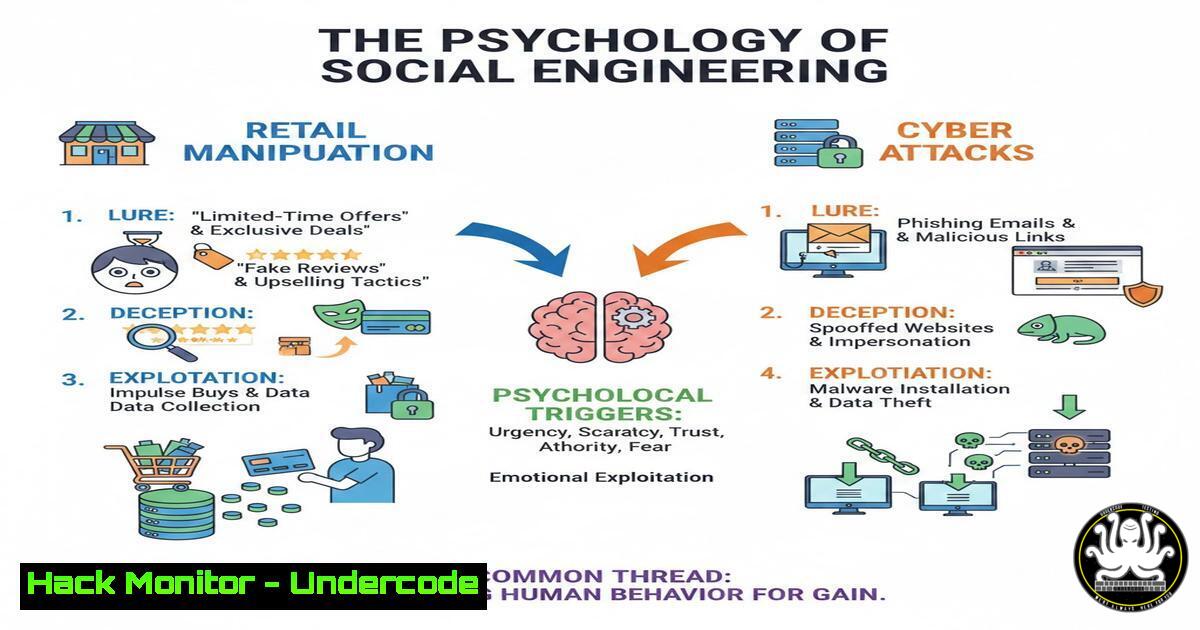
Introduction:
The tactics employed by sophisticated retail sales operations share striking parallels with modern social engineering cyber attacks. Both leverage psychological principles, environmental manipulation, and strategic pressure to override logical decision-making processes. Understanding these behavioral manipulation techniques provides critical insights for developing effective cybersecurity defenses against human-targeted attacks.
Learning Objectives:
- Identify common psychological principles between physical retail and digital social engineering
- Implement technical countermeasures against behavioral manipulation attacks
- Develop organizational awareness protocols for social engineering detection
You Should Know:
- The Principle of Reciprocity and Strategic Free Offers
The retail practice of providing “free” samples or special deals creates psychological debt, making customers more susceptible to additional purchases. Similarly, cyber attackers leverage this principle through fake free software, “limited-time” offers, or bogus security scans that create false urgency and compliance.
Step-by-step guide explaining what this does and how to use it:
– Technical Implementation: Deploy email filtering rules to flag urgency-inducing language
 Microsoft Exchange Online PowerShell
New-TransportRule -Name "UrgencyFilter" -SubjectOrBodyContainsWords "limited time", "free", "act now", "immediate attention" -SetSCL 5 -SentToScope NotInOrganization
– Defense Protocol: Implement mandatory cooling-off periods for any “urgent” security alerts
– Technical Control: Configure web filters to block known fake software sites
 Windows PowerShell command to block sites via hosts file
Add-Content -Path "C:\Windows\System32\drivers\etc\hosts" -Value "127.0.0.1 malicious-fake-software.com"
2. Environmental Control and Scent-Based Psychological Warfare
Retail environments use scent marketing to create emotional connections and lower critical thinking. In cybersecurity, attackers create controlled digital environments through fake login portals, spoofed websites, and manipulated interface elements that mimic legitimate services.
Step-by-step guide explaining what this does and how to use it:
– Technical Defense: Implement certificate pinning to prevent spoofed websites
 Example for Android app development
CertificatePinner certificatePinner = new CertificatePinner.Builder()
.add("example.com", "sha256/AAAAAAAAAAAAAAAAAAAAAAAA=")
.build();
– Browser Security: Deploy strict Content Security Policies (CSP)
 Apache .htaccess CSP implementation
Header always set Content-Security-Policy "default-src 'self'; script-src 'self' https://trusted.cdn.com"
– User Training: Conduct simulated phishing exercises with fake environments
3. The Decoy Effect and Strategic Product Placement
The “3-for-4” deal represents classic decoy pricing that makes unnecessary purchases seem rational. Cyber attackers use similar tactics by offering fake “bonus” features, false additional services, or bundled malware with legitimate-looking software packages.
Step-by-step guide explaining what this does and how to use it:
– Technical Analysis: Use package vulnerability scanning
 npm audit for JavaScript packages
npm audit --audit-level high
– Implementation: Deploy application allowlisting policies
 Windows AppLocker PowerShell
New-AppLockerPolicy -RuleType Publisher,Path -User Everyone -Xml | Set-AppLockerPolicy -Merge
– Organizational Policy: Require third-party software validation before installation
4. Emotional Connection Through Targeted Messaging
The “lotion I absolutely did not need but somehow emotionally connected with” demonstrates effective emotional manipulation. Social engineers craft messages that resonate with specific targets through OSINT-gathered personal information, creating false rapport and trust.
Step-by-step guide explaining what this does and how to use it:
– Technical Control: Implement social media privacy hardening
 Python script to audit social media exposure
import requests
from bs4 import BeautifulSoup
 Check public profile visibility
def check_public_profile(profile_url):
response = requests.get(profile_url)
soup = BeautifulSoup(response.content, 'html.parser')
return len(soup.find_all('div', class_='personal-info')) > 0
– Defense Protocol: Establish strict personal information sharing policies
– Monitoring: Deploy digital footprint analysis tools
5. Multi-sensory Overload and Decision Fatigue
The overwhelming sensory experience in retail environments parallels DDoS-style psychological attacks where excessive information, fake warnings, or complex interfaces cause mental exhaustion and poor decision-making.
Step-by-step guide explaining what this does and how to use it:
– Technical Implementation: Configure alert correlation to reduce noise
 SIEM rule example for alert fatigue reduction
rule AlertCorrelation {
meta:
description = "Reduce duplicate alerts"
events:
$e.metadata.alert_type = $alert_type
$e.metadata.src_ip = $src_ip
condition:
 Group similar alerts within 5 minutes
$e over 5m | count() > 3
}
– Interface Design: Implement clean security dashboard layouts
– Training: Conduct stress testing under high-alert conditions
6. Authority and Expertise Impersonation
The “friendly smiles that disarm you” represent authority establishment tactics. Cyber attackers impersonate IT support, executives, or trusted vendors using compromised accounts and social proof to bypass security protocols.
Step-by-step guide explaining what this does and how to use it:
– Technical Control: Implement multi-factor authentication universally
 Azure MFA deployment via PowerShell
Connect-MsolService
$mf= New-Object -TypeName Microsoft.Online.Administration.StrongAuthenticationRequirement
$mf.RelyingParty = ""
$mf.State = "Enabled"
Set-MsolUser -UserPrincipalName [email protected] -StrongAuthenticationRequirements $mf
– Verification Protocol: Establish out-of-band verification for sensitive requests
– Monitoring: Deploy anomalous behavior detection
 SQL query for detecting impossible logins
SELECT user_id, login_time, ip_address
FROM auth_logs
WHERE ip_address NOT IN (SELECT known_ip FROM user_geolocations)
7. The Illusion of Scarcity and Urgency
“Tactical coupon deployment” creates artificial scarcity that overrides rational consideration. Similarly, phishing campaigns use limited-time offers, fake expiration notices, or false limited availability to prompt hasty actions.
Step-by-step guide explaining what this does and how to use it:
– Technical Defense: Implement email authentication protocols
 DNS records for DMARC, DKIM, SPF
"v=spf1 include:spf.protection.outlook.com -all"
"v=DKIM1; k=rsa; p=MIGfMA0GCSqGSIb3DQEBAQUAA4GNADCBiQKBgQC..."
"v=DMARC1; p=reject; rua=mailto:[email protected]"
– Organizational Policy: Mandate dual authorization for urgent requests
– User Training: Conduct simulated urgency-based phishing tests
What Undercode Say:
- Human psychology remains the most consistent vulnerability across both physical and digital security environments
- Effective defense requires understanding manipulation techniques rather than just implementing technical controls
- Organizational security culture must address behavioral vulnerabilities with the same rigor as technical ones
- The most sophisticated attacks make victims feel smart while manipulating their decisions
- Environmental controls can be as important as technical controls in security planning
- Regular reality-testing protocols help maintain perspective under manipulation attempts
- Emotional intelligence training provides measurable security ROI
- Multi-layered defenses must address psychological attack vectors
- Security fatigue creates exploitable windows of vulnerability
- Cross-domain analysis (retail/military/cyber) reveals universal manipulation patterns
Prediction:
The convergence of psychological manipulation techniques across physical and digital domains will lead to increasingly sophisticated hybrid social engineering attacks. We anticipate rise in AI-powered personalized manipulation campaigns that leverage behavioral biometrics, emotional response analysis, and cross-platform consistency to create overwhelmingly persuasive attack environments. Organizations that fail to integrate behavioral science into their security programs will experience significantly higher breach rates despite technical control investments, as attackers increasingly target the human element through scientifically-optimized manipulation strategies.
🎯Let’s Practice For Free:
IT/Security Reporter URL:
Reported By: Mrdigitalexhaust Walking – Hackers Feeds
Extra Hub: Undercode MoN
Basic Verification: Pass ✅


