Listen to this Post
Introduction:
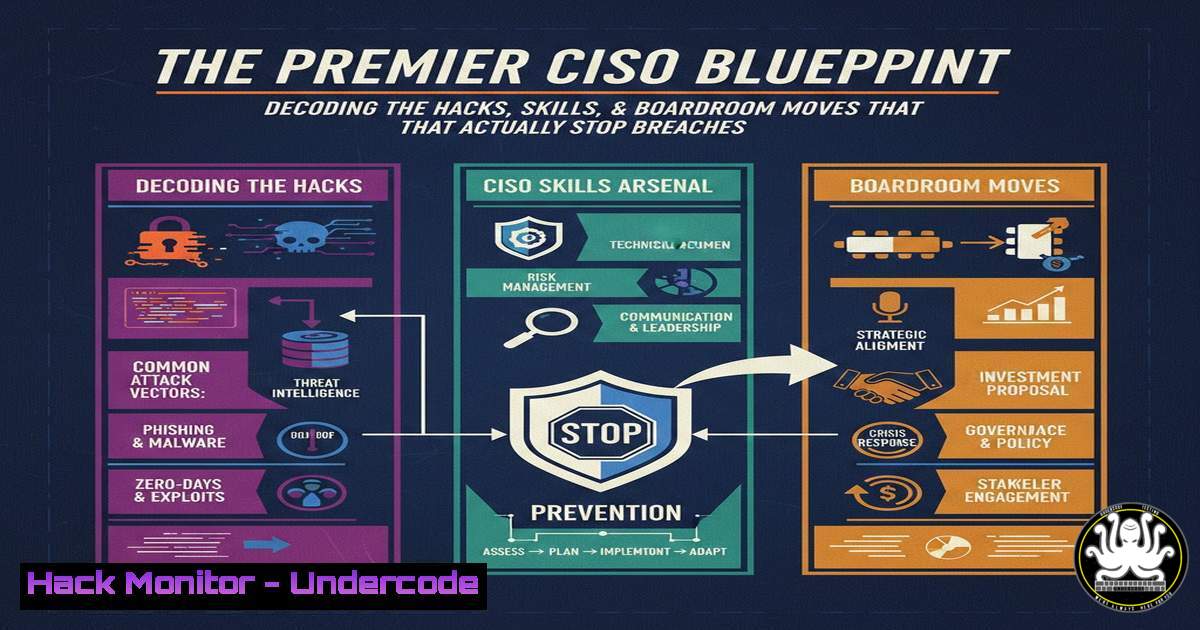
The cybersecurity battlefield has shifted from server rooms to boardrooms, where technical prowess alone is insufficient for victory. Michael S. Oberlaender’s latest book, “PREMIER CISO – BOARD & C-SUITE: RAISING THE BAR FOR CYBERSECURITY,” serves as a tactical manual for this new era, defining the comprehensive skill set required to navigate executive conversations, correct industry-wide misperceptions, and implement genuinely effective security strategies. It moves beyond generic job descriptions to provide a battle-tested profile for leadership success in an age of AI and quantum threats.
Learning Objectives:
- Decode the “Premier CISO” skill profile beyond technical certifications to include board-level communication, strategic business alignment, and leadership.
- Identify and rectify common security misperceptions and false efforts that waste resources and create vulnerabilities.
- Implement practical, technical controls and processes that translate high-level strategy into actionable defense, from cloud hardening to SecDevOps.
You Should Know:
- The Premier CISO Skill Set: Beyond Certifications to Business Acumen
A Premier CISO is defined not by a checklist of certifications (like CISSP, CISM) but by a holistic blend of knowledge, experience, and strategic acumen. Oberlaender’s book argues that many job descriptions fail by copying generic templates, lacking the substance of reality. The true profile combines deep technical know-how with the ability to communicate cyber risk in the language of business value, regulatory consequence, and reputational impact to the CEO, CFO, and Board of Directors (BoD).
Step‑by‑step guide explaining what this does and how to use it.
1. Conduct a Self-Audit: Map your current skills against three pillars: Technical Governance (e.g., architecture, SecDevOps), Business Leadership (e.g., budgeting, strategic planning), and Executive Communication (e.g., translating technical risk to financial exposure).
2. Develop a Board-Level Briefing Template: Create a standard presentation format that starts with business impact. For example, instead of leading with “we have 50 unpatched CVEs,” frame it as “A critical vulnerability in our payment system exposes us to a potential $X million regulatory fine and operational downtime.”
3. Practice “The Translation”: Regularly take a technical report from your team and rewrite its executive summary in two sentences that answer: “What is the business risk?” and “What do we need to decide?”
4. Command Reference – Risk Calculation: Use a simple formula to quantify risk in discussions: Risk = Probability of Breach x Financial Impact. Gather data from tools like breach databases (e.g., VERIS Community Database) and internal cost estimates to ground your numbers.
- Identifying and Eliminating “False Efforts” in Security Programs
The book highlights “false (or fake) efforts on the wrong aspects in security”—initiatives that consume budget and resources but do not meaningfully reduce risk. Common examples include over-investing in advanced threat intelligence without having basic patch management automated, or creating lengthy policy documents that are never operationalized.
Step‑by‑step guide explaining what this does and how to use it.
1. Initiate a Program Audit: Review all active security projects and controls. Ask for each: “What specific risk does this mitigate, and how do we measure its effectiveness?”
2. Prioritize Foundational Hygiene: Redirect resources to automate and enforce basics first. Use these commands to audit foundational security on key systems:
Linux (Check for unpatched high-severity issues): `apt list –upgradable 2>/dev/null | grep -i security` or `grep -r “CRITICAL” /var/log/dpkg.log`
Windows (PowerShell – Get last patch installation date): `Get-HotFix | Sort-Object InstalledOn -Descending | Select-Object -First 5`
3. Implement Measurable Controls: Replace a vague effort like “improve endpoint security” with a measurable project: “Deploy application whitelisting via Windows AppLocker on all critical servers by Q2, measured by a 70% reduction in unauthorized software alerts.”
4. Validate with Attack Simulations: Use tools like the MITRE CALDERA or Atomic Red Team to run simulated attacks. If your “false effort” controls don’t detect or stop the simulation, they have failed the test.
- Mastering the Board & C-Suite Conversation: The “Food Chain”
Success requires understanding the “CISO food chain” and the unique concerns of each executive partner. The CFO cares about financial risk and cyber insurance; the CLO cares about regulatory compliance; the CEO cares about strategic growth and brand reputation. A one-size-fits-all message fails.
Step‑by‑step guide explaining what this does and how to use it.
1. Map the Stakeholders: Identify each C-suite member and board committee. Document their primary objectives and key performance indicators (KPIs).
2. Tailor the Message:
For the CFO: Present cybersecurity as a financial risk management and return on investment (ROI) issue. Frame spending in terms of loss avoidance (e.g., “This $500k investment mitigates a potential $10M ransom demand plus business interruption costs”).
For the CEO/Board: Focus on strategic risk and governance. Use frameworks like the NIST Cybersecurity Framework to show how the security program aligns with business objectives and manages enterprise risk.
3. Prepare for Inevitable Questions: Anticipate and rehearse answers to questions like, “Are we secure?” (Answer: “We manage risk; here are our top 5 residual risks and our mitigation plans”) and “How do we compare to our peers?” (Use reports from Gartner or Forrester for benchmarking).
4. Follow-Up with Actionable Reports: Send concise, post-meeting summaries that reiterate decisions, agreed-upon actions, and required resources.
4. Implementing SecDevOps and Enterprise Security Architecture
Oberlaender’s book pursues SecDevOps and Enterprise Architecture as critical frameworks for building security into the fabric of the organization. This moves security “left” in the development lifecycle and ensures it is designed-in, not bolted-on.
Step‑by‑step guide explaining what this does and how to use it.
1. Integrate Security Tools into CI/CD Pipelines: Automate security checks within the developer’s workflow.
Code Repository (e.g., GitLab CI): Insert a SAST (Static Application Security Testing) scan stage.
 Example GitLab CI snippet
sast:
stage: test
image:
name: "shiftleft/scan:latest"
entrypoint: [""]
script:
- scan --src . --type golang --out_file gl-sast-scan.json
artifacts:
reports:
sast: gl-sast-scan.json
Container Security: Scan Docker images in the registry for vulnerabilities before deployment using Trivy: `trivy image –exit-code 1 –severity CRITICAL,HIGH your-registry/your-app:latest`
2. Define Security Architecture Principles: Establish mandatory design rules, such as “All new microservices must authenticate via the central identity service” or “No direct internet access is allowed for databases.”
3. Use Infrastructure as Code (IaC) Security Scanners: Scan Terraform or CloudFormation templates for misconfigurations before provisioning. Use checkov: `checkov -d /path/to/terraform/code –quiet`
4. Govern with Policy as Code: Use tools like Hashicorp Sentinel or Open Policy Agent (OPA) to enforce that deployed cloud resources (e.g., AWS S3 buckets) are never configured as publicly writable.
- Hardening for the Future: AI and Quantum Security Postures
The book transitions to emerging topics, urging CISOs to prepare for AI-driven threats and the future impact of quantum computing, which will break current public-key encryption.
Step‑by‑step guide explaining what this does and how to use it.
1. AI Security – Protect Your Models and Data:
Adversarial Input Protection: Implement input sanitization and anomaly detection for AI models serving customer-facing applications.
Supply Chain Security for AI: Vet training data sources and third-party model providers. Use tools like MLSecOps frameworks to scan for poisoned data or malicious code in models.
2. Quantum Readiness – Initiate Cryptographic Inventory:
Step 1 – Discovery: Use discovery tools to find all systems using cryptography. On Linux, a simple scan can be: `sudo nmap -sV –script ssl-enum-ciphers -p 443
Step 2 – Inventory: Catalog algorithms (especially RSA, ECC, Diffie-Hellman) and their purpose (TLS, code signing, document encryption).
Step 3 – Prioritize & Plan: Systems with long-lived sensitive data (e.g., classified archives, health records) are highest priority. Develop a migration plan to post-quantum cryptography (PQC) algorithms, starting with pilot projects using NIST-standardized PQC algorithms like CRYSTALS-Kyber.
6. Operationalizing Regulatory Change (e.g., SEC Rules)
The book introduces recent regulatory changes, such as the SEC’s cybersecurity disclosure rules, which require public companies to report material incidents within 4 days. The Premier CISO must operationalize compliance.
Step‑by‑step guide explaining what this does and how to use it.
1. Define “Materiality” with Legal & Finance: Establish a quantitative and qualitative threshold (e.g., potential financial impact > $X, data loss > Y records, critical system downtime > Z hours) that triggers reporting.
2. Build an Incident Response (IR) Playbook with Legal Gate: Integrate a mandatory “SEC Reporting Assessment” step into your IR process immediately after containment. The playbook should include pre-drafted notification templates.
3. Conduct a Tabletop Exercise: Run a simulated breach scenario with the C-suite, General Counsel, and IR team. Practice making the materiality determination and drafting the disclosure statement under time pressure.
4. Document Governance: Maintain clear, auditable records of all incidents, assessments, and decisions to demonstrate due diligence and compliance with the “good faith” provision of the rules.
7. Building and Leading the Premier Security Team
Beyond technology and process, the human element is critical. The book examines team building, reporting structures, and the necessary blend of skills to execute the Premier CISO’s vision.
Step‑by‑step guide explaining what this does and how to use it.
1. Skills-Based Hiring: Move beyond job titles. Actively recruit for T-shaped professionals—deep experts in one area (e.g., cloud security) with broad understanding across others (e.g., networking, compliance).
2. Implement a Career Lattice (Not Just a Ladder): Create pathways for technical individual contributors to advance in seniority and compensation without forcing them into people management.
3. Foster a “Coachable” Culture: Use blameless post-mortems after incidents and exercises. Focus on fixing systemic issues, not assigning individual fault. Start retrospectives with: “What did we learn that can make our systems and processes more resilient?”
4. Measure Team Health: Track metrics beyond tickets closed, such as mean time to mentor (how quickly new hires become productive), training hours per engineer, and participation in community projects (e.g., open-source security tool contributions).
What Undercode Say:
- The CISO Role is Fundamentally a Risk Translation Role. The core thesis of Oberlaender’s work is that the most critical technical skill a modern CISO needs is the ability to deconstruct complex cyber threats and reconstruct them as clear business decisions for non-technical leaders. Failure to master this translation dooms security programs to being viewed as a cost center rather than a value-protection engine.
- Future-Proofing is a Present-Day Operational Task. The discussion on AI and quantum security is not theoretical. It mandates immediate action in the form of cryptographic inventory, securing ML pipelines, and piloting new algorithms. Organizations that treat these as “future problems” will face insurmountable technical debt and catastrophic catch-up costs.
The analysis suggests the industry is at an inflection point. The “Premier CISO” model presented is a direct response to the systemic failure of siloed security functions. This book provides the framework for evolving from a technical manager to an enterprise leader. Its emphasis on correcting “false efforts” is particularly crucial; it forces a ruthless prioritization that aligns security work directly with business risk reduction, cutting through the noise of marketing hype and compliance checkbox exercises. This is the playbook for security leaders who aim to be strategic partners, not just expert problem-solvers.
Prediction:
The delineation between a standard CISO and a “Premier CISO” will become the primary differentiator in organizational cyber resilience over the next 3-5 years. Companies led by leaders who embody this integrated, business-aligned, and communicative profile will demonstrate significantly faster detection and response times, more efficient security spending, and stronger regulatory standing. Conversely, organizations that retain the traditional, technically isolated CISO model will suffer more frequent “surprise” breaches, higher incident costs, and increasing tension between the security function and the board, potentially leading to accelerated turnover and strategic vulnerability. The rise of AI-driven attacks and the quantum computing horizon will only accelerate this divide.
🎯Let’s Practice For Free:
IT/Security Reporter URL:
Reported By: Mymso Cybersecurity – Hackers Feeds
Extra Hub: Undercode MoN
Basic Verification: Pass ✅


