
Listen to this Post
Introduction:
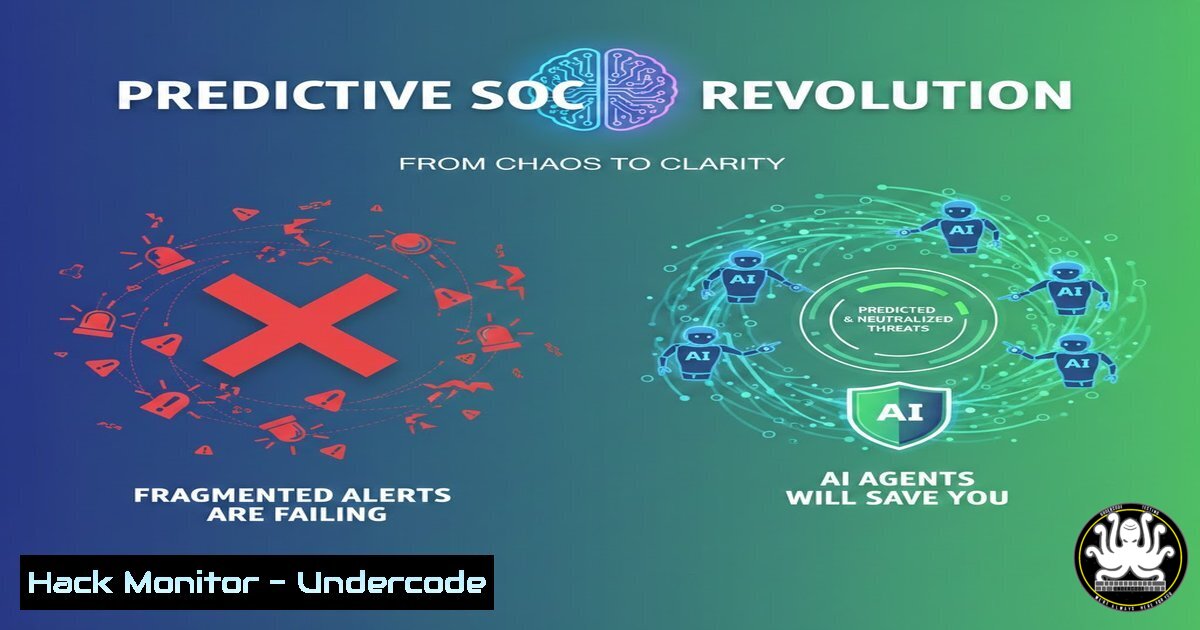
Security Operations Centers (SOCs) are at a breaking point. Despite deploying dozens of security tools, organizations face a dangerous reality: nearly half of all security alerts are never investigated, creating massive blind spots for attackers to exploit. This fragmentation forces analysts to manually stitch insights across multiple consoles, eroding resilience and slowing response times. The industry is now shifting from reactive alert triage toward a “Predictive SOC” model—one that leverages AI agents and automation to anticipate attack paths, measure risks proactively, and enable threat hunting at machine speed.
Learning Objectives:
- Understand the core challenges causing SOC fragmentation and alert fatigue.
- Learn how AI and agentic automation can transform reactive triage into proactive threat hunting.
- Identify key technologies and commands for integrating automated investigation workflows.
You Should Know:
1. The Fragmentation Crisis: Stitching Across Double-Digit Consoles
The modern SOC is a victim of its own tooling. Security teams often manage 10 to 20 different security consoles (EDR, SIEM, NDR, Email Security, etc.), none of which communicate natively. This fragmentation forces Tier-1 and Tier-2 analysts to manually pivot between dashboards to correlate a single incident.
– The Reality Check: According to the referenced Microsoft study, this manual stitching is why 75% of security leaders worry their SOC is losing pace. Attackers exploit this latency, moving laterally while analysts are still logging in.
– Linux/Windows Command Line Context: To understand the data gap, consider how you might manually gather host evidence today:
– Linux (Host Recon): `sudo journalctl _COMM=sshd –since “24 hours ago” | grep “Failed password”` (Manual log checking for brute force).
– Windows (PowerShell): `Get-EventLog -LogName Security -InstanceId 4625 -After (Get-Date).AddHours(-24) | Select-Object TimeGenerated, Message` (Manual audit for failed logins).
– The Problem: An AI agent could query APIs across EDR, VPN, and Identity systems simultaneously to correlate this failed login with a subsequent anomalous VPN connection, whereas a human takes hours to do the same.
- The Shift to a Predictive SOC with Agentic Assistance
The solution lies in moving from reactive triage to predictive defense. This involves “agentic AI”—AI models that can reason over context and orchestrate multi-step workflows. Instead of an analyst hunting for a needle in a haystack, an AI agent investigates the haystack automatically.
– What It Does: Agents ingest alerts, enrich them with threat intelligence, query historical data, and present a curated investigation narrative.
– Step‑by‑Step Guide: Simulating an Automated Investigation with Open Source Tools
While tools like Command Zero are proprietary, you can simulate a workflow using Python and open-source APIs to understand the logic:
1. Trigger: Simulate an alert (e.g., a file hash detected by YARA).
2. Enrichment (VirusTotal API): Use `curl` to automate hash lookup.
curl --request GET --url "https://www.virustotal.com/api/v3/files/{file_hash}" --header "x-apikey: YOUR_API_KEY"
3. Contextualization (Grep on logs): If the file is malicious, the agent would automatically SSH into the asset or query the SIEM API to see what processes ran before and after.
4. Output: The agent generates a summary: “File X is malicious. It was executed by User Y at 10:00 AM. The user has admin rights. Immediate containment recommended.”
- Turning Intent into Action: AI Agents Orchestrating Response
In a mature Predictive SOC, the AI doesn’t just investigate; it acts. It turns the analyst’s intent into “machine-speed” action. If an analyst thinks, “This looks like ransomware behavior,” they can task an AI agent to isolate the host, snapshot the memory, and revoke the user’s session tokens simultaneously.
– Step‑by‑Step Guide: Automating Host Isolation Logic
This is a conceptual example of the commands an agent might execute or script to contain a threat.
– Windows Firewall (Block All Traffic):
 This command would be run on the compromised host via RMM or EDR tooling
netsh advfirewall set allprofiles firewallpolicy blockinbound,blockoutbound
– Linux (iptables – Emergency Isolation):
 Block all traffic except SSH from a management IP
sudo iptables -P INPUT DROP
sudo iptables -P OUTPUT DROP
sudo iptables -P FORWARD DROP
sudo iptables -A INPUT -s [bash] -p tcp --dport 22 -j ACCEPT
– Azure CLI (Cloud VM Isolation):
 Apply a Network Security Group that denies all traffic
az network nsg rule create --resource-group MyRG --nsg-name BlockAllNSG --name DenyAll --priority 1000 --direction Inbound --access Deny --protocol '' --destination-port-ranges ''
4. Proactive Threat Hunting: Anticipating Attack Paths
Instead of waiting for alerts, a Predictive SOC hunts for indicators of attack paths. This involves querying for configuration weaknesses that are prerequisites for common attacks, such as Kerberoasting or Pass-the-Hash.
– Step‑by‑Step Guide: Hunting for Over-privileged Accounts (Active Directory)
An AI agent could continuously run these queries and flag anomalies.
– PowerShell (Active Directory Module): Find accounts with Service Principal Names (SPNs) that are high-value targets for Kerberoasting.
Get-ADUser -Filter {ServicePrincipalName -ne "$null"} -Properties ServicePrincipalName, LastLogonDate | Select-Object Name, ServicePrincipalName, LastLogonDate
– Linux (BloodHound ingestor simulation): While BloodHound is a tool, the concept is mapping relationships. An agent would run queries like: “Find all users with admin rights to Domain Controllers” and check if MFA is enforced on them.
- API Security and Cloud Hardening in the Predictive Era
The Predictive SOC must also monitor the “machines” talking to machines—APIs. Attackers now target APIs directly, bypassing traditional web interfaces. Proactive defense means hardening cloud posture before an attacker scans for misconfigurations.
– Step‑by‑Step Guide: AWS S3 Bucket ACL Audit (AWS CLI)
An agent would routinely check for public buckets, a top cloud vulnerability.
 List all buckets and check public access
aws s3api list-buckets --query 'Buckets[].Name' --output text | xargs -I {} aws s3api get-bucket-acl --bucket {} | grep -B 1 "URI.AllUsers"
If a bucket is public, the agent could trigger a Lambda function to remediate it.
What Undercode Say:
- Key Takeaway 1: The era of the “swivel-chair analyst” is ending. Organizations that fail to integrate their security stack will continue to hemorrhage risk as attack speeds outpace manual workflows. The cost is not just tooling; it’s the resilience of the business.
- Key Takeaway 2: AI agents are not here to replace analysts but to elevate them. By automating the “drudgery” of data collection and correlation, agents free human experts to focus on the “curious analysis”—hunting novel attacks and understanding the adversary’s strategy, not just their tactics.
Analysis:
This transition represents a fundamental shift in SOC architecture. It moves the value proposition from buying more tools to buying better workflows. The “Predictive SOC” concept hinges on data unification and the maturity of AI reasoning. Currently, many AI implementations are limited to chatbot-style summaries. The leap to true “agentic” orchestration requires deep API integrations and trust in automation. For the defenders, this is a net positive: it levels the playing field against adversaries who already automate their attacks. The SOC of the future will be smaller, more strategic, and operate at a pace that rivals the machines it defends.
Prediction:
Within the next three years, the term “alert fatigue” will become obsolete as legacy SIEMs are replaced by AI-native investigation platforms. The primary role of the SOC analyst will evolve from triage engineer to AI operations supervisor. We will see the rise of “Autonomous Defense Contracts,” where cyber insurance policies mandate the use of AI agents to maintain coverage, fundamentally changing the economics and speed of cyber response. The winners in this landscape will be those who master the orchestration layer, not just the detection layer.
▶️ Related Video (74% Match):
🎯Let’s Practice For Free:
IT/Security Reporter URL:
Reported By: Robipapp Soc – Hackers Feeds
Extra Hub: Undercode MoN
Basic Verification: Pass ✅


