Listen to this Post
Introduction:
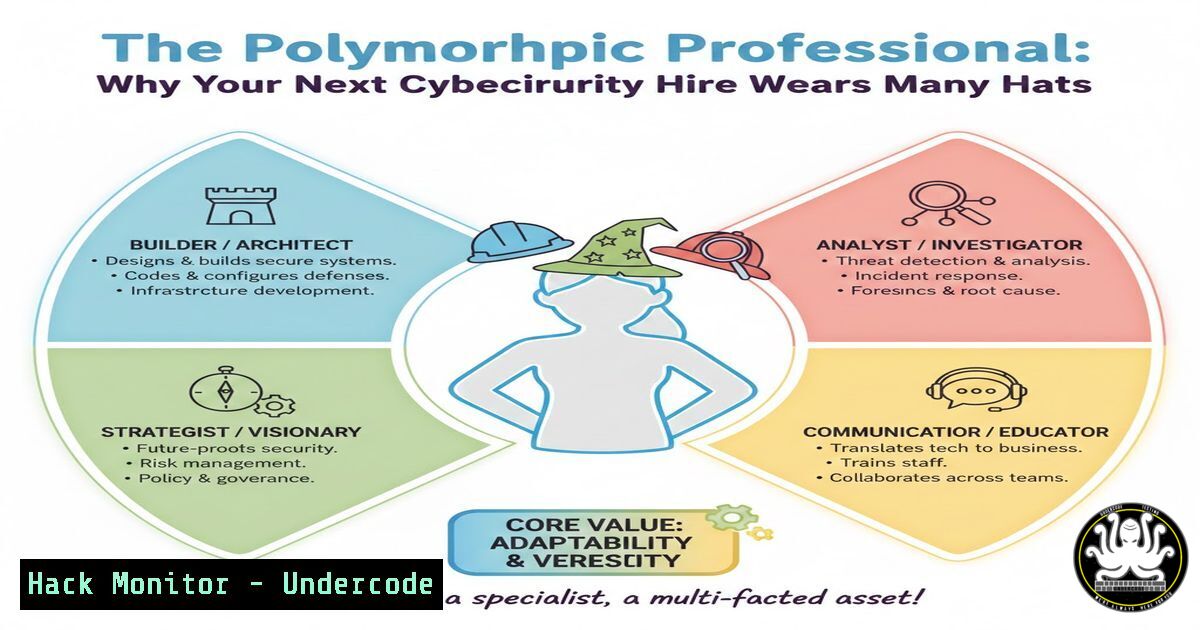
The traditional image of a cybersecurity expert as a singularly focused, tunnel-visioned technician is obsolete. In today’s threat landscape, the most effective defenders are polymorphic professionals who integrate diverse experiences—from history and communications to business strategy—into a holistic security mindset. This multidisciplinary approach is critical for anticipating novel attack vectors and building resilient, human-centric defense systems.
Learning Objectives:
- Understand the critical advantage of a T-shaped skill set in cybersecurity, combining deep technical expertise with broad contextual knowledge.
- Learn how to implement foundational security controls across different operating systems to establish a base layer of defense.
- Develop a strategy for continuous, cross-disciplinary learning to enhance threat modeling and risk assessment capabilities.
You Should Know:
1. The Strategic Power of a T-Shaped Skillset
The comment from Khang Ngo highlights a corporate pressure to “pick a lane,” which is antithetical to modern security needs. A T-shaped professional possesses deep vertical expertise (e.g., penetration testing, digital forensics) complemented by broad horizontal knowledge (e.g., history, psychology, business processes). This breadth allows them to model threats more effectively. An attacker only needs to find one flaw, often at the intersection of technology and human processes. A defender with a multifaceted worldview is better equipped to anticipate these intersectional attacks. For instance, understanding historical social manipulation techniques can directly inform a phishing campaign analysis.
- Building Your First Line of Defense: System Hardening
Before deploying advanced tools, fundamental system hardening is essential. This involves configuring an OS to reduce its attack surface.
Step-by-step guide for Linux (Ubuntu/CentOS):
Step 1: Update and Upgrade. Always start with the latest security patches.
`sudo apt update && sudo apt upgrade -y` For Debian/Ubuntu
`sudo yum update -y` For RHEL/CentOS
Step 2: Harden SSH Access. The primary remote access vector must be secured.
`sudo nano /etc/ssh/sshd_config`
Change key parameters:
`PermitRootLogin no`
`PasswordAuthentication no` (Requires key-based auth)
`Port 2222` (Change from default port 22)
Restart the service: `sudo systemctl restart sshd`
Step 3: Configure a Firewall (UFW/iptables). Control inbound and outbound traffic.
`sudo ufw enable`
`sudo ufw allow 2222` (Allow your custom SSH port)
`sudo ufw deny incoming`
`sudo ufw allow outgoing`
Step-by-step guide for Windows (via PowerShell):
Step 1: Enable and Configure Windows Defender Firewall.
`Set-NetFirewallProfile -Profile Domain,Public,Private -Enabled True`
Step 2: Harden Network Services. Disable unnecessary services.
`Get-Service | Where-Object {$_.Status -eq ‘Running’ -and $_.Name -like ‘telnet’ -or $_.Name -like ‘ftp’} | Stop-Service -PassThru | Set-Service -StartupType Disabled`
Step 3: Enforce PowerShell Logging. Track potential malicious activity.
This is configured via Group Policy (gpedit.msc) under: Computer Configuration > Administrative Templates > Windows Components > Windows PowerShell.
- The Art of Threat Modeling: Thinking Like an Adversary
Threat modeling is the structured process of identifying and prioritizing potential threats. A professional with diverse experiences, like our “Tech Lady,” can brainstorm more creative and plausible threat scenarios.
Step-by-step guide using the STRIDE model:
Step 1: Diagram Your Application/System. Create a data flow diagram showing all components, trust boundaries, and data stores.
Step 2: Identify Threats. Use the STRIDE acronym for each component:
Spoofing: Can an attacker impersonate a user?
Tampering: Can data be modified in transit or at rest?
Repudiation: Can a user deny performing an action?
Information Disclosure: Is sensitive data exposed?
Denial of Service: Can the service be made unavailable?
Elevation of Privilege: Can a user gain unauthorized privileges?
Step 3: Mitigate. For each identified threat, define a countermeasure (e.g., encryption for tampering, logging for repudiation).
4. Cloud Security Posture Management (CSPM) Fundamentals
As businesses move to the cloud, misconfigurations become the primary attack vector.
Step-by-step guide for a basic AWS S3 Bucket security check:
Step 1: Check for Public Read/Write Access. A common and critical misconfiguration.
`aws s3api get-bucket-acl –bucket YOUR_BUCKET_NAME`
`aws s3api get-bucket-policy –bucket YOUR_BUCKET_NAME`
Step 2: Enable Bucket Encryption.
`aws s3api put-bucket-encryption –bucket YOUR_BUCKET_NAME –server-side-encryption-configuration ‘{“Rules”: [{“ApplyServerSideEncryptionByDefault”: {“SSEAlgorithm”: “AES256”}}]}’`
Step 3: Enable Logging. Monitor access for suspicious activity.
`aws s3api put-bucket-logging –bucket YOUR_BUCKET_NAME –bucket-logging-status ‘{“LoggingEnabled”: {“TargetBucket”: “YOUR_LOGGING_BUCKET”, “TargetPrefix”: “YOUR_PREFIX/”}}’`
5. Human Firewall: The Non-Technical Core of Technical Defense
Technology is only as strong as the people using it. The “polymorphic professional” excels at bridging the gap between technical controls and human behavior.
Step-by-step guide for launching a phishing simulation:
Step 1: Define Goals and Metrics. Is the goal to measure click rates, credential submissions, or reporting rates?
Step 2: Craft a Believable Phishing Email. Use a relevant pretext (e.g., a fake HR update, IT support ticket). Do not make it overtly malicious.
Step 3: Use a Simulation Platform. Tools like GoPhish (open-source) or commercial platforms can be used to send emails and track results.
Step 4: Provide Immediate Feedback. If a user clicks the link, redirect them to a short, engaging training video about spotting phishing attempts.
Step 5: Analyze and Report. Use the data to target specific departments or roles with additional training.
What Undercode Say:
- Depth is Useless Without Breadth. A penetration tester who only understands code will miss the social engineering attack that bypasses all their technical defenses. The most critical vulnerabilities often exist in the seams between technology, process, and people.
- Embrace Your Polymorphic Nature. Do not silo yourself. The experiences you gather from seemingly unrelated fields—like hosting a scientific seminar or engaging in cross-cultural conversations—are the very assets that will allow you to model complex, real-world attacks that a purely technical mind would never foresee.
The original post and the ensuing discussion are not just a personal story; they are a strategic blueprint for the future of cybersecurity talent. The industry’s obsession with hyper-specialization has created experts who can defend against known attacks with high efficiency but are often blind to novel, cross-domain threats. The “polymorphic professional” represents the next evolution: a defender whose diverse mental models and contextual awareness form an adaptive immune system against an ever-changing adversary. Hiring and cultivating such talent is no longer a “nice-to-have” but a critical imperative for organizational resilience.
Prediction:
The future of cybersecurity will be dominated by organizations that actively recruit and foster these polymorphic professionals. We will see a sharp rise in security roles with titles like “Human Risk Analyst,” “Security Culture Lead,” and “Cognitive Security Engineer.” AI will handle the repetitive, known-variant detection tasks, freeing human experts to focus on strategic, creative threat hunting and system design. The most devastating future cyber-attacks will be defeated not by a single piece of technology, but by a professional who could connect a historical pattern of misinformation to a modern API vulnerability, because they understand that the map is not the territory, and the attack surface is everywhere.
🎯Let’s Practice For Free:
IT/Security Reporter URL:
Reported By: Techladyofficial M%E1%BB%8Di – Hackers Feeds
Extra Hub: Undercode MoN
Basic Verification: Pass ✅


