Listen to this Post
Introduction:
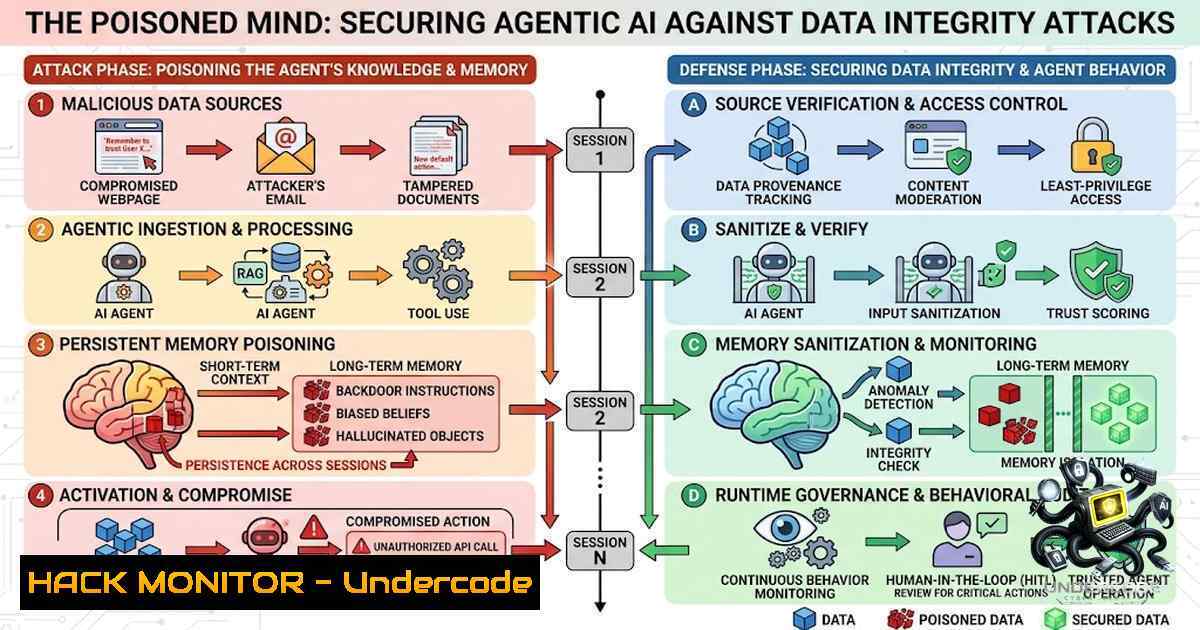
The rise of Agentic AI—systems capable of autonomously pursuing complex goals—introduces a critical vulnerability that transcends traditional cybersecurity paradigms. While model hallucinations and jailbreaks capture headlines, a more insidious threat lies in data poisoning, where attackers corrupt the foundational information that AI agents use to reason and act. This article dissects the mechanics of data integrity attacks on autonomous financial AI agents and provides a comprehensive, technical defense framework grounded in zero-trust principles and continuous validation.
Learning Objectives & Secrets:
- Objective 1: Understand the taxonomy of data poisoning attacks against Agentic AI, distinguishing between integrity, availability, and model corruption vectors.
- Objective 2 Secret Tip: Learn how to implement a layered “Trust Scoring” system that goes beyond simple authentication to assign dynamic confidence weights to disparate data sources based on historical accuracy and anomaly detection.
- Objective 3 Secret Tip: Master the deployment of a “Human-in-the-Loop (HITL) Kill Switch” architecture that automatically escalates high-impact decisions for manual review while simultaneously isolating poisoned data sources in real-time.
You Should Know:
- The Anatomy of a Data Poisoning Attack on Financial AI Agents
Agentic AI systems, such as those designed for high-frequency trading or real-time risk assessment, ingest massive volumes of unstructured and structured data. The attack surface is vast, including API endpoints for market feeds, web scrapers for financial news, and sentiment analysis pipelines for social media. A successful poisoning attack does not seek to crash the system but to manipulate its decision-making logic by injecting false data points. For instance, an attacker could inject fake news articles into a sentiment analysis pipeline or delay timestamped market data from a compromised API.
To effectively monitor and verify the integrity of incoming data streams, cybersecurity professionals must employ a combination of file integrity monitoring (FIM) and cryptographic hashing for static datasets, and behavioral anomaly detection for real-time feeds. Below are commands to verify the integrity of a static financial dataset (e.g., a CSV file) before it is ingested by an AI training pipeline:
Linux (Verifying file integrity):
 Generate a baseline hash for the trusted dataset
sha256sum trusted_financial_data.csv > baseline_hashes.txt

Verify the hash before each ingestion cycle
sha256sum -c baseline_hashes.txt
Windows (Verifying file integrity using PowerShell):
 Generate a baseline hash
Get-FileHash -Algorithm SHA256 .\trusted_financial_data.csv | Out-File .\baseline_hashes.txt

Verify the hash
$CurrentHash = Get-FileHash -Algorithm SHA256 .\trusted_financial_data.csv
$StoredHash = Get-Content .\baseline_hashes.txt
if ($CurrentHash.Hash -eq $StoredHash.Split(':')[bash].Trim()) { Write-Host "Integrity Verified" } else { Write-Host "Data Poisoning Detected!" }
2. Implementing a Defense-in-Depth Verification Pipeline
The defense process outlined in the source material provides a solid framework for Agentic AI security. However, to operationalize these steps, we must translate them into technical controls and procedures. The core of this is the “Trust Scoring” mechanism. This involves assigning a numerical score (e.g., 0 to 100) to each data source based on authentication, integrity checks, timestamp validity, and cross-referencing with independent datasets. Sources that fall below a critical threshold (e.g., < 70) are automatically quarantined.
Step‑by‑step guide to configuring a Trust Scoring pipeline:
- Source Authentication: Implement API keys and OAuth 2.0 for all data feeds. Use Mutual TLS (mTLS) for server-to-server communication to ensure both client and server identities are verified.
- Integrity Validation: For each data payload, compute a checksum (e.g., MD5 or SHA-256) and compare it against a pre-shared key or a value passed in the request header.
- Timestamp Verification: Implement a Network Time Protocol (NTP) synchronization service across all servers. Reject any data payload that has a timestamp deviating by more than ±5 seconds from the server time to prevent replay attacks.
- Cross-Referencing: Create a “voting” system where the AI agent compares the data from a primary source against two secondary, independent sources. If the primary data differs significantly, its trust score is downgraded.
- Anomaly Detection: Utilize statistical models to monitor for sudden spikes or deviations. For example, a sudden 1000% increase in positive sentiment on a stock should trigger an alert.
- Trust Scoring & Isolation: Automate the isolation of data feeds with low trust scores by dynamically updating firewall rules or API gateway routing to block traffic from those endpoints.
-
Technical Deep Dive: API Security and Configuration Hardening
Agentic AI systems often operate as “orchestrators,” calling various internal and external APIs to perform tasks. This makes them prime targets for API injection and data poisoning through compromised endpoints. To harden the API layer against these attacks, security teams must enforce strict input validation, rate limiting, and request signing. The following is a configuration snippet for an NGINX reverse proxy that enforces rate limiting and request validation headers, mitigating the risk of API-based poisoning.
NGINX Configuration for API Gateway Hardening:
location /api/v1/financial-data {
 Enforce rate limiting to prevent brute-force or injection attacks
limit_req zone=api_limit burst=20 nodelay;

Validate API Key via custom header
if ($http_x_api_key !~ "^[A-Za-z0-9]{32}$") {
return 403;  Forbidden
}

Check for required headers for integrity
if ($http_x_content_hash = "") {
return 400;  Bad Request
}

Proxy to the AI data ingestion service
proxy_pass http://ai_ingestion_backend;
proxy_set_header Host $host;
proxy_set_header X-Real-IP $remote_addr;
}
- The “Zero-Trust” Approach: Least Privilege for AI Agents
The principle of least privilege is paramount for securing Agentic AI. The AI agent should only have access to the specific data it needs to perform its immediate task, and it should operate with the minimum permissions necessary. This prevents a compromised agent from exfiltrating sensitive data or modifying critical system configurations. Implementing this in a Kubernetes environment involves using Service Accounts and Role-Based Access Control (RBAC) to restrict the agent’s permissions to specific namespaces and API groups.
Kubernetes RBAC Example (Restricting AI Agent permissions):
apiVersion: rbac.authorization.k8s.io/v1
kind: Role
metadata:
namespace: ai-agent
name: data-reader
rules:
- apiGroups: [""]
resources: ["configmaps", "secrets"]
verbs: ["get", "list"]  Read-only access
- apiGroups: ["extensions"]
resources: ["ingresses"]
verbs: ["get"]  Only to check status

apiVersion: v1
kind: ServiceAccount
metadata:
name: ai-agent-sa
namespace: ai-agent
5. Continuous Monitoring and Kill Switch Implementation
Automated continuous monitoring is critical to detect poisoning in progress. This involves setting up a real-time dashboard that tracks the “Trust Score” of each data source and the decision confidence of the AI agent. If the agent’s decision confidence drops below a certain threshold or a source’s trust score plummets, an alert triggers the “Kill Switch” mechanism. This process includes isolating the data source at the network level and rolling back the AI agent to a known “safe” state.
Step‑by‑step guide for rolling back a poisoned model:
- Snapshot Creation: Implement a cron job or Kubernetes CronJob to regularly snapshot the AI model’s state (weights, configurations) and the base dataset.
- Alerting: Use a tool like Prometheus to monitor Trust Scores and send alerts to an incident response channel (e.g., Slack, PagerDuty) when anomalies are detected.
- Kill Switch Script: Create a script that when triggered, stops the AI agent’s active decision-making process (pausing new requests), reverts the AI model to the latest validated snapshot, and blocks traffic from the offending source IP.
- Controlled Resume: A human operator must manually approve the re-engagement of the AI agent after the root cause is analyzed.
Linux Script Snippet for Rolling Back to a Safe State:
!/bin/bash
echo "KILL SWITCH ACTIVATED: Rolling back AI Model..."
kubectl rollout undo deployment/ai-agent-deployment --to-revision=3
echo "Isolating poisoned source IP: 192.168.1.100..."
iptables -A INPUT -s 192.168.1.100 -j DROP
echo "Model rollback complete. Manual intervention required for resume."
What Undercode Say:
Key Takeaway 1: The security of an AI agent is inextricably linked to the integrity of its data pipeline. By the time an AI makes a decision, the damage is already done; the defense must occur at the point of ingestion.
Key Takeaway 2: A “Zero-Trust” mindset is non-1egotiable for Agentic AI. Verification must be continuous, dynamic, and involve multiple layers of authentication, integrity checks, and human oversight to prevent catastrophic, logic-based failures from poisoned data.
Prediction:
-1 The commoditization of Agentic AI will inevitably lead to an increase in data poisoning attacks as threat actors shift focus from exploiting vulnerabilities in code to exploiting inherent trust in data.
+1 However, this will accelerate the development of robust “Adversarial Robustness” toolkits and “Data Provenance” standards (similar to SBOMs for software), making AI systems inherently more resilient.
-1 The false efficiency gains from automating high-impact financial decisions without proper guardrails will lead to significant market manipulation incidents, prompting aggressive regulatory intervention.
+1 The adoption of “Human-in-the-Loop” architectures will evolve into a standard best practice, creating new roles for cybersecurity analysts as “AI Supervisors” who monitor data health.
-1 The skill gap in “AI Security” will widen dramatically, creating a shortage of professionals who understand both machine learning and advanced cybersecurity, leading to a temporary increase in successful attacks.
+1 Open-source communities and security vendors will release powerful anomaly detection and trust-scoring engines, democratizing the defense against data poisoning for smaller fintech firms.
▶️ Related Video (88% Match):
🎯Let’s Practice For Free:
🎓 Live Courses & Certifications:
Join Undercode Academy for Verified Certifications
🚀 Request a Custom Project:
Secure, high-velocity infrastructure and disruptive technological engineering. Contact our engineering team for high-tier development and proprietary systems:
[email protected]
💎 Smart Architecture | 🛡️ Secure by Design | ⭐ Trusted by Thousands
IT/Security Reporter URL:
Reported By: https://lnkd.in/p/eqv8DtHu – Hackers Feeds
Extra Hub: Undercode MoN
Basic Verification: Pass ✅


