Listen to this Post
Introduction:
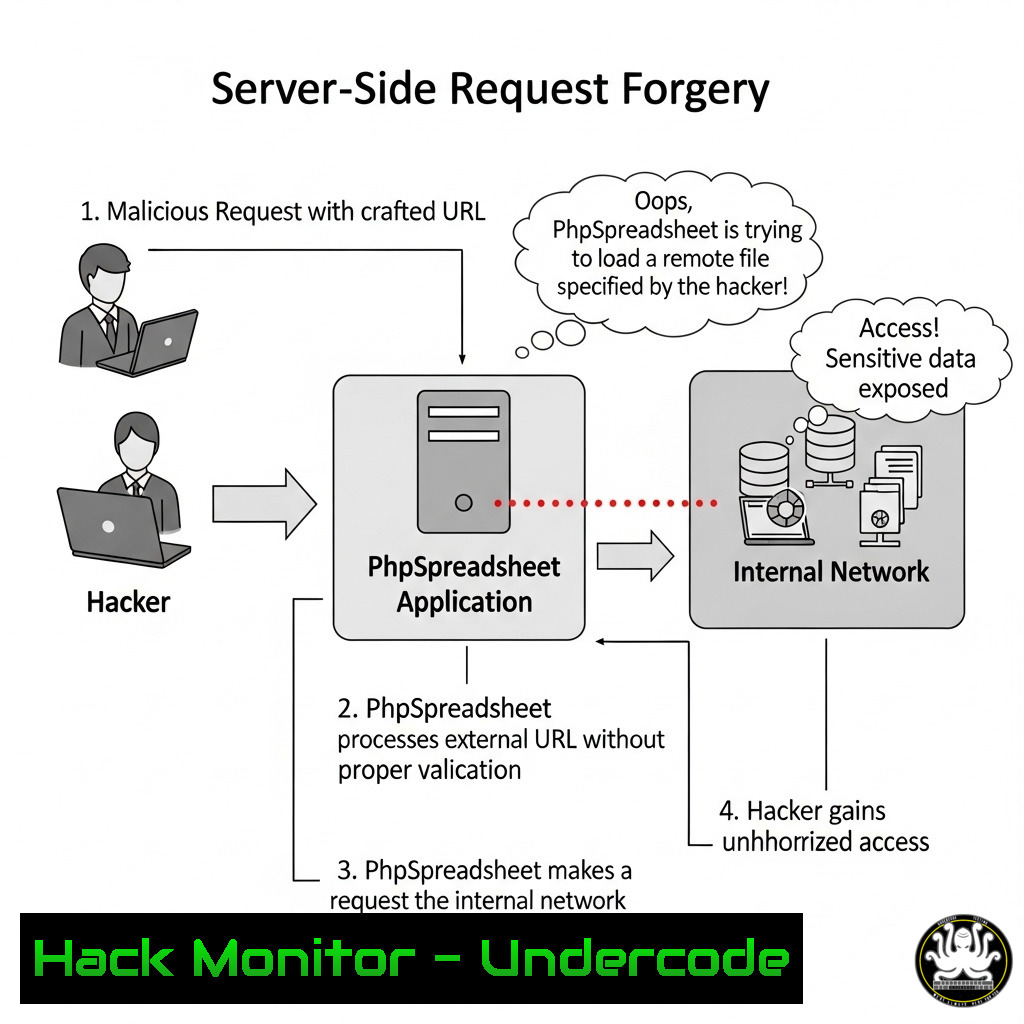
A critical Server-Side Request Forgery (SSRF) vulnerability, designated CVE-2025-54370, has been discovered in the ubiquitous PhpSpreadsheet library. With over 250 million downloads, this PHP library for reading and writing spreadsheet files is deeply embedded in countless enterprise applications, making this flaw a significant threat to global cybersecurity. This vulnerability allows attackers to bypass security controls and force the server to make unauthorized internal network requests, potentially leading to data exposure, internal service enumeration, and even remote code execution.
Learning Objectives:
- Understand the mechanics of the CVE-2025-54370 SSRF vulnerability in PhpSpreadsheet.
- Learn to identify and mitigate this vulnerability in your own applications and dependencies.
- Master defensive coding practices and system hardening to prevent similar SSRF flaws.
You Should Know:
1. Identifying Vulnerable PhpSpreadsheet Installations
The first step in mitigation is identifying if your application uses a vulnerable version of the library. This can be done via command-line dependency checks.
`composer show maennchen/zipstream-php` A dependency often used with PhpSpreadsheet
`composer show phpoffice/phpspreadsheet` The direct command to check the installed version
Step-by-step guide:
Open a terminal in your project’s root directory. Run the `composer show phpoffice/phpspreadsheet` command. This will output the currently installed version. The vulnerability affects versions prior to the patched release. Compare your version number against the official security advisory. If your version is below the patched version, you must immediately update.
2. Exploiting the SSRF: A Proof-of-Concept HTTP Request
The vulnerability is triggered when a maliciously crafted spreadsheet is parsed. The library insecurely processes embedded hyperlinks, allowing attackers to point to internal, non-routable addresses.
`curl -X POST -F “[email protected]” http://vulnerable-target.com/upload.php`
Step-by-step guide:
An attacker creates an Excel file (malicious.xlsx) with a hyperlink cell set to `http://169.254.169.254/latest/meta-data/` (a common cloud metadata endpoint). They then upload this file to the target application. The server, while processing the file with a vulnerable PhpSpreadsheet version, will make a request to that internal IP, potentially returning sensitive cloud instance metadata to the attacker.
3. Network Monitoring to Detect Exploitation Attempts
Detecting SSRF attacks requires vigilant network monitoring. Tools like `tcpdump` can be used to watch for suspicious internal traffic originating from the web server itself.
`sudo tcpdump -i any -n host 169.254.169.254 and src net [bash]`
Step-by-step guide:
On a critical internal server or a network monitoring node, run this `tcpdump` command. Replace `[bash]` with the IP address of your application server. This command filters traffic to show only packets coming from your web server that are destined for the common metadata service IP. Any matches could indicate an active SSRF exploitation attempt.
4. Patching the Vulnerability with Composer
The primary mitigation is immediate patching. The PhpSpreadsheet maintainers have released a fixed version; update using the PHP Composer package manager.
`composer update phpoffice/phpspreadsheet –with-dependencies`
Step-by-step guide:
In your project directory, run the update command. The `–with-dependencies` flag ensures that related packages (like ZipStream-PHP, which is also involved in this vulnerability chain) are also updated to compatible versions. After the update, test your application thoroughly to ensure the update does not break existing functionality related to spreadsheet import/export.
5. Implementing Outbound Firewall Rules as a Stopgap
While patching is permanent, implementing strict outbound firewall rules on web servers can act as a critical layer of defense-in-depth, blocking SSRF attempts even if the vulnerability is present.
`sudo iptables -A OUTPUT -p tcp -d 127.0.0.0/8,10.0.0.0/8,172.16.0.0/12,192.168.0.0/16,169.254.0.0/16 -j DROP`
Step-by-step guide:
This `iptables` command blocks all outbound traffic from the server to private and link-local IP address ranges (localhost, RFC1918, cloud metadata). Apply this rule carefully on a test server first, as it may break legitimate functionality if the server needs to communicate with internal services. Configure allow-list rules for necessary internal communication before applying a blanket deny.
6. Input Sanitization and Validation Patch
Beyond updating the library, implement robust input validation on all file upload endpoints. Reject files with suspicious hyperlinks or unusual properties before they ever reach the parsing library.
`$fileInfo = new finfo(FILEINFO_MIME);`
`$mimeType = $fileInfo->file($_FILES[‘spreadsheet’][‘tmp_name’]);`
`if (!in_array($mimeType, [‘application/vnd.openxmlformats-officedocument.spreadsheetml.sheet’, ‘application/vnd.ms-excel’])) {`
` throw new Exception(‘Invalid file type.’);`
`}`
Step-by-step guide:
This PHP code snippet uses the `fileinfo` extension to validate the MIME type of an uploaded file on the server-side. Do not rely on client-side checks. By ensuring only expected, genuine spreadsheet files are processed, you reduce the attack surface. This should be used in conjunction with patching, not as a replacement.
- Web Application Firewall (WAF) Rule to Block Malicious Payloads
Configure your WAF to inspect incoming file uploads for patterns indicative of SSRF payloads, such as internal IP addresses or sensitive DNS names within POST data.`SecRule FILES_TMPNAMES “@rx http://(127\.|10\.|172\.1[6-9]\.|172\.2[0-9]\.|172\.3[0-1]\.|192\.168\.|169\.254\.)” “phase:2,deny,id:1000005,msg:’Potential SSRF Payload in Uploaded File'”`
Step-by-step guide:
This is a ModSecurity WAF rule example. It scans the temporary files created from uploads for hyperlinks containing private IP address patterns. If a match is found, the request is denied before the file is passed to the PhpSpreadsheet library for processing. Tune this rule to avoid false positives in your specific environment.
What Undercode Say:
- The Supply Chain is the Weakest Link. This vulnerability exemplifies the massive risk posed by third-party dependencies. A single flaw in a widely adopted library can instantly expose millions of applications, making Software Bill of Materials (SBOM) and proactive dependency management non-negotiable for enterprise security.
- SSRF is a Gateway to Catastrophe. Modern security perimeters mean nothing to a flaw that allows an external attacker to become an internal one. SSRF remains one of the most critical vulnerability classes because it bypasses firewalls and network access controls, directly leading to data breaches and system compromises.
The discovery of CVE-2025-54370 is a stark reminder that trust in open-source software must be validated continuously, not given blindly. While the library maintainers responded with a patch, the responsibility for deployment lies with thousands of individual development teams, creating a vast and unpredictable attack window. Organizations must shift from reactive patching to a proactive, hardened posture, employing layers of defense like strict network egress filtering and robust input validation to mitigate threats when patches cannot be immediately applied. The software supply chain is now the primary battlefield for cyber attackers.
Prediction:
The fallout from CVE-2025-54370 will accelerate the automated scanning of web applications for vulnerable software components, leading to a wave of opportunistic attacks against unpatched systems in the coming months. This event will serve as a key case study, pushing major regulatory bodies to formally mandate Software Bill of Materials (SBOM) disclosure and software supply chain security audits, transforming them from best practices into legal requirements for any organization handling sensitive data. Furthermore, it will fuel the development and adoption of more advanced runtime application self-protection (RASP) technologies designed to mitigate such vulnerabilities at the engine level, even when the underlying code remains unpatched.
🎯Let’s Practice For Free:
IT/Security Reporter URL:
Reported By: Jmetayer Cve – Hackers Feeds
Extra Hub: Undercode MoN
Basic Verification: Pass ✅


