Listen to this Post
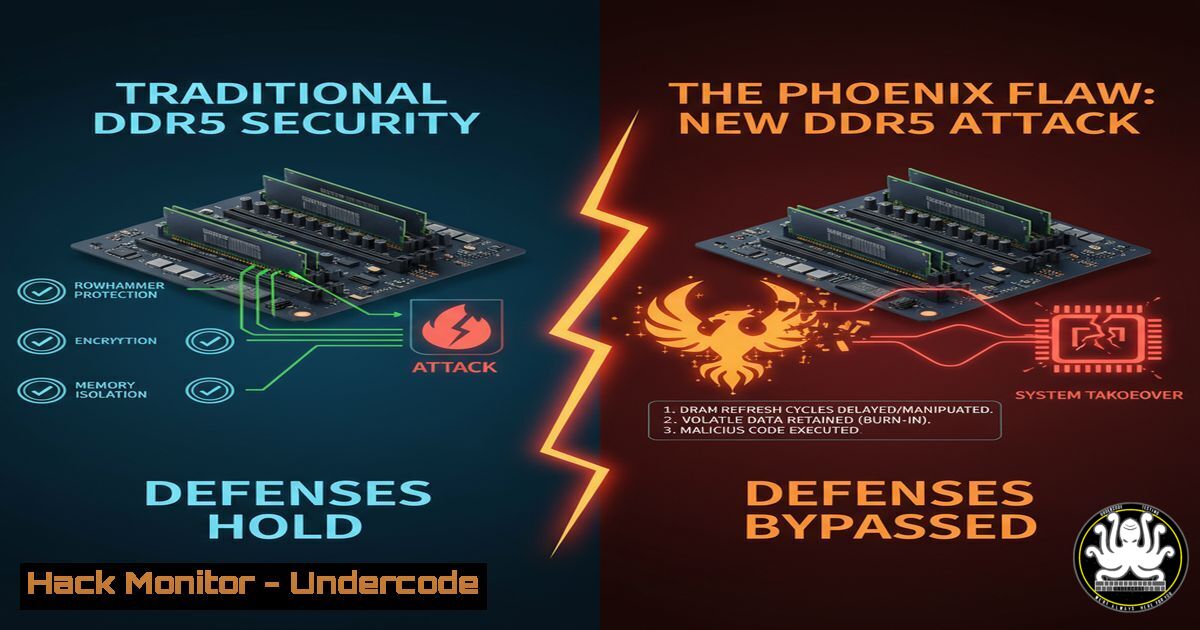
Introduction:
A groundbreaking new hardware-based cyber attack dubbed “Phoenix” has successfully bypassed DDR5’s advanced security protections, including Error-Correcting Code (ECC) and On-Die ECC. This Rowhammer-style attack, designated CVE-2025-6202, enables threat actors to achieve privilege escalation and extract sensitive data by inducing bit-flips in system memory, proving that hardware-level vulnerabilities remain a critical threat vector.
Learning Objectives:
- Understand the mechanics of the Phoenix Rowhammer attack against DDR5 memory
- Identify system diagnostics to detect potential memory corruption vulnerabilities
- Implement mitigation strategies to harden systems against physical memory attacks
You Should Know:
1. Diagnosing Memory Vulnerabilities with Linux Tools
sudo apt install memtester
memtester 1G 1
sudo dmidecode --type memory
cat /proc/meminfo | grep -i error
Step-by-step guide: The `memtester` utility allocates and tests memory for errors by writing patterns and checking their integrity. The `dmidecode` command reveals detailed memory module information including manufacturer and specifications. Monitoring `/proc/meminfo` for error counters helps identify potential memory corruption issues that could be exploited by Phoenix-style attacks.
2. Monitoring System Memory for Anomalous Activity
sudo apt-get install edac-utils
sudo edac-util --status
watch -n 1 'cat /sys/devices/system/edac/mc/mc0/ce_count'
watch -n 1 'cat /sys/devices/system/edac/mc/mc0/ue_count'
Step-by-step guide: EDAC (Error Detection and Correction) utilities monitor memory error correction systems. The `ce_count` shows corrected errors while `ue_count` tracks uncorrectable errors. A sudden spike in either could indicate attempted memory manipulation attacks.
3. Hardening Linux Against Rowhammer Attacks
echo 16 | sudo tee /proc/sys/vm/min_unmapped_ratio
echo 60 | sudo tee /proc/sys/vm/zone_reclaim_mode
sudo sysctl -w kernel.randomize_va_space=2
sudo systemctl disable --now hugepages.service
Step-by-step guide: These commands adjust memory management parameters to reduce Rowhammer vulnerability. Increasing unmapped pages ratio and modifying zone reclaim mode makes memory patterns less predictable. Address space randomization and disabling hugepages complicate targeted memory access.
4. Windows Memory Integrity Verification
Get-WmiObject -Class Win32_PhysicalMemory | Format-List
Get-CimInstance -ClassName Win32_DeviceMemoryAddress
PowerShell "md5sum C:\Windows\System32\ntoskrnl.exe"
Step-by-step guide: These PowerShell commands inventory physical memory specifications and verify critical system file integrity. Regular checksum verification of kernel files can detect unauthorized modifications resulting from memory bit-flip attacks.
5. SSH Key Protection and Rotation Protocol
ssh-keygen -t ed25519 -a 100 -f ~/.ssh/new_key
ssh-copy-id -i ~/.ssh/new_key.pub user@host
sudo systemctl restart sshd
rm ~/.ssh/old_key
Step-by-step guide: Generating new ED25519 keys with high iteration counts and rotating keys regularly mitigates risks from attacks that extract SSH keys from memory. Immediate key rotation is recommended after suspected memory compromise.
6. Sudo Binary Integrity Monitoring
sudo dpkg --verify sudo
echo $(sha256sum /usr/bin/sudo) | sudo tee -a /var/log/sudo-integrity.log
sudo apt-get install -y debsums
debsums -c sudo
Step-by-step guide: Continuous verification of the sudo binary integrity through checksum monitoring and package validation tools can detect manipulation attempts. Logging checksum values enables rapid identification of unauthorized changes.
7. Cloud Instance Memory Hardening
gcloud compute instances create hardened-instance \
--min-cpu-platform "Intel Haswell" \
--maintenance-policy TERMINATE \
--shielded-integrity-monitoring \
--shielded-vtpm \
--shielded-secure-boot
Step-by-step guide: Cloud instances should be configured with shielded VM options that include integrity monitoring, virtual TPM protection, and secure boot. These features help detect and prevent memory manipulation attacks in virtualized environments.
What Undercode Say:
- Hardware-level attacks represent the ultimate escalation in cybersecurity warfare, bypassing traditional software defenses
- Memory integrity can no longer be assumed, requiring new approaches to secure computation
- The 100% success rate in PTE manipulation demonstrates fundamental architectural flaws
The Phoenix attack fundamentally changes the threat landscape by proving that even the latest hardware protections can be bypassed. This isn’t just another vulnerability—it’s a paradigm shift that forces reevaluation of how we secure systems at the most fundamental level. The attack’s effectiveness against ECC and ODECC technologies, previously considered robust defenses, indicates that hardware security requires a complete rearchitecture rather than incremental improvements. Organizations must now assume that memory cannot be fully trusted and implement additional verification layers for critical security functions.
Prediction:
The Phoenix vulnerability will trigger a massive industry shift toward hardware-software co-design for security, with new architectures featuring cryptographic memory verification and physical attack detection becoming standard within 3-5 years. This incident will accelerate adoption of memory encryption technologies and hardware-based root of trust solutions, ultimately leading to a complete redesign of DDR memory architecture that incorporates real-time integrity checking at the hardware level.
🎯Let’s Practice For Free:
IT/Security Reporter URL:
Reported By: https://lnkd.in/p/dUm2BbaR – Hackers Feeds
Extra Hub: Undercode MoN
Basic Verification: Pass ✅


