
Listen to this Post
Introduction:
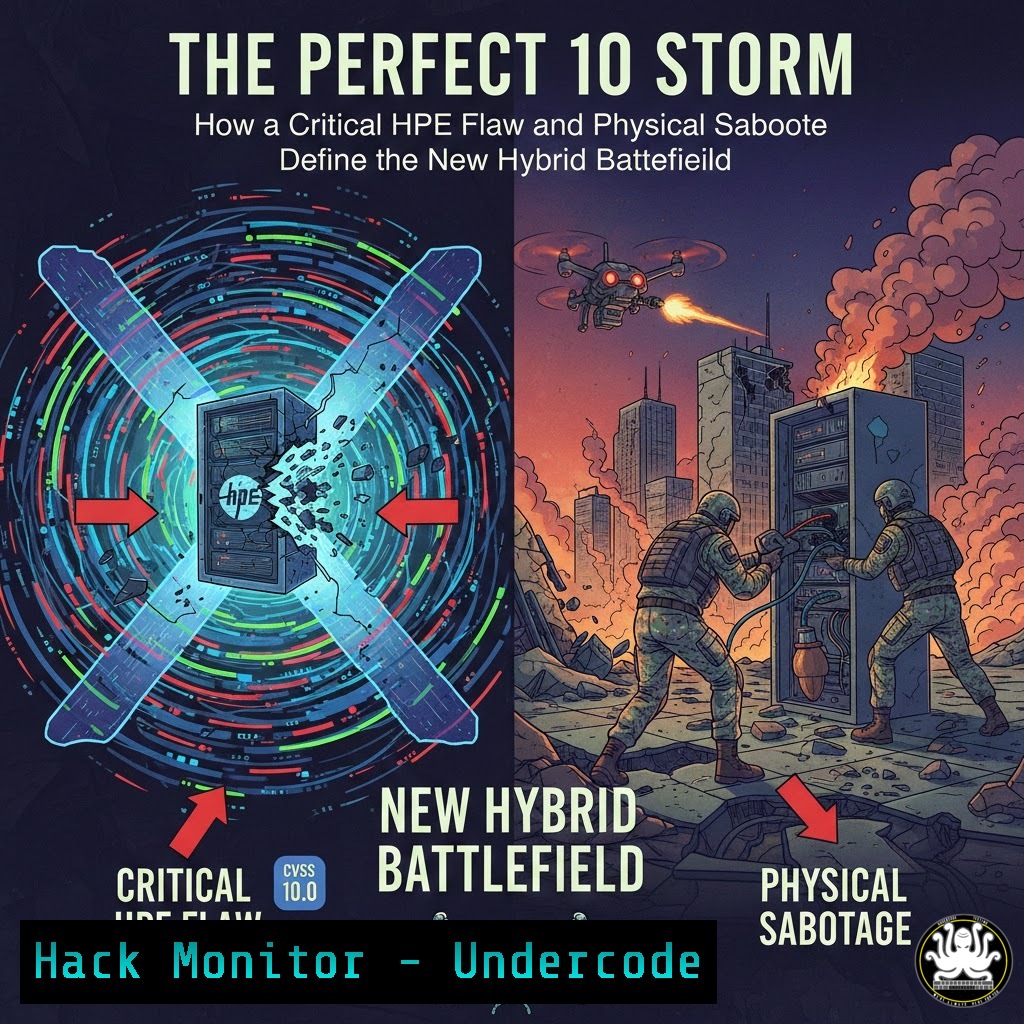
The convergence of unpatched critical software vulnerabilities and targeted physical attacks represents the pinnacle of modern hybrid threats. A perfect 10.0 CVSS-scored Remote Code Execution flaw in HPE’s OneView management suite, actively exploited while organizations hesitated, coincides with a militant campaign against data center power infrastructure in Germany. This dual-front assault underscores a brutal reality: cybersecurity can no longer be isolated from physical security, and delaying patches on management interfaces is an existential gamble.
Learning Objectives:
- Understand the critical severity and mechanics of CVE-2025-37164 in HPE OneView and how to remediate it immediately.
- Learn to harden network management interfaces and segment critical infrastructure to limit the blast radius of exploitation.
- Develop strategies to integrate physical security assessments (like power, cooling, and access) into cyber threat models and incident response plans.
You Should Know:
- CVE-2025-37164: The Unforgivable 10.0 in Your Management Backbone
The vulnerability resides in HPE OneView, a central nervous system for managing servers, storage, and networking. With a CVSS score of 10.0, it indicates an attack of trivial complexity that requires no privileges, can be performed over the network, and leads to complete compromise of confidentiality, integrity, and availability. The article suggests it may have been exploited either as a backdoor or via reckless security testing. The HPE advisory is unequivocal: patch immediately.
Step‑by‑step guide explaining what this does and how to use it.
Step 1: Immediate Identification and Isolation.
On your security management network, scan for HPE OneView instances. Use `nmap` to identify hosts running the typical service.
nmap -sV -p 443,8443 <your-network-range> --script http-title | grep -i "oneview"
Step 2: Apply the Patch.
Refer to the HPE Security Bulletin (link in original post: https://lnkd.in/gwgrZbMd). There is no workaround; applying the patch is mandatory. Ensure you have a verified backup before proceeding. The patching process is typically administered through the OneView web interface or its underlying OS.
Step 3: Post-Patch Validation.
After patching, verify the version is updated and run a credentialed vulnerability scan against the host to confirm CVE-2025-37164 is no longer detected. Isolate the OneView interface so it is not directly accessible from the internet or broad corporate networks.
- Network Segmentation: Building a Moat Around Your Crown Jewels
A management interface like OneView should never reside on a flat network. Its compromise is a direct path to managing all connected hardware. Segmentation is critical.
Step‑by‑step guide explaining what this does and how to use it.
Step 1: Map Dependencies.
Document every system that talks to HPE OneView (servers, SAN switches, PDUs). This defines your “crown jewels” zone.
Step 2: Implement Firewall Rules.
Using your enterprise firewall (e.g., Palo Alto, Fortinet, or Linux iptables), create explicit rules. Only allow specific, necessary IP addresses to reach the OneView HTTPS port (e.g., 443/TCP from a designated jump host or administrator VLAN).
 Example Linux iptables rule on the OneView host (if applicable)
iptables -A INPUT -p tcp --dport 443 -s 10.10.10.0/24 -j ACCEPT
iptables -A INPUT -p tcp --dport 443 -j DROP
Step 3: Implement Jump Hosts.
Administrative access should flow through a hardened, monitored jump host or a Privileged Access Management (PAM) solution. This adds a layer of authentication and logs all sessions.
3. Hardening the Management Interface: Beyond the Patch
Patching closes the door, but hardening locks the windows. Default configurations are a persistent risk.
Step‑by‑step guide explaining what this does and how to use it.
Step 1: Enforce Strong Authentication & MFA.
Ensure HPE OneView is configured to use strong, centralized authentication (e.g., LDAP/AD integration) and mandate Multi-Factor Authentication for all accounts. Disable any default or unused accounts.
Step 2: Encrypt All Communications.
Verify TLS 1.2/1.3 is enforced and weak ciphers are disabled. Use tools like `testssl.sh` to audit the configuration.
./testssl.sh https://<your-oneview-ip>:443
Step 3: Audit Logging and Monitoring.
Enable comprehensive audit logging within OneView. Forward these logs to a SIEM (Security Information and Event Manager) and create alerts for any administrative logins, configuration changes, or failed access attempts.
- The Physical Threat: When the Grid Goes Dark
The activist attack in Germany, targeting a power plant to disrupt data centers, is a stark lesson. Cyber defenses are meaningless without electricity, cooling, and physical access controls.
Step‑by‑step guide explaining what this does and how to use it.
Step 1: Conduct a Physical Threat Assessment.
Map all dependencies: primary and secondary power feeds, substations, water for cooling, and access roads. Identify single points of failure.
Step 2: Engage with Utility Providers.
Establish direct communication with power and utility providers. Understand their security posture and incident notification procedures. Are they aware of threats to critical infrastructure?
Step 3: Redundancy and Resilience Testing.
Test failover to backup generators and UPS systems regularly. Simulate an extended power outage. Ensure fuel contracts are in place and generators are maintained.
5. Integrating Physical & Cyber Incident Response
Your IR plan must account for hybrid scenarios where a cyber event (like an exploited OneView) coincides with or triggers a physical event (like a power cut).
Step‑by‑step guide explaining what this does and how to use it.
Step 1: Unified Command Structure.
Ensure your CSIRT (Computer Security Incident Response Team) includes or can immediately liaison with facilities management, physical security, and site operations.
Step 2: Scenario Planning and Tabletop Exercises.
Run exercises based on the HPE/ Germany scenario. “An exploited OneView is found, and simultaneously, the building access control system fails and generator alarms trigger.” Practice communication and decision-making chains.
Step 3: Secure Alternate Communications.
When power and network are down, how do you coordinate? Establish procedures using satellite phones, pre-designated meeting points, and offline copies of critical response documentation.
What Undercode Say:
- Key Takeaway 1: A 10.0 CVSS score is a five-alarm fire, not a warning. HPE’s lack of downplay is a rare and serious signal. Any delay in patching network management tools is an act of gross negligence, effectively ceding control of your entire hardware estate to attackers.
- Key Takeaway 2: The modern threat landscape is hybrid by design. Attackers will exploit the softest target, whether it’s a forgotten HTTPS port on a management interface or an unguarded fence around a substation. Security programs that treat “cyber” and “physical” as separate domains are architecting their own failure.
Analysis: The simultaneous emergence of these threats is not coincidence but correlation. Adversaries, whether financially motivated APTs or ideological activists, are thinking holistically. They see the interconnectedness of digital and physical systems. The HPE flaw provides a path to silently own the data center from the inside; the physical attack offers a blunt-force denial of service. For defenders, the takeaway is profound: risk assessments must now model cascading failures across these domains. The most elegant firewall rules are irrelevant if the rack loses power. Resilience requires investing with equal seriousness in prompt patch management and in relationships with local law enforcement and utility providers. The battlefield is no longer just the network; it’s the entire operational technology ecosystem that supports it.
Prediction:
The next 18-24 months will see a dramatic rise in “converged operations” by threat actors. Cybercriminal groups will partner with or hire personnel skilled in physical intrusion to maximize ransomware impact (e.g., disabling backups or generators). Conversely, activist groups will increasingly adopt basic cyber tools to enhance physical disruptions, such as using simple RCE flaws to disable building management systems ahead of an attack. This will force a regulatory shift, with frameworks like NIST CSF and ISO 27001 expanding mandates to include integrated physical-cyber resilience testing for critical infrastructure operators. The CISO role will evolve into a Chief Resilience Officer, with budgetary and operational authority over both digital and physical security portfolios.
▶️ Related Video (74% Match):
🎯Let’s Practice For Free:
IT/Security Reporter URL:
Reported By: Mthomasson When – Hackers Feeds
Extra Hub: Undercode MoN
Basic Verification: Pass ✅


