Listen to this Post
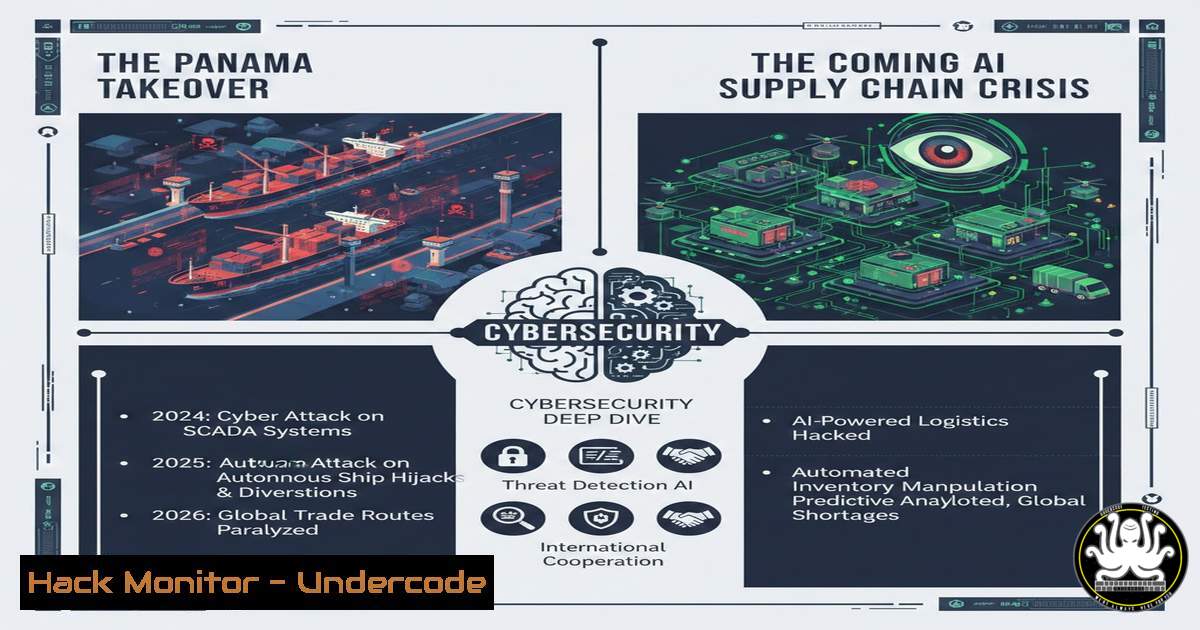
Introduction:
The recent geopolitical maneuver by Panama to seize control of key ports from a Hong Kong-based operator is more than a trade story; it is a stark reminder of how vulnerable global critical infrastructure is to sudden policy shifts. When combined with the parallel discussion surrounding “AI working too well” and the increasing complexity of supply chain decisions, we see a perfect storm forming. This article analyzes the technical undercurrents of these events, exploring the cybersecurity implications of contested infrastructure, the risks of over-leveraging AI in operational technology (OT), and the practical steps professionals must take to harden these environments.
Learning Objectives:
- Analyze the cybersecurity risks associated with geopolitical control shifts over critical infrastructure (SCADA/ICS).
- Understand the attack surface expansion caused by integrating AI into legacy supply chain and logistics systems.
- Identify command-line tools and techniques for auditing network perimeters and API security in hybrid cloud/OT environments.
- Evaluate the concept of an “Intelligence Crisis” where AI-driven automation outpaces human oversight and security validation.
You Should Know:
- Geopolitical Infrastructure Shifts and the ICS/SCADA Threat Landscape
The handover of port operations from one governing entity to another is not just a legal and logistical challenge; it is a critical cybersecurity incident waiting to happen. Ports are complex industrial environments relying heavily on Industrial Control Systems (ICS) for cargo handling, gate systems, and vessel traffic management. When operational control changes, there is a significant risk of unsecured legacy systems being exposed, backdoors left by previous vendors, or configuration drift.
To assess the exposure of such maritime infrastructure, security teams must conduct rapid external and internal audits.
Linux Command for Perimeter Assessment:
 Use masscan to quickly identify open ports on a range associated with maritime logistics IPs (example IP range)
sudo masscan -p1-65535 --rate=10000 --output-format grepable --output-filename port_scan_results.gnmap 203.0.113.0/24

Use nmap to deeply enumerate services on discovered critical ports (e.g., Modbus TCP port 502)
nmap -sV -p 502 --script modbus-discover 203.0.113.45
Windows Command for Internal Segmentation Checks:
 Test connectivity from a Windows management host to a critical crane controller (simulated)
Test-NetConnection 10.10.50.100 -Port 502

Use tracert to map the logical path to a remote terminal gateway
tracert 192.168.10.1
These commands help identify if ICS protocols are unintentionally exposed to broader networks, a common vulnerability during transitional periods when firewall rules are often hastily reconfigured.
- The Risk of “AI Working Too Well”: Model Poisoning in Supply Chain Logic
Scott Luton highlights a critical question: “What if AI works TOO good?” From a cybersecurity perspective, an AI that works “too well” without proper oversight can be a liability. In supply chain, AI models optimize routing, inventory, and vendor selection. However, if these models are trained on data that is subtly poisoned, the “optimization” could route sensitive materials through compromised nodes or systematically select vendors with lax security postures.
To audit an AI model’s integrity, security engineers must validate the data pipeline.
Python Snippet for Data Integrity Check (Hash Verification):
import hashlib
import os

Verify that training datasets haven't been tampered with
def verify_dataset_integrity(file_path, expected_hash):
sha256_hash = hashlib.sha256()
with open(file_path, "rb") as f:
for byte_block in iter(lambda: f.read(4096), b""):
sha256_hash.update(byte_block)
if sha256_hash.hexdigest() == expected_hash:
print(f"[bash] Hash match for {file_path}")
else:
print(f"[bash] Hash mismatch for {file_path} - Possible Tampering!")

Example usage
verify_dataset_integrity("supply_chain_training_v2.csv", "a1b2c3d4e5f6...")
Implementing cryptographic checksums on datasets ensures that the “intelligence” driving critical decisions hasn’t been manipulated by a state actor seeking to cause logistical chaos.
3. Hardening the API Economy in Logistics
The conversation with Stefan Groschupf at Manifest 2026 revolves around applying stock market decision-making to supply chains. This implies heavy reliance on real-time APIs connecting shippers, carriers, and warehouses. These APIs become high-value targets. An attacker who compromises a rate-shopping API could reroute millions in freight or cause systemic delays.
Securing these connections requires rigorous API gateway configuration and authentication hardening.
Configuration Example: Kong API Gateway Rate Limiting and JWT Validation
 Kong declarative configuration snippet
_format_version: "3.0"
services:
- name: freight-rate-service
url: http://internal.rates.svc.cluster.local
routes:
- name: rate-route
paths:
- /v1/rates
plugins:
- name: rate-limiting
config:
minute: 100
policy: local
- name: jwt
config:
uri_param_names: [bash]
claims_to_verify: [exp, nbf]
Additionally, teams must rotate secrets aggressively. A Linux one-liner can generate strong random keys for these services:
 Generate a cryptographically secure 32-character key for HMAC signing
openssl rand -base64 32
- The “Intelligence Crisis”: Scenario Planning for Cyber-Physical Failure
The Citrini Research piece posits a future where systems are too fast for humans to manage. In OT environments, this speed can be deadly. Security teams must move from reactive patching to proactive “war-gaming.” This involves simulating attacks that cause AI to make catastrophic decisions, such as shutting down refrigeration units in a food supply chain or diverting hazardous materials.
To simulate this, security teams can use tools like Metasploit to test human responses to fake alerts without actually disrupting operations.
Metasploit Auxiliary Module for Simulating a PLC Scan (Educational Use Only):
msf6 > use auxiliary/scanner/scada/modbusclient
msf6 auxiliary(scanner/scada/modbusclient) > set RHOSTS 192.168.1.50
msf6 auxiliary(scanner/scada/modbusclient) > set ACTION READ_REGISTERS
msf6 auxiliary(scanner/scada/modbusclient) > set START_ADDRESS 0
msf6 auxiliary(scanner/scada/modbusclient) > set NUMBER 10
msf6 auxiliary(scanner/scada/modbusclient) > run
The output provides a snapshot of coil/register values. If the AI is “making decisions” based on these values, security teams must ensure the integrity of the data source. If an attacker can spoof these registers (e.g., making a freezer report -10°C when it is actually +10°C), the AI will make disastrous decisions.
5. Cloud Hardening for Hybrid Supply Chain Environments
As supply chain decisions become “71% more complex,” they are increasingly moved to the cloud for processing power. This creates a massive cloud security architecture challenge. Misconfigured S3 buckets leaking shipping manifests or exposed Azure Blob Storage containing customs data are common failure points.
Using the Azure CLI, an engineer can audit for public exposure:
 List all storage accounts and check network rule sets
az storage account list --query "[].{name:name, networkRules:networkRuleSet}" -o table

Check blob public access setting for a specific account
az storage account show --name mystorageaccount --query "allowBlobPublicAccess"
On AWS, the AWS CLI can be used to enforce S3 Block Public Access at the account level:
 Get the current Block Public Access configuration for the account
aws s3control get-public-access-block --account-id 123456789012

Set strict block public access
aws s3control put-public-access-block --account-id 123456789012 --public-access-block-configuration BlockPublicAcls=true,IgnorePublicAcls=true,BlockPublicPolicy=true,RestrictPublicBuckets=true
What Undercode Say:
- The Geopolitical Vector is Underrated: The Panama port seizure is a case study in how quickly physical control shifts can expose cyber weaknesses. Security teams must treat changes in ownership or management as critical security events, initiating full audits and credential rotations.
- AI is the New Attack Surface: The “Intelligence Crisis” is real. We are automating critical decisions in the supply chain faster than we are securing the data pipelines and models that drive those decisions. Model theft and data poisoning will become the preferred methods for nation-states to disrupt economies without firing a shot.
- Resilience Over Speed: The focus must shift from making decisions “57% faster” to making them “securely and verifiably.” The triple constraint mentioned by Gartner must include a fourth dimension: Integrity. Without data integrity, speed is just a faster way to crash.
Prediction:
In the next 3-5 years, we will witness the first major “AI WARS” where a nation-state does not attack a rival’s military, but their AI-driven logistics models. By subtly corrupting the training data of a port’s container placement AI or a railway’s routing algorithm, an adversary could induce a “digital blockade” more effectively than a physical navy. The Panama Canal situation is merely the opening act; the main event will be fought over control of the algorithms that run the infrastructure.
▶️ Related Video (78% Match):
🎯Let’s Practice For Free:
IT/Security Reporter URL:
Reported By: Scottwindonluton Supplychain – Hackers Feeds
Extra Hub: Undercode MoN
Basic Verification: Pass ✅


