Listen to this Post
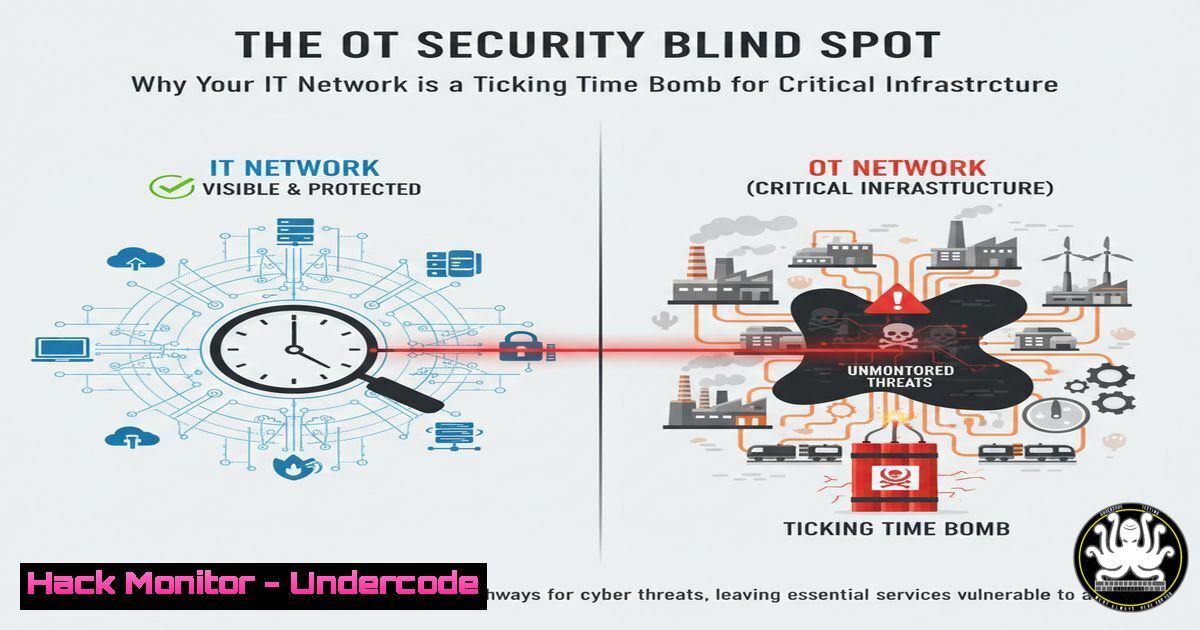
Introduction:
The convergence of Information Technology (IT) and Operational Technology (OT) networks is no longer a future possibility but a present-day reality. While this integration drives efficiency, it also creates a perilous pathway for cyber threats to cross from corporate IT environments into the critical systems that control industrial processes. Without robust segmentation and a defense-in-depth strategy, a simple IT breach can escalate into catastrophic OT downtime, safety risks, and massive production losses.
Learning Objectives:
- Understand and implement core network segmentation techniques to create a hardened perimeter between IT and OT environments.
- Master essential commands for asset discovery, firewall configuration, and network monitoring within both Windows and Linux-based OT systems.
- Develop a proactive security posture through host hardening, vulnerability management, and continuous traffic analysis to detect and mitigate crossover threats.
You Should Know:
1. Architecting the IT-OT Perimeter with Firewalls
The first and most critical line of defense is a properly configured firewall between the IT and OT zones. This isn’t just about blocking traffic; it’s about enforcing a least-privilege policy where only explicitly allowed, necessary communications can cross.
Verified Command/Configuration:
On a Palo Alto Networks firewall, a sample security policy rule would look like this:
rule name "IT-to-OT-MES-Allow"
from trust [IT-Zone]
to trust [OT-Zone]
source [IT-Subnet]
destination [MES-Server-IP]
application msexchange
service tcp/1352
action allow
Step-by-step guide:
This rule allows traffic only from a specific IT subnet to a specific Manufacturing Execution System (MES) server in the OT zone, only using the MS Exchange protocol over TCP port 1352. Every other connection attempt from IT to OT is implicitly denied. The process involves: 1) Identifying the exact source and destination IP ranges. 2) Defining the specific application and port required for business function. 3) Creating the rule with a descriptive name. 4) Placing it in the correct order of precedence in the rulebase.
2. Discovering and Inventorying OT Assets
You cannot secure what you do not know exists. Passive and semi-passive network discovery is essential to map the OT environment without disrupting sensitive industrial control systems (ICS).
Verified Command/Code Snippet:
Using `nmap` for a non-intrusive scan:
sudo nmap -sS -T polite -p 80,443,502,20000,44818,47808 -O 10.10.100.0/24
Step-by-step guide:
This command performs a TCP SYN scan (-sS) at a slow timing (-T polite) to avoid overloading PLCs and RTUs. It checks for common IT and OT ports (e.g., 502 for Modbus, 44818 for EtherNet/IP) and attempts OS detection (-O) on the `10.10.100.0/24` OT subnet. The output provides a list of active devices, their open ports, and inferred operating systems, forming the basis of your asset inventory.
3. Implementing Micro-Segmentation with Windows Firewall
Internal segmentation within the OT network is crucial to contain breaches. The Windows Firewall with Advanced Security can be used to segment Windows-based HMIs and engineering workstations.
Verified Command/Code Snippet:
Creating a firewall rule via PowerShell to block all but necessary SCADA traffic:
New-NetFirewallRule -DisplayName "Block-Inbound-Except-SCADA" -Direction Inbound -Protocol TCP -LocalPort 1-65535 -Action Block -Enabled True
New-NetFirewallRule -DisplayName "Allow-SCADA-Client" -Direction Inbound -Protocol TCP -LocalPort 4840 -RemoteAddress 10.10.100.50 -Action Allow -Enabled True
Step-by-step guide:
The first command creates a default-deny rule for all inbound TCP traffic. The second command creates a highly specific allow rule, permitting inbound traffic only on TCP port 4840 (common for OPC UA) and only from the specific SCADA server at 10.10.100.50. This ensures the HMI only communicates with its intended partner.
4. Hardening Linux-Based Historians and Data Diodes
Many OT components like data historians run on Linux. Hardening these systems is vital as they often sit in the DMZ between IT and OT.
Verified Command/Code Snippet:
Using `iptables` to create a strict policy and using `fail2ban` to block brute-force attacks:
 Set default policies to DROP
iptables -P INPUT DROP
iptables -P FORWARD DROP
iptables -P OUTPUT ACCEPT

Allow established connections and SSH from a management jumpbox
iptables -A INPUT -m state --state ESTABLISHED,RELATED -j ACCEPT
iptables -A INPUT -p tcp -s 10.10.1.100 --dport 22 -j ACCEPT

Install and configure fail2ban
sudo apt-get install fail2ban
echo "[bash]
enabled = true
port = 22
filter = sshd
logpath = /var/log/auth.log
maxretry = 3
bantime = 3600" | sudo tee /etc/fail2ban/jail.d/sshd.local
Step-by-step guide:
This setup first blocks all traffic by default, then carves out exceptions for already-established connections and SSH from a single, trusted management IP. The `fail2ban` configuration monitors the auth log for repeated SSH failures and automatically bans the offending IP address for one hour after three failed attempts, mitigating credential-based attacks.
5. Monitoring for Anomalous Cross-Zone Traffic
Continuous monitoring can detect policy violations and emerging threats. Tools like `tcpdump` and Security Onion can be used to analyze traffic at the IT-OT boundary.
Verified Command/Code Snippet:
Using `tcpdump` to capture and analyze traffic on the OT boundary interface:
sudo tcpdump -i eth1 -nn 'net 10.10.100.0/24 and not net 192.168.1.0/24' -w ot_capture.pcap
Step-by-step guide:
This command captures all traffic on interface `eth1` that is destined for the OT network (10.10.100.0/24) but does not originate from the expected IT management network (192.168.1.0/24). The `-nn` prevents DNS resolution for performance. The captured packets are written to a file (ot_capture.pcap) for later analysis in a tool like Wireshark to identify unauthorized connection attempts.
6. Vulnerability Assessment for OT Assets
Regularly scanning for vulnerabilities in OT systems requires specialized tools and careful configuration to avoid causing disruptions.
Verified Command/Code Snippet:
Using the `tenable.cli` to initiate a passive vulnerability scan against an OT subnet:
tenablecli scan launch --targets 10.10.100.0/24 --scan-template "passive" -- scanner-group "OT-Scanners"
Step-by-step guide:
This command leverages Tenable’s passive scan template, which identifies assets and vulnerabilities primarily by analyzing network traffic rather than sending active probes. This is significantly safer for fragile OT devices. The scan is directed at the OT subnet and executed by a pre-defined scanner group that is configured with appropriate, non-disruptive scan policies.
7. Securing Industrial Protocols (Modbus TCP)
Protocols like Modbus TCP have no inherent security. Using network access control and monitoring can help prevent unauthorized commands.
Verified Command/Code Snippet:
A Suricata network intrusion detection rule to alert on unauthorized Modbus function codes:
alert tcp any any -> $OT_NETWORK 502 (msg:"OT POLICY Unauthorized Modbus Function Code"; content:"|00 00 00 00 00 06|"; depth:6; byte_test:1, >, 5, 6, relative; sid:1000001; rev:1;)
Step-by-step guide:
This Suricata rule triggers an alert for any Modbus TCP packet (port 502) destined for the OT network that contains a function code (the byte at position 6, after the 6-byte Modbus header) greater than 5. Since common, read-only functions are 1-4, this could indicate a write attempt (e.g., function code 6 or 16) or a diagnostic command from an unauthorized source, prompting immediate investigation.
What Undercode Say:
- Segmentation is Non-Negotiable: A flat network where IT and OT freely communicate is an incident waiting to happen. The architectural control provided by a tightly managed firewall is the single most effective mitigation.
- Visibility is Paramount: Continuous, passive monitoring of the IT-OT data flow is not a “nice-to-have” but a core security control. You must be able to detect and alert on violations of your segmentation policy and anomalous cross-zone traffic patterns.
The analysis from the field, as seen in the LinkedIn comments, reinforces that technical controls like segmentation are futile without ongoing governance and review. Relying on a legacy, “set-and-forget” segmentation architecture is akin to a ticking bomb. The recent attack on JLR is a stark reminder that threats do successfully traverse this boundary. The key is to adopt a resilient posture that combines robust technical segmentation (zoning, conduits) with a proactive process of reviewing rules, monitoring traffic, and updating defenses as the threat landscape and operational requirements evolve.
Prediction:
The future of OT security will be defined by the weaponization of IT-born attacks specifically designed to pivot into OT environments. We will see a rise in ransomware strains with embedded modules capable of scanning for and exploiting common industrial protocols like OPC UA and EtherNet/IP. As AI-driven penetration testing tools become more accessible, attackers will automatically generate targeted cross-zone exploitation campaigns, making manual, static defenses obsolete. Organizations that fail to implement dynamic, deeply segmented, and intelligently monitored networks will face not just production halts but potentially life-threatening safety system compromises.
🎯Let’s Practice For Free:
IT/Security Reporter URL:
Reported By: Otsecurityprofessionals Otsecprotip – Hackers Feeds
Extra Hub: Undercode MoN
Basic Verification: Pass ✅


