Listen to this Post
Introduction:
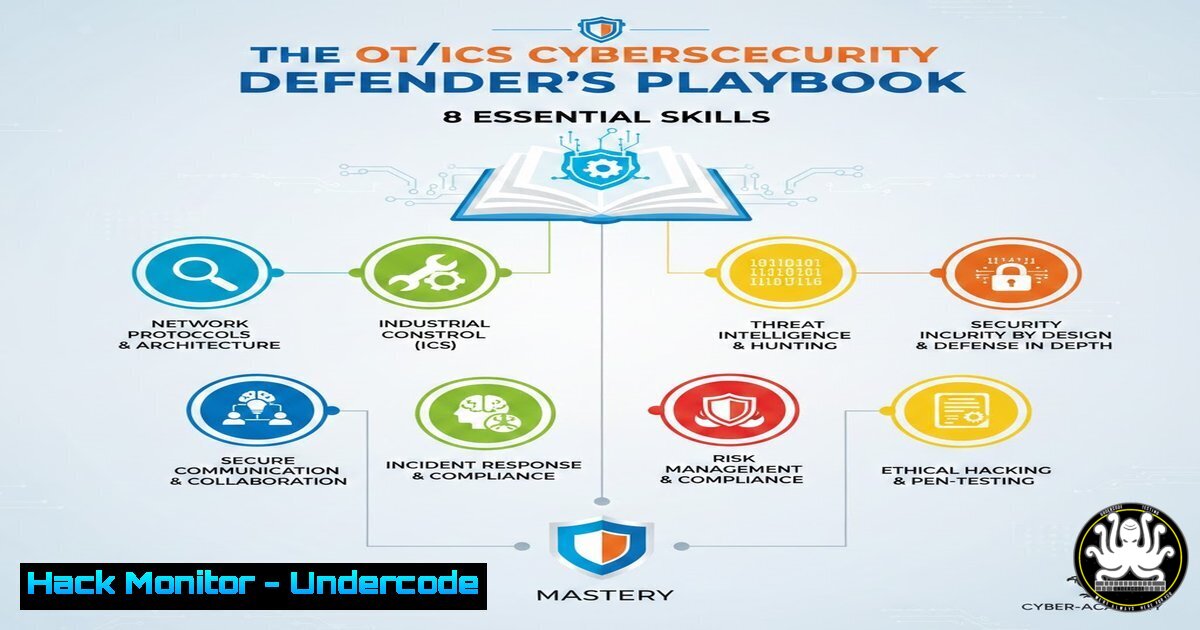
As Operational Technology (OT) and Industrial Control Systems (ICS) become increasingly connected to IT networks, the attack surface for critical infrastructure expands exponentially. Defending these environments requires a unique hybrid skillset that blends traditional cybersecurity knowledge with a deep understanding of physical processes and industrial protocols. Unlike standard corporate IT security, where data confidentiality is paramount, OT security prioritizes safety and availability, making the human element and specific technical competencies absolutely critical.
Learning Objectives:
- Understand the unique “cyber-physical” skills required to defend OT/ICS environments effectively.
- Learn practical, command-line based techniques for analyzing industrial network traffic and system configurations.
- Identify the key frameworks and mindsets necessary for building a resilient OT security posture.
You Should Know:
- Cognitive Skills: Network Traffic Analysis & Root Cause Diagnosis
The foundation of OT defense lies in the ability to analyze network behavior and diagnose failures without disrupting live operations. You must be able to distinguish between a malfunctioning sensor and an active intrusion.
Step‑by‑step guide: Analyzing Modbus TCP Traffic
Modbus is one of the most common industrial protocols. Here’s how to analyze it for suspicious activity using Linux command-line tools.
- Step 1: Capture traffic. Use `tcpdump` to capture traffic on the industrial network interface (e.g.,
eth0). Focus on the Modbus port (502).Capture Modbus traffic and save to a file sudo tcpdump -i eth0 -w modbus_capture.pcap port 502
- Step 2: Analyze with TShark. TShark (the terminal version of Wireshark) allows you to filter for specific Modbus function codes. Function code 16 (Write Multiple Registers) is often used for malicious reconfiguration.
Read the pcap and display only packets with Modbus function code 16
tshark -r modbus_capture.pcap -Y "modbus.func_code == 16" -V
- Step 3: Investigate a frozen HMI. A frozen Human-Machine Interface (HMI) could be a DoS attack. Check for excessive TCP retransmissions or out-of-order packets indicating network stress.
Check for TCP errors in the capture
tshark -r modbus_capture.pcap -z io,stat,1,"COUNT(tcp.analysis.retransmission)tcp.analysis.retransmission" -q
- Technology Skills: Secure Network Architecture & Incident Response
Segmentation is the holy grail of OT security. The Purdue Model for ICS segmentation must be enforced via firewalls and switches.
Step‑by‑step guide: Implementing Basic ACLs on a Cisco Switch
– Step 1: Identify zones. Assume you have a Level 3 (Site Operations) network and a Level 2 (Area Supervisory) network.
– Step 2: Create an Access Control List (ACL) to block IT protocols from reaching the control level, but allow specific OT protocols.
configure terminal
! Create an extended ACL to allow only Modbus from IT to OT
access-list 101 permit tcp 192.168.1.0 0.0.0.255 10.10.10.0 0.0.0.255 eq 502
access-list 101 deny ip any any log
! Apply to the interface facing the OT network
interface GigabitEthernet0/1
ip access-group 101 in
end
write memory
3. Management Skills: Building an Asset Register
You cannot protect what you cannot see. In OT, this means identifying every PLC, RTU, and sensor.
Step‑by‑step guide: Active and Passive Asset Discovery
- Step 1: Passive Discovery (Nmap). Use Nmap to ping sweep the OT subnet without causing disruptions (avoid aggressive scans).
Simple ping sweep to find live hosts
nmap -sn 192.168.1.0/24
- Step 2: Banner Grabbing for PLCs. Once live hosts are found, gently grab banners to identify the device type.
Check for common industrial ports (102 for Siemens, 44818 for Rockwell)
nmap -sV -p 102,44818,502 192.168.1.10
- Step 3: Windows-based Inventory (PowerShell). If the engineering workstations are Windows-based, use PowerShell to document installed industrial software.
List all installed software related to Siemens
Get-WmiObject -Class Win32_Product | Where-Object {$_.Name -like "Siemens"} | Select-Object Name, Version
- Working with Others & Engagement Skills: Thinking Like an Attacker
To support new team members and secure the plant, you must adopt the attacker’s mindset to ask the right questions.
Step‑by‑step guide: Simple Vulnerability Discovery with Search Engines
- Step 1: Use Shodan. Search for exposed industrial devices. The query `port:502 country:US` will show US-based Modbus devices.
- Step 2: Use Nmap Scripts. Run safe scripts to see if a PLC is vulnerable to known exploits without crashing it.
Check for S7-1200 CPU vulnerabilities (use with extreme caution in production)
nmap --script s7-info.nse -p 102 192.168.1.10
5. Self-efficacy & Physical Abilities: Safety and Preparedness
In OT, cybersecurity professionals must be comfortable with physical safety protocols. This means knowing how to interact with the hardware.
Step‑by‑step guide: Checking System Integrity on a Windows Engineering Workstation
– Step 1: Verify running processes. Look for unauthorized software that could interfere with HMI operations.
 List all processes, focusing on those with high memory usage
Get-Process | Sort-Object CPU -Descending | Select-Object -First 20
– Step 2: Check for unauthorized users. Ensure only authorized engineers have local access.
 List all local users
Get-LocalUser
– Step 3: Verify open ports (local). Use `netstat` to ensure no backdoors are listening for external connections.
netstat -an | find "LISTENING"
What Undercode Say:
- The Human Firewall is Paramount: While firewalls and IDS are crucial, the cognitive and ethical skills of the defender—such as diagnosing a frozen HMI or insisting on safety protocols—are the last line of defense against catastrophic failure.
- Bridging the IT/OT Divide: The commands and steps above illustrate that an OT defender must be a polyglot; fluent in networking, Windows/Linux administration, and industrial engineering. Security in this field isn’t just about patching software; it’s about ensuring a pump doesn’t explode while patching.
Prediction:
As AI-driven attacks become more sophisticated, targeting the analog gaps in industrial processes, the demand for “cyber-physical” defenders will skyrocket. We will likely see the emergence of specialized “ICS Incident Response” teams that combine data scientists (for anomaly detection) with control engineers. The skills listed above will evolve from “nice-to-have” to mandatory requirements for critical infrastructure protection, leading to new certification tracks that blend automation engineering with red teaming.
🎯Let’s Practice For Free:
IT/Security Reporter URL:
Reported By: Mikeholcomb What – Hackers Feeds
Extra Hub: Undercode MoN
Basic Verification: Pass ✅


