Listen to this Post
Introduction:
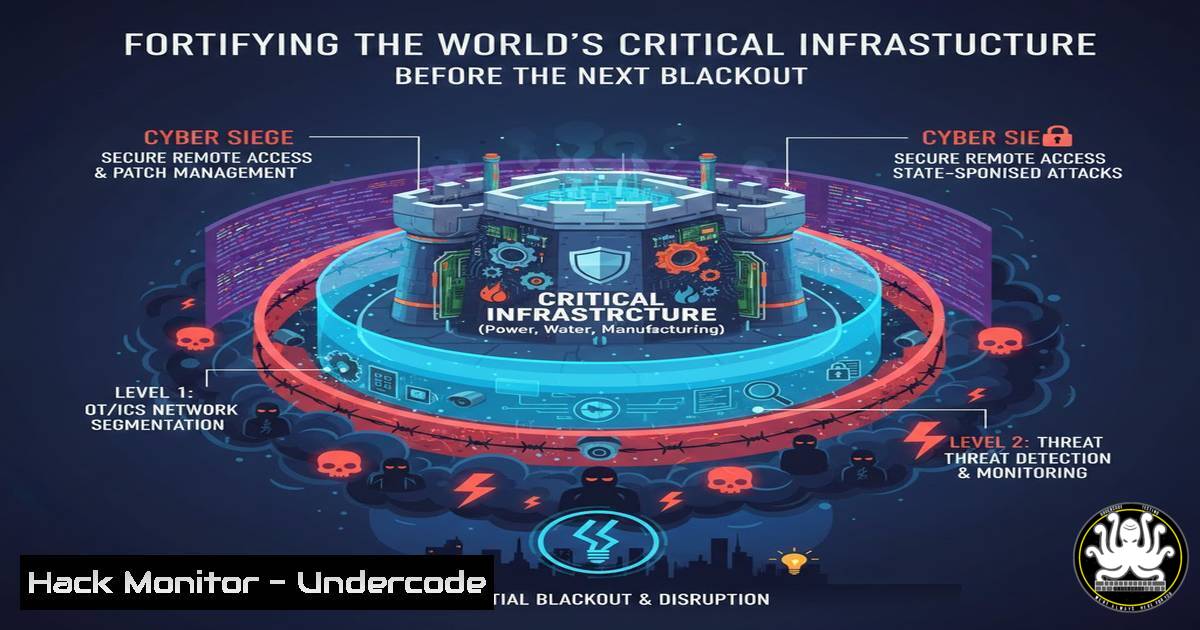
The digital battleground has expanded beyond corporate servers to the very heart of our physical world: Operational Technology (OT) and Industrial Control Systems (ICS). These systems control everything from the power in our homes to the water in our taps, and they are under increasing threat. This article deconstructs the five-pillar blueprint for securing these environments, moving from fundamental understanding to advanced defensive implementation.
Learning Objectives:
- Understand the core components and communication protocols of an ICS/OT environment.
- Identify the unique threat landscape targeting critical infrastructure.
- Implement practical defensive strategies and leverage established security frameworks.
You Should Know:
1. ICS/OTS Fundamentals: Knowing Your Cyber-Physical Enemy
Before deploying a single sensor, you must map the territory. An ICS/OT network is a hierarchy of specialized devices, not standard IT equipment.
Step-by-step guide to asset discovery and mapping:
- Passive Network Sniffing: Begin with passive monitoring to avoid disrupting processes. Use a tool like `Wireshark` on a span port to listen.
Command: Launch Wireshark and apply a filter for common OT protocols: `modbus || enip || dnp3`
This identifies active communicators without sending a single packet. - Active Discovery (With Caution): In maintenance windows, use specialized scanners.
Tool: `Nmap` with scripts. `sudo nmap -sU -p 502 –script modbus-discover` probes for Modbus PLCs.
WARNING: Always coordinate with operations. A scan can crash a legacy PLC.
3. Asset Inventory: Categorize findings:
Engineering Workstation (EWS): Runs control logic programming software (e.g., Siemens TIA Portal).
Human-Machine Interface (HMI): The operator’s visual interface. Often runs on Windows.
Programmable Logic Controller (PLC): The physical controller. Hardens logic.
Distributed Control System (DCS): For complex, integrated processes.
- Protocols & Communications: The Insecure Language of Machines
OT protocols were built for reliability, not security. They lack authentication, encryption, and are often broadcast in plaintext.
Step-by-step guide to protocol analysis and network segmentation:
- Traffic Decryption & Analysis: Use a tool like `Wireshark` with dissectors.
In Wireshark, go toAnalyze -> Enabled Protocols. EnsureMODBUS,EtherNet/IP, `DNP3` are checked. You will see readable function codes (e.g., “Write Single Register”). - Implement a Demilitarized Zone (DMZ): Segment IT from OT using a firewall-configured DMZ.
Firewall Rule Example (Conceptual): Allow only specific traffic from IT network (10.1.1.0/24) to historian in DMZ (172.16.1.10) on port `TCP/1433` (SQL), and from historian to OT assets on port `UDP/2222` (Proprietary). - Enforce Unidirectional Gateways: For the highest security, use a data diode (e.g., Waterfall, Owl) to allow data out of OT for monitoring but physically block any return traffic.
-
Threats & Attacks: From Script Kiddies to State-Sponsored Sabotage
The motive shifts from data theft to physical disruption and ransom.
Step-by-step guide to understanding and detecting common attack vectors:
1. Phishing for Initial Access: Attackers often target IT to pivot to OT. Train staff and monitor for suspicious emails.
2. Lateral Movement via Default Credentials: Use (authorized) scanning to find systems using default passwords.
Mitigation Command (Windows OT Host): Enforce password policy: `net accounts /MINPWLEN:14 /UNIQUEPW:8 /MAXPWAGE:90`
3. Malware Targeting Controllers: Understand threats like TRITON/Industroyer2, which directly targets safety instrumented systems. Deploy application whitelisting.
Windows Command (Local Security Policy): Configure Software Restriction Policies or AppLocker to only allow executables from `C:\Program Files\ICS\` and C:\Windows\System32\.
4. Defensive Strategies: Building the Cyber Fortress
Defense-in-depth is non-negotiable. It’s about creating multiple layers of failure.
Step-by-step guide to implementing core defenses:
- Patch Management: Prioritize patches based on ICS-CERT advisories. Test patches on an identical offline system first.
2. Host Hardening: Harden Windows-based HMIs and EWS.
Disable unnecessary services: `Get-Service | Where-Object {$_.StartType -eq ‘Auto’ -and $_.Status -eq ‘Running’} | Select Name`
Disable USB ports via Group Policy: Computer Configuration -> Administrative Templates -> System -> Removable Storage Access.
3. Network Monitoring with IDS: Deploy a purpose-built OT IDS like SURICATA or a commercial tool.
Rule Example (Snort/Suricata): `alert tcp any any -> $OT_NETWORK 502 (msg:”MODBUS Write Multiple Registers”; content:”|10 17|”; depth 2; sid:1000001;)` to flag a specific, potentially dangerous Modbus function.
- Frameworks, Compliance & Governance: Your Blueprint for Success
Don’t start from scratch. Leverage the work of experts to build a resilient program.
Step-by-step guide to adopting the ISA/IEC 62443 framework:
- Perform a System Security Assessment (62443-3-2): Define your system under consideration (SUC), zone it, and conduct conduit analysis to map data flows.
- Define Security Levels (SL): Assign target SL (e.g., SL2 for basic protection, SL3 for sophisticated threats) for each zone based on risk.
- Implement Technical Requirements (62443-3-3): Translate SL into controls. For SL2, this includes account management (SR 1.1), software integrity (SR 3.1), and information confidentiality (SR 4.1).
- Continuous Monitoring & Improvement: Use tools to monitor compliance with defined policies and review incident logs weekly. Integrate with a GRC platform.
What Undercode Say:
- OT Security is Physical Safety. A compromised PLC isn’t a data breach; it’s a pipeline rupture, a grid failure, or a manufacturing line catastrophe. The stakes redefine risk calculus.
- Air-Gapping is a Myth, Segmentation is King. The dream of a totally isolated network is often impractical. Robust, monitored segmentation and strict access control at every junction form the modern defensive perimeter.
Prediction:
The convergence of IT and OT will accelerate, driven by IIoT and Industry 4.0, exponentially increasing the attack surface. We will see the rise of AI-driven malware capable of learning process behaviors to execute maximally destructive attacks with surgical precision. Simultaneously, defensive AI will become critical for anomaly detection in vast, noisy OT data. The future battleground will be AI vs. AI in the physical domain, with regulatory frameworks like 62443 becoming legally mandated, not just advisory, for critical infrastructure operators globally.
▶️ Related Video (82% Match):
🎯Let’s Practice For Free:
IT/Security Reporter URL:
Reported By: Https: – Hackers Feeds
Extra Hub: Undercode MoN
Basic Verification: Pass ✅


