Listen to this Post
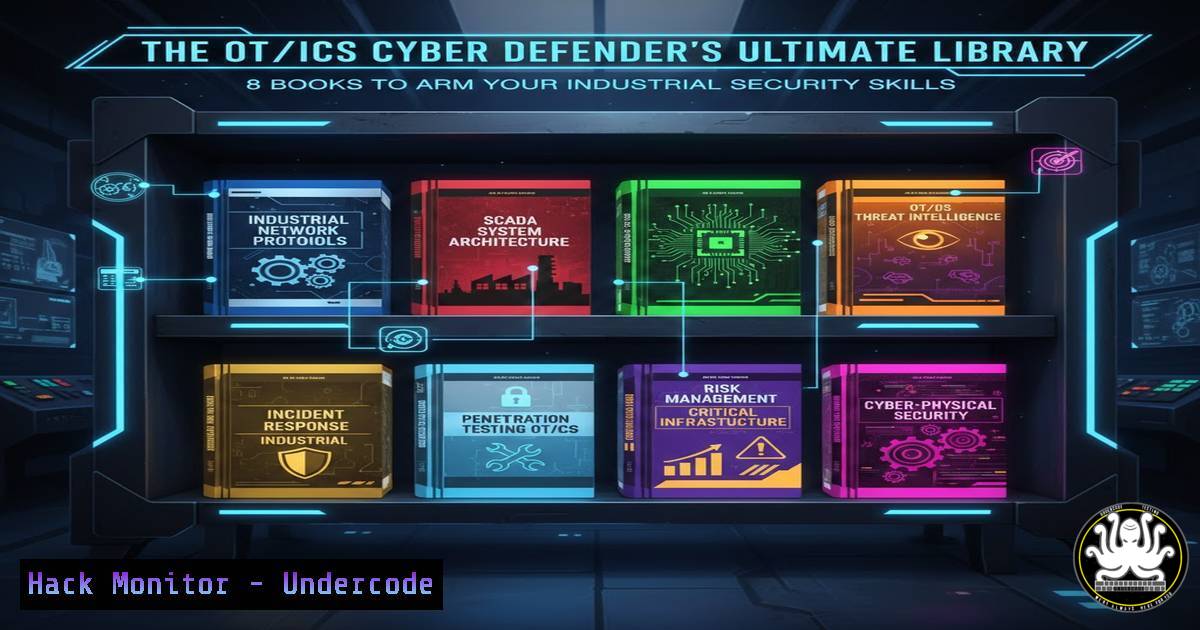
Introduction:
Operational Technology (OT) and Industrial Control Systems (ICS) form the backbone of critical infrastructure, from power grids to manufacturing plants. As these once-isolated networks converge with IT systems, their vulnerability to sophisticated cyber-attacks has skyrocketed. Building a robust defense requires a foundational understanding of both engineering principles and adversarial tactics, a knowledge base meticulously compiled in the essential reading list curated by industry expert Mike Holcomb.
Learning Objectives:
- Understand the historical evolution and current threat landscape of state-sponsored OT/ICS attacks.
- Develop a foundational knowledge of industrial network architecture, protocols, and security baselines.
- Learn offensive techniques and methodologies specific to ICS to proactively build stronger defensive postures.
You Should Know:
- From History to Hacking: Understanding the Adversary and Their Playbook
The journey to securing industrial environments begins with comprehending the threat. Andy Greenberg’s Sandworm provides a crucial narrative on the evolution of state-sponsored threats, tracking real-world attacks that have caused physical damage. This historical context is the “why” behind the technical “how.” Parallel to this, Hacking Exposed: Industrial Control Systems serves as the technical manual, detailing the attack lifecycle specific to ICS. It translates high-level threats into practical vulnerabilities.
Step‑by‑step guide explaining what this does and how to use it:
To bridge the gap between reading and practice, after studying these texts, set up a safe, isolated lab environment (using tools like GRFICS or OpenPLC) and practice initial reconnaissance. A fundamental step is network discovery to identify ICS assets, which often use atypical protocols.
Command (Linux): `nmap -sS -sU -p 1-1024 –script broadcast,smb-enum-shares,modbus-discover -sS) and UDP scan (-sU) on common ports, while employing scripts to discover shared resources and Modbus PLCs.
Analysis: Running this in your lab helps you understand how an attacker maps the network. The book Hacking Exposed: ICS will then guide you in interpreting these results and planning subsequent exploitation steps, such as targeting specific PLC ports (e.g., TCP 502 for Modbus).
2. Mastering the Industrial Network Foundation
Before deploying advanced defenses, you must understand what you’re protecting. Eric Knapp’s Industrial Network Security and the Practical Industrial Cybersecurity guide by Brooks & Craig Jr. provide the architectural blueprint. They cover Purdue Model levels, key protocols (Modbus TCP, PROFINET, DNP3), and how safety and reliability requirements differ from traditional IT security.
Step‑by‑step guide explaining what this does and how to use it:
A core skill is traffic analysis to establish a network baseline and detect anomalies. Use Wireshark to capture and inspect industrial protocol traffic.
Tutorial:
- Capture: In Wireshark, start a capture on the relevant network interface.
- Filter: Apply a display filter for a common ICS protocol: `modbus` or
dnp3. - Analyze: Examine a Modbus packet. The Function Code field is critical (e.g., `0x05` = Write Single Coil). Knapp’s book explains the significance of these codes.
- Baseline: Document normal traffic patterns, source/destination pairs, and common function codes. This baseline is your reference for detecting malicious commands, such as an unauthorized `Write` command to a critical coil.
3. Engineering Your Defense: From Theory to Practice
With fundamentals in place, Pascal Ackerman’s exhaustive Industrial Cybersecurity volumes and Steve Mustard’s Case Studies offer depth and real-world context. They move from theory to the implementation of defense-in-depth strategies tailored for OT. This is where concepts like segmentation, host hardening, and secure remote access are detailed.
Step‑by‑step guide explaining what this does and how to use it:
Implementing a basic network segmentation control is a primary defense. In an OT network, a next-generation firewall (NGFW) or even a hardened Linux router can be used to enforce strict rules between zones (e.g., separating the Manufacturing Zone from the Control Zone).
Command (Linux iptables – Basic Example): To only allow Modbus TCP (port 502) from a specific engineering workstation (192.168.1.100) to a PLC (192.168.2.10), and deny all else:
 Allow established connections
iptables -A FORWARD -m state --state ESTABLISHED,RELATED -j ACCEPT
 Allow specific Modbus traffic
iptables -A FORWARD -p tcp --dport 502 -s 192.168.1.100 -d 192.168.2.10 -j ACCEPT
 Log and drop all other forwarded traffic between these subnets
iptables -A FORWARD -j LOG --log-prefix "OT-BLOCK: "
iptables -A FORWARD -j DROP
Ackerman’s and Mustard’s works provide the policy rationale and more complex architectural examples behind such rules.
4. Communicating Risk and Building a Management Strategy
Technical controls fail without organizational buy-in. Engineering Grade OT Security: A Manager’s Guide and Countering Cyber Sabotage address this gap. They provide frameworks for translating technical risks into business impacts (safety, production loss, environmental harm) and advocate for integrating cybersecurity into engineering safety practices.
Step‑by‑step guide explaining what this does and how to use it:
Create a one-page risk briefing for management based on a discovered vulnerability.
1. Identify: From your lab work, you find a PLC with a default password.
2. Translate: Don’t just report “CVE-XXXX.” State: “An attacker could alter the pressure setpoint on Reactor X, leading to a potential safety valve failure and unplanned shutdown, costing an estimated $Y per hour in downtime.”
3. Recommend: Pair the finding with a mitigated action from the Manager’s Guide: “We recommend implementing the NIST CSF ‘Protect’ function by commissioning a password management project for all Level 1 devices, estimated to reduce this risk by 80%.”
This process turns a technical finding into an actionable business decision.
- Committing to Continuous Learning in a Rapidly Evolving Field
The final, ongoing step is committing to continuous education. The resources shared by Mike Holcomb, including his FREE videos for learning OT/ICS cyber (https://lnkd.in/eif9fkVg`) and his newsletter for 6,800+ others (https://lnkd.in/ePTx-Rfw`), are vital for staying current. The field evolves daily; yesterday’s air-gap is today’s breached VPN.
Step‑by‑step guide explaining what this does and how to use it:
Build a personal learning pipeline.
- Schedule: Dedicate 30 minutes daily or 2-3 hours weekly to professional development.
- Diversify: Mix the deep dives from the recommended books with the timely updates from the newsletter and video tutorials.
- Practice: Regularly visit repositories like `https://github.com/momalab/eIquarius` for ICS-focused attack/defense tools and test them in your lab. Replicate techniques from Hacking Exposed: ICS to maintain hands-on skills.
- Engage: Follow the authors and experts mentioned on professional networks to participate in the community dialogue, as highlighted in the original post’s call to action.
What Undercode Say:
- Offense Informs Defense: The curated list heavily emphasizes learning attack methodologies (Hacking Exposed: ICS) to build effective, pragmatic defenses. This “red team” mindset is non-negotiable for modern OT security professionals.
- Bridging the Cultural Gap: The most critical takeaway is the focus on resources that translate between engineering/operations and cybersecurity (Engineering Grade OT Security, Countering Cyber Sabotage). Lasting security requires aligning safety culture with security culture.
Analysis: This isn’t just a reading list; it’s a structured career development path for OT cybersecurity. It starts with threat awareness (Sandworm), moves to technical fundamentals and offensive skills (Knapp, Bodungen et al.), deepens with engineering practice (Ackerman, Mustard), and culminates in risk management and communication (Bochman & Freeman, Manager’s Guide). The inclusion of free, ongoing resources (newsletter, videos) acknowledges that static knowledge is obsolete. The underlying philosophy is clear: defending OT requires a hybrid expert—part engineer, part cybersecurity analyst, and part risk communicator—who is committed to lifelong learning in a field where the stakes are physical and environmental.
Prediction:
The convergence of IT/OT and the rise of Industrial IoT (IIoT) will continue to expand the attack surface exponentially. Future state-sponsored and criminal attacks will increasingly leverage AI for vulnerability discovery and campaign automation, while defenders will adopt AI-driven anomaly detection on OT networks. The foundational knowledge from these texts will remain relevant, but the tools and tactics will evolve. Professionals who master these core principles and commit to continuous learning will be those who successfully transition defenses from “air-gap wishful thinking” to “resilient, adaptive cyber-physical systems” capable of withstanding the sophisticated attacks of the next decade.
🎯Let’s Practice For Free:
IT/Security Reporter URL:
Reported By: Mikeholcomb Want – Hackers Feeds
Extra Hub: Undercode MoN
Basic Verification: Pass ✅


