Listen to this Post
Introduction:
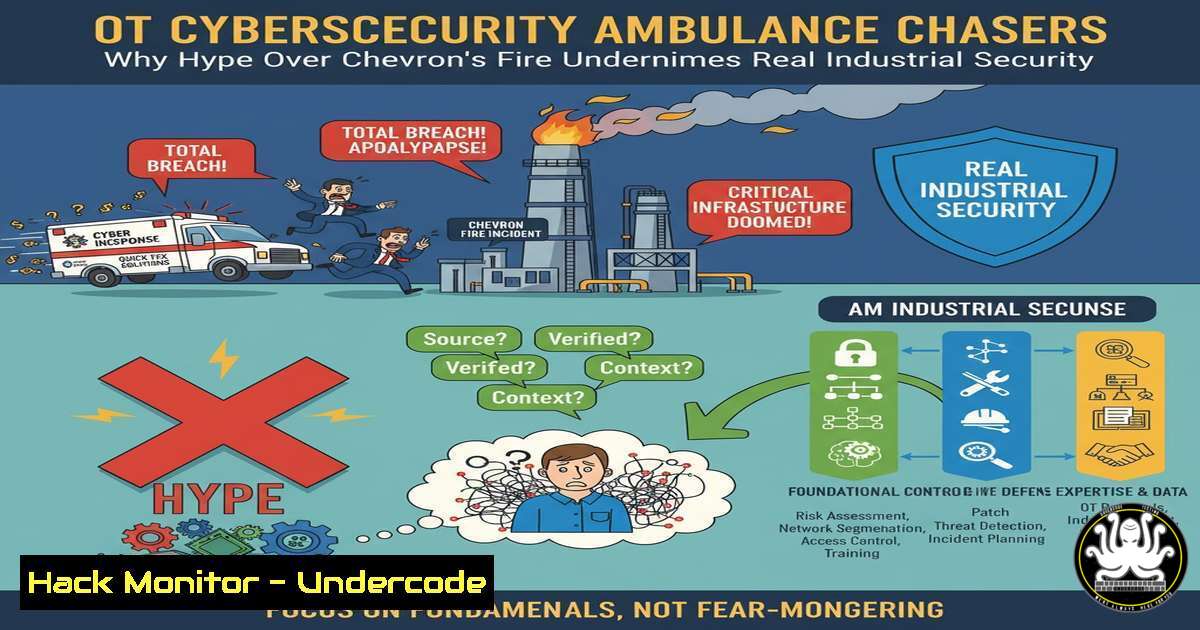
The recent fire at Chevron’s refinery ignited a parallel blaze across LinkedIn, with cybersecurity professionals hastily linking the physical incident to digital threats. This phenomenon highlights a critical issue in the Operational Technology (OT) security field: the premature attribution of industrial incidents to cyber causes, which risks eroding professional credibility and diverting attention from actual security fundamentals.
Learning Objectives:
- Understand the core technical controls necessary for genuine OT security implementation
- Master practical command-line and configuration techniques for industrial network protection
- Develop methodologies for accurate incident analysis without premature cyber attribution
You Should Know:
1. Network Segmentation Verification
 Linux: Check network interfaces and routing
ip addr show
ip route show
iptables -L -n -v

Windows: Verify network configuration
Get-NetIPAddress | Where-Object {$<em>.InterfaceAlias -eq "OT_Network"}
Get-NetFirewallRule | Where-Object {$</em>.Enabled -eq "True"}
Step-by-step guide: Proper network segmentation prevents lateral movement from IT to OT networks. Use these commands to verify interface configurations, routing tables, and firewall rules. The Linux commands display all network interfaces and active routing paths, while Windows PowerShell cmdlets specifically check IP assignments and firewall rules for OT segments. Regular verification ensures air gaps remain intact.
2. OT Asset Discovery and Inventory
 Nmap scan for OT protocols (use with extreme caution)
nmap -sU -p 44818,502,102,161 --script enip-info,modbus-discover <OT_subnet>

Passive monitoring with tcpdump
tcpdump -i eth0 -w ot_traffic.pcap port 502 or port 44818 or port 102
Step-by-step guide: Maintain accurate asset inventories using controlled network scanning. The Nmap command specifically targets common OT protocols (EtherNet/IP, Modbus, S7comm, SNMP) while the tcpdump command captures traffic for passive analysis. Always conduct these activities during maintenance windows with proper authorization to avoid disrupting critical processes.
3. Windows OT Host Hardening
 Disable unnecessary services
Get-Service | Where-Object {$_.DisplayName -like "Remote Registry"} | Stop-Service -Force
Set-Service -Name "Spooler" -StartupType Disabled

Configure audit policies
auditpol /set /category:"Object Access" /success:enable /failure:enable
Get-WinEvent -FilterHashtable @{LogName='Security'; StartTime=(Get-Date).AddHours(-24)}
Step-by-step guide: Harden Windows-based HMI and engineering stations by disabling non-essential services and enabling comprehensive auditing. The PowerShell commands stop high-risk services like Remote Registry and print spooler, while auditpol configures detailed logging for security monitoring.
4. Linux ICS Server Security
 Check for unnecessary network services
netstat -tulpn | grep LISTEN
systemctl list-unit-files | grep enabled

File integrity monitoring
apt install aide
aideinit
cp /var/lib/aide/aide.db.new /var/lib/aide/aide.db
aide --check
Step-by-step guide: Secure Linux-based SCADA and historian servers by identifying exposed network services and implementing file integrity monitoring. The netstat command reveals listening ports, while AIDE configuration detects unauthorized file changes that might indicate compromise.
5. PLC Access Control Configuration
 Python script to check ModTCP security (educational purposes)
import socket
def check_plc_access(ip, port=502):
try:
sock = socket.socket(socket.AF_INET, socket.SOCK_STREAM)
sock.settimeout(5)
sock.connect((ip, port))
print(f"PLC at {ip}:{port} accepts connections")
sock.close()
except Exception as e:
print(f"Connection failed: {e}")
Step-by-step guide: Programmable Logic Controllers often lack authentication. This Python script demonstrates how to check for open Modbus TCP ports. In production environments, ensure PLCs are behind firewalls with strict access control lists and consider industrial DMZ architectures.
6. Industrial Protocol Analysis
 Using Wireshark CLI for OT protocol inspection
tshark -i eth0 -f "port 502" -V -x -c 1000
tshark -r ot_capture.pcap -Y "modbus" -T fields -e modbus.func_code

SCADA protocol filtering
tshark -i eth0 -f "port 44818" -d udp.port==44818,enip
Step-by-step guide: Analyze industrial network traffic using Wireshark’s command-line interface. These commands capture and decode Modbus and EtherNet/IP communications, helping security teams understand normal traffic patterns and detect anomalies without affecting system performance.
7. OT Incident Response Commands
 Network isolation procedures
iptables -A INPUT -s <compromised_ip> -j DROP
iptables -A OUTPUT -d <malicious_ip> -j DROP

Process analysis on OT systems
ps aux | grep -E "(python|perl|wget|curl)"
netstat -anp | grep ESTABLISHED
lsof -i :502
Step-by-step guide: During potential security incidents, quickly isolate affected systems and investigate running processes. These Linux commands block malicious network traffic, identify suspicious processes, and check for unauthorized connections to PLC ports.
8. Secure Remote Access Configuration
 SSH jump server configuration
 /etc/ssh/sshd_config
PermitRootLogin no
PasswordAuthentication no
AllowUsers [email protected]/24
MaxAuthTries 3

VPN configuration audit
ipsec verify
systemctl status strongswan
Step-by-step guide: Secure remote access to OT networks requires hardened SSH configurations and properly configured VPNs. These settings disable root login and password authentication while restricting access to specific source networks, significantly reducing attack surface.
9. Backup and Recovery Procedures
 Windows SCADA backup script
wbadmin start backup -backupTarget:\backup_server\scada_backups -include:C:,D: -allCritical -quiet

Linux historian backup
tar -czf /backup/historian_$(date +%Y%m%d).tar.gz /var/lib/historian_data/
scp /backup/historian_.tar.gz backup_user@secure_storage:/ot_backups/
Step-by-step guide: Regular, tested backups are crucial for OT system resilience. These commands create system backups for Windows SCADA servers and Linux historian databases, ensuring quick recovery capability during incidents while maintaining data integrity.
10. Security Monitoring and Logging
 SIEM log forwarding configuration
 rsyslog.conf for OT devices
. @@192.168.100.100:514

Log analysis for anomalies
grep -i "failed|error|denied" /var/log/syslog | tail -20
journalctl --since "1 hour ago" | grep -i "authentication"
Step-by-step guide: Centralized logging and monitoring provide visibility into OT security events. Configure rsyslog to forward logs to a security information and event management system, then use grep and journalctl to investigate recent authentication failures and system errors.
What Undercode Say:
- Premature cyber attribution damages professional credibility and distracts from real security fundamentals
- Genuine OT security requires meticulous implementation of basic controls rather than speculative incident linking
- The field must prioritize technical substance over sensationalism to maintain stakeholder trust
The Chevron incident discussion reveals a troubling pattern in OT security discourse. While awareness of cyber-physical risks is valuable, the rush to connect unconfirmed incidents to cybersecurity threats ultimately undermines the profession’s credibility. Real security value comes from consistently implementing and verifying fundamental controls like network segmentation, asset management, and access control—not from speculative incident analysis. The industry’s focus should remain on measurable security improvements rather than leveraging physical incidents for cybersecurity advocacy without conclusive evidence.
Prediction:
The increasing frequency of industrial incidents will lead to more sophisticated forensic capabilities that can definitively determine cyber causation. Within two years, standardized investigation frameworks and specialized tools will emerge, reducing speculative attribution and shifting focus toward evidence-based security investments. This evolution will separate genuine security practitioners from opportunistic commentators, ultimately strengthening the OT security field through improved methodologies and credible incident analysis.
🎯Let’s Practice For Free:
IT/Security Reporter URL:
Reported By: Ralph Langner – Hackers Feeds
Extra Hub: Undercode MoN
Basic Verification: Pass ✅


