Listen to this Post
Introduction:
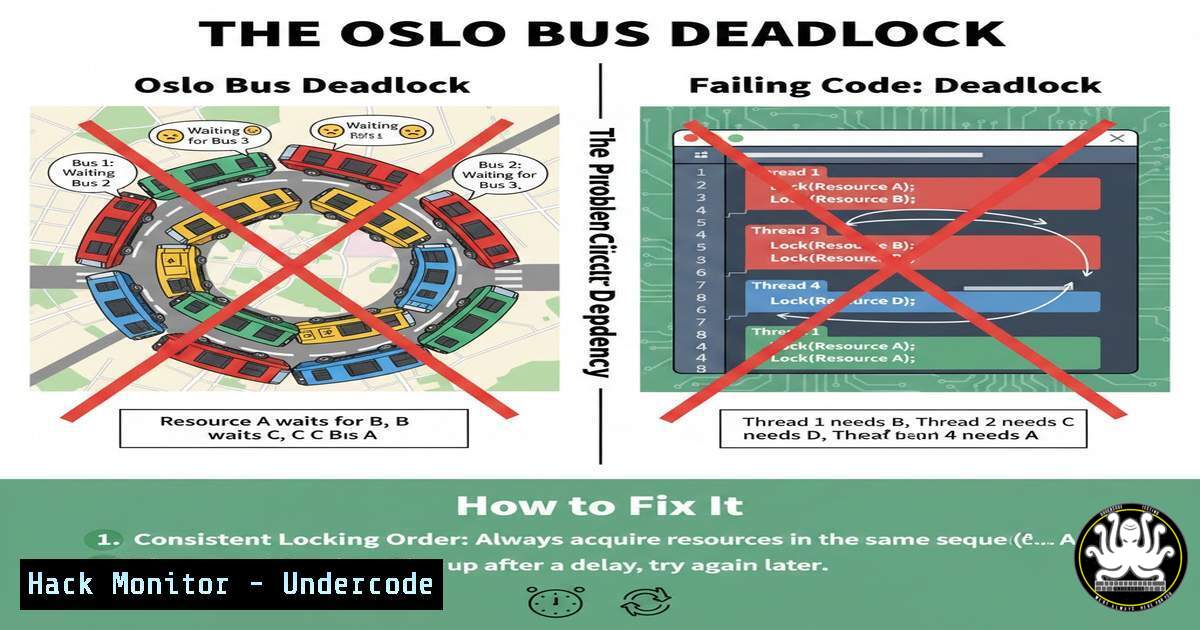
In a striking real-world analogy, a traffic roundabout in Oslo, Norway, became the stage for a perfect demonstration of a computational deadlock, mirroring the same conditions that can freeze critical enterprise applications. This incident, involving four buses locked in a circular wait, provides a tangible model for understanding one of the most pernicious problems in concurrent programming and systems design. By dissecting this event, developers and system architects can gain profound insights into preventing, detecting, and resolving deadlocks in their software.
Learning Objectives:
- Understand and identify the four Coffman conditions that must be present for a deadlock to occur.
- Learn practical commands and techniques to detect deadlocks in both Linux and Windows environments.
- Implement proven coding strategies and system design principles to prevent deadlocks from happening in the first place.
You Should Know:
- The Anatomy of a Deadlock: Coffman’s Conditions Explained
The Oslo bus incident is a textbook illustration of the four conditions defined by Edward G. Coffman in 1971. For a deadlock to occur, all four must be true simultaneously. Mutual Exclusion means each bus occupied a lane section that could not be shared. Hold and Wait describes how each bus held its current position while waiting for the next section to become free. No Preemption means traffic rules prevented one bus from forcibly taking another’s spot. Finally, Circular Wait created the endless loop: Bus 1 waited for Bus 2, which waited for Bus 3, which waited for Bus 4, which in turn waited for Bus 1. In software, this translates to threads holding locks on resources (e.g., database rows, file handles, mutexes) while waiting for other locks held by different threads in a circular chain.
2. Detecting Deadlocks in Your Running Systems
Before you can fix a deadlock, you must detect it. Systems often don’t crash; they just become unresponsive. Here’s how to diagnose them.
On Linux using the CLI:
For Java applications, the `jstack` tool is your first line of defense. It prints a snapshot of the JVM’s thread states, revealing which threads are blocked on which locks.
 Find the Java process ID
jps -l
 Take a thread dump
jstack -l <pid> > thread_dump.txt
Analyze the `thread_dump.txt` file. Look for threads with a state of `BLOCKED` and examine the lock ownership chain to identify cycles.
On Windows using Process Explorer:
For native Windows applications, use the powerful Sysinternals suite.
1. Download and run `Process Explorer` as Administrator.
- Find your process, right-click it, and select “Create Dump” -> “Create Full Dump”.
- Analyze the dump file with a debugger like WinDbg to examine thread stacks and critical sections.
3. The Programmer’s Arsenal: Prevention Through Resource Ordering
The most effective way to prevent deadlocks is to break the Circular Wait condition. This is reliably achieved by imposing a total ordering on all resources. If every thread in the system always requests locks in the same predefined global order, a circular wait becomes impossible.
Example in Java:
Imagine two bank account transfer methods that can cause a deadlock if Thread A transfers from Acc1 to Acc2 while Thread B transfers from Acc2 to Acc1 simultaneously. The solution is to always lock the account with the lower ID first.
public void deadlockProneTransfer(Account from, Account to, BigDecimal amount) {
synchronized(from) {
synchronized(to) { // DANGER: Potential circular wait
from.debit(amount);
to.credit(amount);
}
}
}

public void safeTransfer(Account from, Account to, BigDecimal amount) {
// Define resource order: lock account with lower ID first.
Object firstLock = from.getId() < to.getId() ? from : to;
Object secondLock = from.getId() < to.getId() ? to : from;

synchronized(firstLock) {
synchronized(secondLock) {
from.debit(amount);
to.credit(amount);
}
}
}
- Leveraging Timeouts and Deadlock Detection at the Database Level
Sometimes, avoiding a circular wait is impractical. In such cases, using try-lock with timeouts allows a thread to back off and retry, breaking the Hold and Wait condition. Modern databases also have built-in deadlock detectors.
Using `tryLock` in Java:
import java.util.concurrent.locks.Lock;
import java.util.concurrent.locks.ReentrantLock;

Lock lock1 = new ReentrantLock();
Lock lock2 = new ReentrantLock();

if (lock1.tryLock(1, TimeUnit.SECONDS)) {
try {
if (lock2.tryLock(1, TimeUnit.SECONDS)) {
try {
// ... critical section
} finally {
lock2.unlock();
}
}
} finally {
lock1.unlock();
}
} else {
// Log warning and retry or abort
}
Database Deadlock Monitoring (PostgreSQL example):
Query the `pg_stat_activity` and `pg_locks` views to identify blocking processes.
SELECT bl.pid AS blocked_pid,
ka.query AS blocking_statement,
kl.pid AS blocking_pid,
ka.query AS current_statement_in_blocking_process
FROM pg_catalog.pg_locks bl
JOIN pg_catalog.pg_stat_activity a ON a.pid = bl.pid
JOIN pg_catalog.pg_locks kl ON kl.transactionid = bl.transactionid AND kl.pid != bl.pid
JOIN pg_catalog.pg_stat_activity ka ON ka.pid = kl.pid
WHERE NOT bl.granted;
5. System Design and The Trade-Offs of Mitigation
Complete deadlock avoidance can sometimes come at the cost of performance or concurrency. Understanding the trade-offs is key. Techniques like lock timeouts introduce latency through retries. Database deadlock killers sacrifice one transaction to save others. In distributed systems, protocols like Chandy-Misra-Haas add communication overhead. The choice depends on your system’s tolerance for latency vs. its requirement for absolute consistency. Designing with idempotent operations, for instance, means you can safely retry a transaction that was aborted by a deadlock, making mitigation a more viable strategy.
What Undercode Say:
- Prevention is Paramount. While detection tools are crucial, the most robust systems are architected to make deadlocks impossible through strict resource ordering and design patterns that avoid circular waits from the outset.
- Embrace Defensive Programming. Assume concurrency issues will arise. Use try-lock with timeouts, idempotent operations, and circuit breakers to ensure that when a deadlock occurs, the system can self-heal with minimal impact on the end-user.
The Oslo bus deadlock is more than a clever anecdote; it’s a powerful reminder that abstract computer science principles have concrete, real-world consequences. Just as traffic engineers design roundabouts and rules to minimize gridlock, software engineers must design their systems with concurrency hazards in mind. The 20-minute resolution time in Oslo is a best-case scenario for a physical deadlock; in a digital system, a deadlock could go undetected for much longer, causing significant financial and reputational damage. By internalizing the lessons from this event, developers can build more resilient, predictable, and efficient software.
Prediction:
As systems continue to evolve towards greater complexity with microservices, distributed data, and asynchronous event-driven architectures, the nature of deadlocks will also transform. We will see a rise in distributed deadlocks, where the circular wait involves resources across multiple services and databases. This will make detection and diagnosis exponentially harder. Future mitigation will rely heavily on AI-driven observability platforms that can correlate events across service boundaries to automatically identify and visualize dependency cycles before they cause full-blown outages, pushing us from reactive debugging to proactive system orchestration.
🎯Let’s Practice For Free:
IT/Security Reporter URL:
Reported By: Dmakariev Deadlock – Hackers Feeds
Extra Hub: Undercode MoN
Basic Verification: Pass ✅


