
Listen to this Post
Introduction:
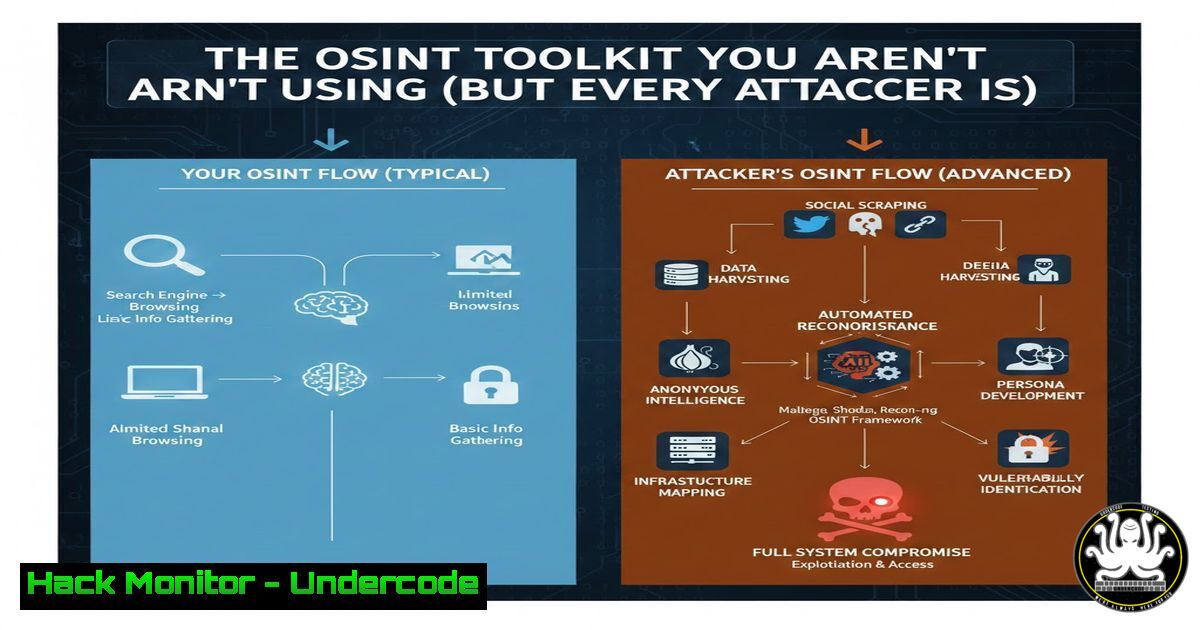
In the modern threat landscape, offensive security begins not with a zero-day exploit, but with publicly available information. Open-Source Intelligence (OSINT) is the foundational phase of both penetration testing and real-world attacks, enabling threat actors to map digital footprints, identify vulnerabilities, and craft highly targeted campaigns. This guide delves into the professional OSINT toolkit and methodology, transitioning from passive reconnaissance to active system exploitation, demonstrating how defenders must think like attackers to build effective barriers.
Learning Objectives:
- Understand and execute a multi-layered OSINT reconnaissance workflow using essential command-line and web-based tools.
- Identify and extract critical data points (emails, subdomains, credentials, technologies) that attackers leverage for initial access.
- Translate gathered intelligence into actionable exploitation steps, such as credential stuffing and targeted phishing, and learn the corresponding mitigation strategies.
You Should Know:
1. The Reconnaissance Foundation: Harvesting Digital Footprints
Before a single packet is sent maliciously, attackers profile their target. This involves systematically collecting data from public sources.
Step-by-step guide:
- Subdomain Enumeration: Use `theHarvester` and `subfinder` to discover target scopes.
Linux/macOS
theHarvester -d example.com -b all -f report_initial
subfinder -d example.com -o subdomains.txt
- DNS Intelligence: Query DNS records for infrastructure clues using
dig.dig ANY example.com @8.8.8.8 dig MX example.com
- Email & People Discovery: Tools like `h8mail` can hunt for breached emails and passwords related to the target domain.
h8mail -t [email protected] -bc path/to/breach_compilation/
2. Advanced Web & GitHub Reconnaissance
Public code repositories and web technologies leak secrets like API keys, internal paths, and credentials.
Step-by-step guide:
- Technology Stack Identification: Use `Wappalyzer` (browser extension) or `whatweb` to fingerprint technologies.
whatweb -a 3 https://example.com
- GitHub Dorking: Use advanced search operators on GitHub to find sensitive data accidentally committed.
Search: `org:example.com password`
Search: `filename:.env example.com`
Search: `”api_key” AND “example.com”`
- S3 Bucket & Public Cloud Discovery: Use tools like `s3scanner` or `cloud_enum` to find misconfigured public cloud storage.
python3 cloud_enum.py -k example -k examplecorp
-
From Data to Credentials: Breach Analysis and Credential Stuffing
Compiled email lists are checked against known breach corpora to find password re-use.
Step-by-step guide:
- Cross-Reference with Breach Databases: Use APIs from HaveIBeenPwned or deploy a local tool like
DeHashed. - Credential Stuffing Attack Simulation: For authorized testing only. Use a tool like `Hydra` or `Medusa` to test for password re-use across services.
hydra -L users.txt -P passwords.txt ssh://192.168.1.100
-
Mitigation Command (Defender): Enforce Multi-Factor Authentication (MFA) and monitor for failed login bursts.
Windows: Audit Account Logon Events via Group Policy
Enable "Audit Logon Events" for Success and Failure.
-
Network Mapping from the Outside: Passive & Active Scanning
With identified subdomains and IPs, attackers map the network perimeter.
Step-by-step guide:
- Passive Port Mapping: Use services like `shodan.io` to see open ports historically associated with an IP.
- Active Scanning (Stealth): Use `nmap` with timing and decoy options for initial scanning.
nmap -sS -T2 -D RND:10 --source-port 53 -p 1-1024 -oA initial_scan target.ip
- Service & Banner Grabbing: Identify versions of running services.
nc -nv target.ip 22
curl -I http://target.ip
5. Vulnerability Correlation and Weaponization
The final stage links gathered data (e.g., software version from banner grabbing) to known exploits.
Step-by-step guide:
- Vulnerability Research: Cross-reference technologies and versions with databases like Exploit-DB, NVD, or
searchsploit.searchsploit "Apache 2.4.49"
- Proof-of-Concept (PoC) Testing: In a controlled lab environment, test relevant exploits.
- Mitigation Command (Defender): Automated patching is critical. On Linux, ensure timely updates.
sudo apt update && sudo apt upgrade -y  Debian/Ubuntu
sudo yum update -y  RHEL/CentOS
- Web Application Firewall (WAF) Rule Example (Mitigation): A basic rule to block excessive scanning in Apache
.htaccess:Block common scanning user agents RewriteCond %{HTTP_USER_AGENT} (nikto|sqlmap|w3af|nessus) [bash] RewriteRule ^ - [F,L]
What Undercode Say:
- The Attack Chain is Linear and Predictable: A successful breach is rarely a single event but a chain of successes through the OSINT->Initial Access->Exploitation pipeline. Breaking any link defeats the attack.
- Defense Requires Mirroring Offense: The most effective defense teams proactively run the same OSINT and scanning tools against their own assets to discover and remediate leaks before adversaries do.
Prediction:
The future of OSINT-driven attacks lies in AI-powered correlation and automation. Machine learning models will soon automatically sift through terabytes of public data (Git commits, social posts, breach dumps, satellite imagery) to identify high-value targets, predict system vulnerabilities, and generate hyper-personalized phishing lures at scale. This will make the initial reconnaissance phase faster, more accurate, and more evasive, drastically shortening the time between target identification and system compromise. Defensive AI will be required to match this pace, autonomously detecting and patching information leaks and misconfigurations in real-time.
▶️ Related Video (74% Match):
🎯Let’s Practice For Free:
IT/Security Reporter URL:
Reported By: Michel Wadangoye – Hackers Feeds
Extra Hub: Undercode MoN
Basic Verification: Pass ✅


