
Listen to this Post
Introduction:
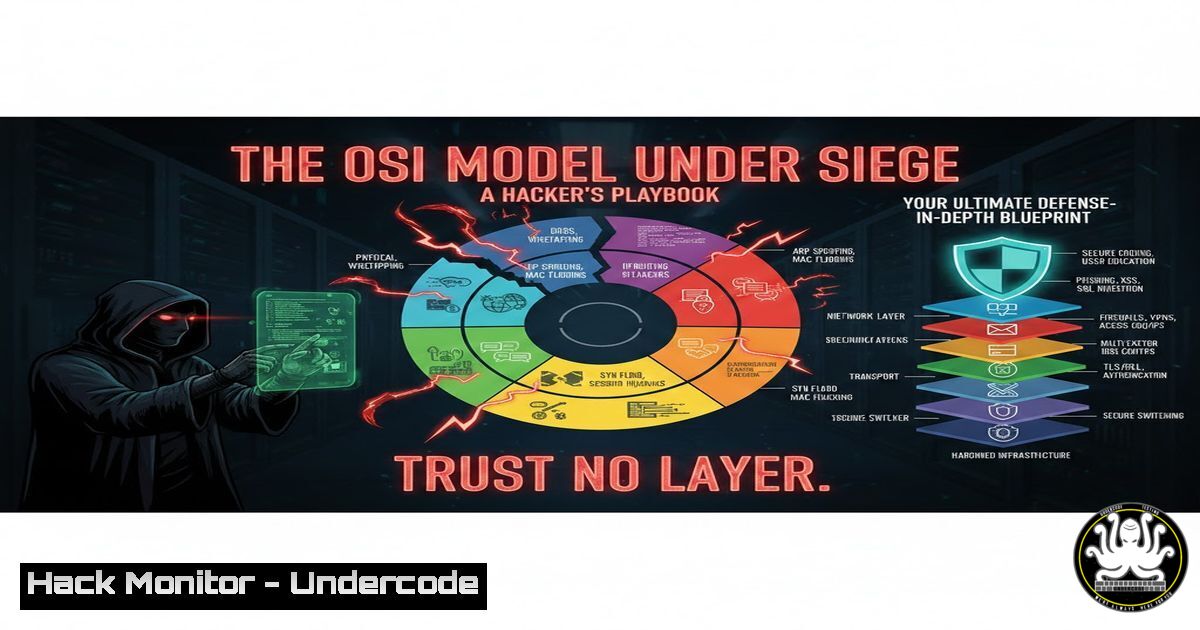
The classic OSI model, a foundational concept for network communication, is also a perfect map for threat actors. Modern cyber attacks are a multi-layered assault, exploiting vulnerabilities at every level of the technological stack, from the physical cable to the user-facing application. This article deconstructs these attacks layer by layer, moving beyond theory to provide actionable commands, configurations, and step-by-step guides to build a resilient, defense-in-depth security posture that can withstand coordinated threats.
Learning Objectives:
- Understand the specific attack vectors and real-world exploits associated with each of the seven OSI layers.
- Implement verified technical controls, using commands and configurations for Linux and Windows systems, to harden each layer.
- Develop a holistic security strategy that integrates technical controls with governance (Layer 8) to create a true defense-in-depth architecture.
You Should Know:
- The Application & Presentation Layers: Code Injection and Input Sanitization
The Application Layer (7) and Presentation Layer (6) are where users interact with data. Attacks here, like SQL Injection (SQLi) and Cross-Site Scripting (XSS), exploit poor input validation and insecure serialization.
Step-by-step guide:
The Attack (Demonstration): A simple SQLi attack on a vulnerable login form. The attacker inputs `’ OR ‘1’=’1` into the username field. If unsanitized, the backend SQL query might become: SELECT FROM users WHERE username = '' OR '1'='1' AND password = '...', bypassing authentication because `’1’=’1’` is always true.
The Mitigation – Input Validation & Prepared Statements:
Never concatenate user input directly into queries. Use parameterized queries or prepared statements.
Example (Python with SQLite):
 VULNERABLE
query = "SELECT  FROM users WHERE username = '" + user_input + "'"
cursor.execute(query)

SECURE - USING PARAMETERIZED QUERY
query = "SELECT  FROM users WHERE username = ?"
cursor.execute(query, (user_input,))
For web outputs (preventing XSS), always sanitize data. Use context-aware encoding (HTML, JavaScript, URL). Libraries like OWASP’s Java Encoder or Python’s `html` module are essential.
- The Session Layer: Hijacking and Securing Session Tokens
The Session Layer (5) manages dialogues between systems. Attackers target session tokens stored in cookies or URLs to impersonate valid users.
Step-by-step guide:
The Attack: Session hijacking via stolen cookie. Using a tool like `Burp Suite` or even browser dev tools, an attacker on the same network (or via XSS) can capture a session cookie and inject it into their own browser to gain unauthorized access.
The Mitigation – Hardening Session Management:
Use Secure & HttpOnly Cookie Flags: This prevents cookies from being accessed via JavaScript (HttpOnly) and ensures they are only sent over HTTPS (Secure).
Set Short Session Timeouts: Implement absolute and idle session timeouts.
Implement Session Rotation: Regenerate the session ID after login and privilege escalation. Example (PHP):
session_start();
// Regenerate session ID to prevent fixation
session_regenerate_id(true);
Enforce HTTPS everywhere using HSTS headers.
3. The Transport Layer: DDoS and Encryption Attacks
The Transport Layer (4) provides host-to-host communication via TCP/UDP. Attacks like SYN floods aim to exhaust resources, while weaknesses in TLS/SSL can lead to data interception.
Step-by-step guide:
The Attack – SYN Flood: A classic DDoS attack where the attacker sends a barrage of TCP SYN packets but never completes the handshake, filling the target’s connection queue.
The Mitigation – System Hardening & DDoS Protection:
Linux System Hardening: Tune kernel parameters to resist floods.
 Increase the queue size and enable SYN cookies
sysctl -w net.ipv4.tcp_max_syn_backlog=4096
sysctl -w net.ipv4.tcp_syncookies=1
sysctl -w net.ipv4.tcp_synack_retries=2
Use Cloud-Based DDoS Protection: Services like AWS Shield, Cloudflare, or Akamai absorb and scrub attack traffic before it reaches your origin server.
Harden TLS/SSL: Disable old protocols (SSLv2/3, TLS 1.0/1.1) and weak cipher suites. Use tools like `testssl.sh` or Qualys SSL Labs to audit your configuration.
4. The Network Layer: Spoofing and Filtering
The Network Layer (3) handles routing and IP addressing. IP spoofing and DoS attacks here can bypass simple filters and disrupt routing.
Step-by-step guide:
The Attack – IP Spoofing: An attacker forges the source IP address of a packet to bypass IP-based access controls or launch reflective amplification attacks.
The Mitigation – Anti-Spoofing & Firewall Rules:
Enable Anti-Spoofing on Routers/Firewalls: Configure to reject packets from outside your network claiming to have a source IP from inside your network (RFC 3704/BCP 38).
Linux Example using `iptables`:
 Drop packets from the outside claiming to be from our internal network (e.g., 192.168.1.0/24)
iptables -A INPUT -i eth0 -s 192.168.1.0/24 -j DROP
Implement Robust Ingress/Egress Filtering on all perimeter devices.
5. The Data Link Layer: Internal Network Poisoning
The Data Link Layer (2) deals with MAC addresses and switching. Attacks like ARP spoofing allow an attacker on a local network to intercept traffic.
Step-by-step guide:
The Attack – ARP Spoofing/Poisoning: Using a tool like `arpspoof` (from the `dsniff` suite), an attacker sends forged ARP replies, tricking the switch into sending victim traffic to the attacker’s machine.
 Attacker command to poison the gateway (192.168.1.1) and victim (192.168.1.100)
arpspoof -i eth0 -t 192.168.1.100 192.168.1.1
arpspoof -i eth0 -t 192.168.1.1 192.168.1.100
The Mitigation – Switch Security Features:
Enable DHCP Snooping: This builds a trusted database of MAC-IP bindings, preventing rogue DHCP servers.
Enable Dynamic ARP Inspection (DAI): DAI uses the DHCP Snooping database to validate ARP packets and block spoofed ones.
Implement Port Security: Restrict which MAC addresses can communicate on a given switch port.
- The Physical Layer: The First and Last Line of Defense
The Physical Layer (1) includes cables, ports, and hardware. A breach here bypasses all digital security.
Step-by-step guide:
The Attack: An intruder plugs a rogue access point or laptop into an unused wall port, gaining direct network access.
The Mitigation – Physical Access Controls:
Disable Unused Ports: On all network switches, administratively disable ports that are not explicitly assigned.
 Cisco IOS Example
configure terminal
interface range GigabitEthernet0/10-24
shutdown
Implement 802.1X Network Access Control (NAC): Requires devices to authenticate before being granted network access, even if physically connected.
Maintain Physical Security: Controlled access to server rooms, network closets, and use of locking port enclosures.
7. Layer 8: The Human and Governance Layer
This unofficial layer encompasses people, processes, and policy. It is the most exploited attack surface, involving social engineering, misconfigurations, and poor governance.
Step-by-step guide:
The Attack: A phishing email (targeting people) leads to stolen credentials. A cloud storage bucket is left publicly accessible due to a misconfiguration (process failure).
The Mitigation – Security Governance:
Implement Regular Security Awareness Training with simulated phishing.
Enforce Least Privilege & Role-Based Access Control (RBAC) across all systems.
Establish a Change Management and Configuration Governance Process. Use Infrastructure as Code (IaC) with security scanning (e.g., `checkov` for Terraform) to prevent drift and misconfigurations.
Conduct Continuous Audits: Use scripts to audit configurations against benchmarks (CIS).
 Example: Check for non-root users with UID 0 (Linux)
awk -F: '($3 == 0) {print $1}' /etc/passwd
What Undercode Say:
- Holistic Defense is Non-Negotiable. Securing only the application or network layer creates critical blind spots. A resilient security program must have documented, implemented, and tested controls at every single layer, from physical port security to user awareness training.
- Automate and Validate. Manual security checks fail at scale. The future of defense-in-depth lies in automated compliance checks (IaC scanning, CIS benchmark automation), continuous vulnerability assessment, and simulated attack exercises like breach and attack simulation (BAS) to validate controls across all layers.
Analysis: The post correctly frames the OSI model as an attack map, but the real-world implementation requires translating high-level “fixes” into specific, executable actions. The integration of Layer 8 is critical; the most sophisticated technical controls are undone by a single misconfigured S3 bucket or a successful phishing campaign. Therefore, modern cybersecurity must be a symbiotic discipline: automated technical hardening governed by robust, living policies and informed by continuous human education. The goal is not to make a system impenetrable—an impossibility—but to raise the cost and complexity of an attack to a level that defeats the adversary’s ROI.
Prediction:
The future of multi-layered attacks will see increased automation and AI-driven exploitation, where adversaries simultaneously probe for weaknesses across multiple OSI layers, choosing the path of least resistance in real-time. Defense will shift from static, layered configuration to dynamic, intelligent security meshes. These systems will use AI and telemetry from endpoints, networks, and cloud services to correlate events across all layers, automatically isolating compromised segments, rotating credentials, and applying micro-perimeter controls before a human analyst is even alerted. The concept of defense-in-depth will evolve from a static, tiered model to an adaptive, self-healing immune system for the digital enterprise.
▶️ Related Video (82% Match):
🎯Let’s Practice For Free:
IT/Security Reporter URL:
Reported By: Shameer Sharief – Hackers Feeds
Extra Hub: Undercode MoN
Basic Verification: Pass ✅


