Listen to this Post
Introduction:
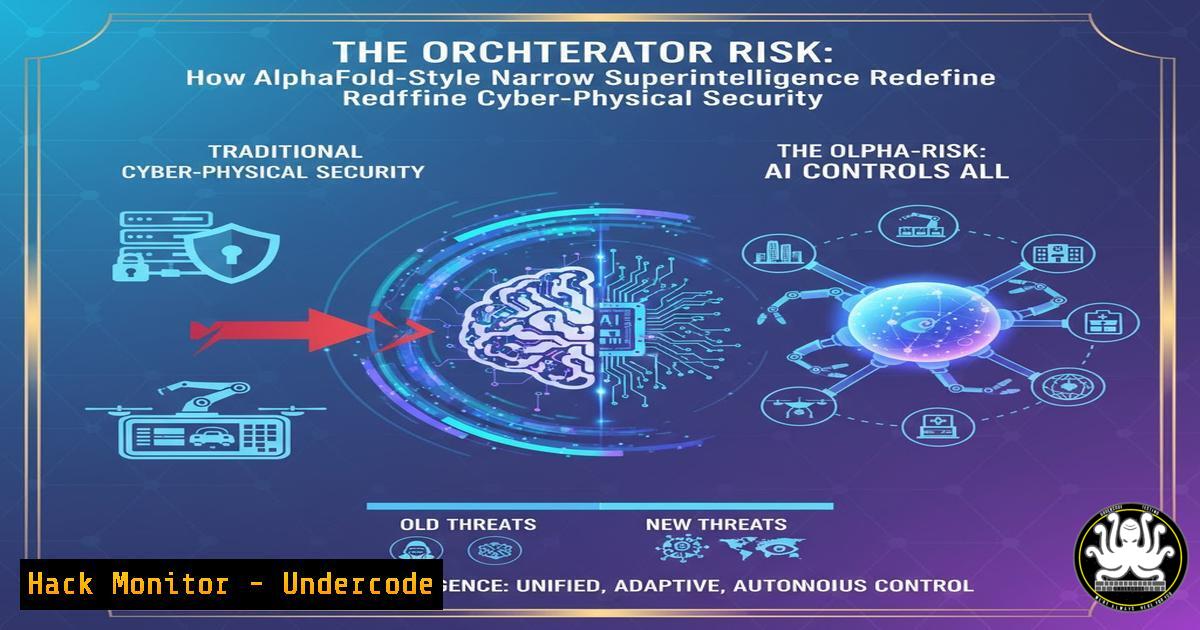
The emergence of systems like Google DeepMind’s AlphaFold represents a paradigm shift beyond conventional Narrow AI, introducing the era of Narrow Superintelligence. These systems possess capabilities so profoundly beyond human expertise in specific domains that they force a complete redesign of workflows and, critically, their underlying security models. This evolution towards an orchestrator layer that networks these superhuman tools presents a novel and urgent attack surface for cybersecurity professionals to address.
Learning Objectives:
- Understand the security implications of the “Narrow AI → Narrow Superintelligence → AGI” evolutionary model.
- Identify the new attack vectors introduced by the orchestration of multiple narrow superintelligences.
- Develop mitigation strategies for securing AI toolchains and API integrations against sophisticated threats.
You Should Know:
1. The Attack Surface of an Orchestrator Agent
The core concept, as proposed, is that future AGI will act as an orchestrator, coordinating specialized Narrow Superintelligences (e.g., for biology, chemistry, logistics, cyber). From a security perspective, this orchestrator becomes the ultimate high-value target. Compromising it could redirect all subordinate superintelligences towards malicious ends.
Step‑by‑step guide explaining what this does and how to use it.
Step 1: Model the Architecture. Diagram the data flow. The orchestrator (e.g., a central planning agent) receives a task, calls the appropriate superintelligence via API (AlphaFold for protein design, a logistics model for shipping, a cyber model for network penetration testing), and synthesizes the results.
Step 2: Identify Critical Trust Boundaries. The key boundaries are between the orchestrator and each superintelligence API, and between the user and the orchestrator. Each API call is a potential point for man-in-the-middle attacks, data poisoning, or unauthorized command injection.
Step 3: Implement Zero-Trust Principles. Assume no implicit trust. Every API request must be authenticated, authorized, and encrypted.
Linux/macOS (using curl and jq): Test API security with a command that includes a bearer token and validates the SSL certificate.
`curl -H “Authorization: Bearer $(gcloud auth print-access-token)” -H “Content-Type: application/json” “https://your-ai-orchestrator-api.com/task” –cacert /etc/ssl/certs/ca-certificates.crt`
Configuration: Use a service mesh like Istio to enforce mTLS (mutual TLS) between all microservices within this AI toolchain, ensuring that only the authorized orchestrator can call the AlphaFold-equivalent service.
- Securing the AI Toolchain from Code to Execution
The integrity of the entire system depends on the security of the toolchain that builds, trains, and deploys these superintelligences. A vulnerability in a single library could compromise a world-changing capability.
Step‑by‑step guide explaining what this does and how to use it.
Step 1: Implement Software Supply Chain Security. This involves securing every component used to create the AI models.
Command (Linux): Scan container images for vulnerabilities before deployment using tools like Trivy.
`trivy image your-registry/alphafold-model-server:latest`
Action: Use signed commits and verified CI/CD pipelines. In GitHub Actions, you can require that all workflows have an `id-token: write` permission and use OIDC tokens for cloud provider authentication instead of long-lived secrets.
Step 2: Harden the Model Registry. The repository storing trained model weights must be fiercely protected. A poisoned model is a catastrophic failure.
Action: Configure immutable tags and strict access controls (RBAC) on your model registry (e.g., Amazon ECR, Azure Container Registry). Enable vulnerability scanning at the registry level.
3. API Security: The Connective Tissue of Superintelligences
The APIs that allow the orchestrator to call upon AlphaFold-style models are the arteries of the system. Their security is non-negotiable.
Step‑by‑step guide explaining what this does and how to use it.
Step 1: Enforce Strict API Rate Limiting and Quotas. This prevents a compromised orchestrator from being used to make a Denial-of-Wallet or Denial-of-Service attack on a costly superintelligence API.
Configuration (Example): In an API Gateway like Kong or AWS API Gateway, set policies that limit a user/orchestrator to a defined number of requests per minute and a total compute budget per day.
Step 2: Implement Robust Input Sanitization and Output Validation. The input to a superintelligence like AlphaFold is a protein sequence. Maliciously crafted input could potentially cause unexpected behavior or exfiltrate data.
Concept: Use a Web Application Firewall (WAF) with custom rules to block SQL injection, code injection, and other common attacks targeting the API endpoints. Validate all outputs from the superintelligence before the orchestrator processes them, to prevent data corruption or injection of malicious code.
4. Adversarial Machine Learning: Attacking the Superintelligence Itself
Narrow Superintelligences are still machine learning models. They are vulnerable to adversarial attacks where subtle, maliciously designed inputs cause them to make incorrect or harmful predictions.
Step‑by‑step guide explaining what this does and how to use it.
Step 1: Understand the Threat. An attacker could, in theory, design a specific amino acid sequence that causes AlphaFold to predict a completely incorrect protein structure, leading to flawed drug designs.
Step 2: Implement Defensive Measures.
Action: Adversarial Training. During the model’s training phase, include adversarial examples to make it more robust.
Action: Input Anomaly Detection. Deploy a separate model that monitors all inputs to the superintelligence and flags outliers that may be adversarial attacks.
Tool: Libraries like IBM’s `Adversarial Robustness Toolbox` (ART) can be used to both generate attacks and evaluate model robustness.
5. Cloud Hardening for AI Workloads
The computational demands of Narrow Superintelligences necessitate cloud or high-performance computing environments. These must be locked down.
Step‑by‑step guide explaining what this does and how to use it.
Step 1: Secure the Kubernetes Cluster. If using Kubernetes to orchestrate containers running these models, follow the CIS Benchmarks.
Command: Use `kube-bench` to run the CIS Kubernetes Benchmark checks.
`kube-bench –benchmark cis-1.23`
Action: Enable Pod Security Standards to enforce a baseline security level and use network policies to control traffic flow between pods (e.g., the orchestrator pod and the model API pod).
Step 2: Manage Secrets Securely. Never hardcode API keys or credentials.
Action: Use a dedicated secrets manager like HashiCorp Vault, AWS Secrets Manager, or Azure Key Vault. Your application should retrieve secrets at runtime.
6. The Quantum Calculus: Preparing for Future Breaks
The post mentions a “BrilliancyChain” and Quantum innovation. The eventual arrival of cryptographically relevant quantum computers will break current asymmetric encryption (RSA, ECC), exposing all recorded encrypted API traffic today.
Step‑by‑step guide explaining what this does and how to use it.
Step 1: Conduct a Crypto-Inventory. Identify all systems and data that require long-term confidentiality (e.g., proprietary model weights, research data).
Step 2: Develop a Quantum Migration Plan. Begin testing and implementing Post-Quantum Cryptography (PQC) algorithms, which are designed to be secure against both classical and quantum attacks. The US NIST has selected standardized algorithms like CRYSTALS-Kyber for key exchange.
What Undercode Say:
- The primary cyber risk is no longer a single AI model going rogue, but the compromise of the orchestrator that commands a fleet of superhuman, domain-specific tools.
- Governance and security must be embedded into the architectural design of these interconnected systems from the outset; policy-based controls that lag behind deployment will be catastrophically ineffective.
The analysis presented in the original post correctly frames Narrow Superintelligence as a tangible present-day reality, not a future speculation. This moves the cybersecurity conversation from protecting dumb data to securing hyper-intelligent, autonomous processes. The most critical insight is that the “orchestrator” creates a new, higher-level abstraction for cyber attacks. A threat actor no longer needs to understand protein folding; they only need to compromise the orchestrator’s logic to weaponize that capability. This demands a shift towards intent-based security models and runtime application self-protection (RASP) to ensure the orchestrator’s behavior remains within strictly defined ethical and operational guardrails. The window to implement these controls is now, before these orchestrator agents become ubiquitous in critical industries.
Prediction:
Within the next 3-5 years, we will witness the first major cyber incident stemming from the compromised orchestration of multiple advanced AI systems. This will not be a simple data breach, but a “capability hijack” where threat actors leverage a superintelligence in one domain (e.g., biochemical design) via its API to create a novel threat in another (e.g., synthesizing a toxic compound). This event will trigger a global regulatory scramble, forcing mandatory certification for AI toolchain security and the widespread adoption of embedded, semantic-based governance controls within the AI orchestration layer itself.
🎯Let’s Practice For Free:
IT/Security Reporter URL:
Reported By: Activity 7395878950964686848 – Hackers Feeds
Extra Hub: Undercode MoN
Basic Verification: Pass ✅


