Listen to this Post
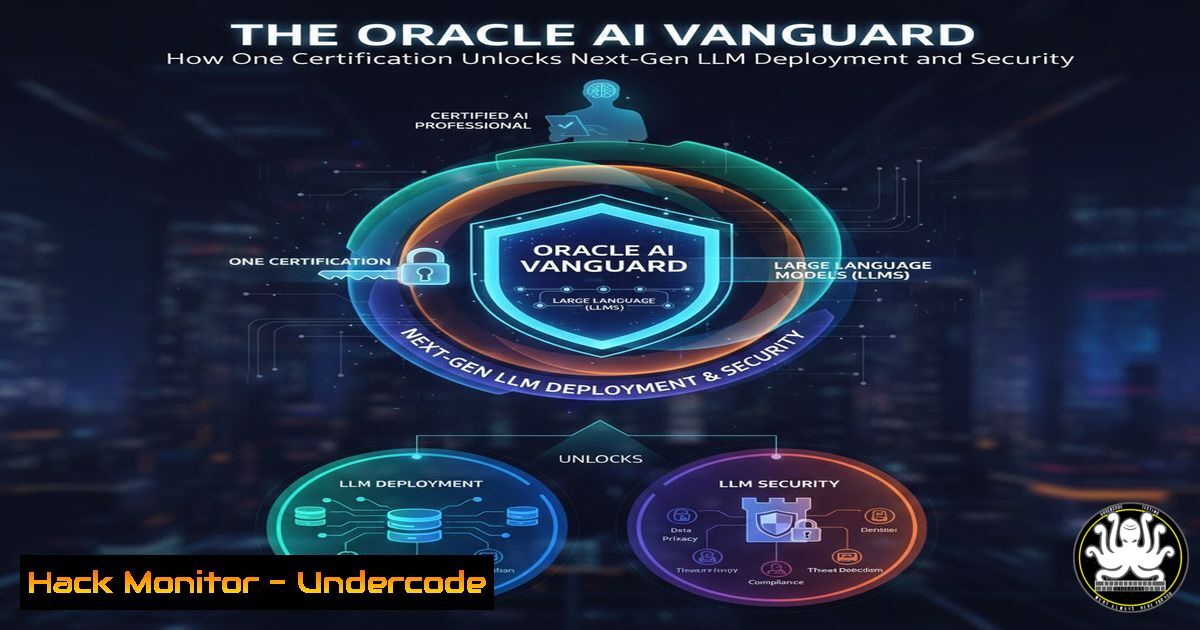
Introduction:
The rapid enterprise adoption of generative AI necessitates a new breed of cybersecurity and IT professionals who can securely deploy and manage Large Language Models. Achieving the Oracle Cloud Infrastructure Certified Generative AI Professional certification represents a critical step in mastering the full stack of modern AI, from model architecture to secure, production-ready deployment on robust cloud infrastructure.
Learning Objectives:
- Architect and deploy secure Large Language Model applications using OCI’s AI services.
- Implement Retrieval-Augmented Generation (RAG) with vector databases to enhance AI accuracy and security.
- Orchestrate, trace, and evaluate end-to-end LLM workflows for optimal performance and governance.
You Should Know:
1. Foundations of OCI Generative AI Service
The OCI Generative AI service is a fully-managed platform that abstracts the underlying infrastructure complexity, allowing developers and architects to focus on building applications. From a security perspective, using a managed service offloads the burden of model patching and infrastructure hardening to Oracle, which inherently incorporates enterprise-grade security controls. The first step is to authenticate and interact with the service via the OCI CLI or SDK.
Step-by-Step Guide:
Step 1: Install and Configure OCI CLI
Ensure the OCI CLI is installed on your machine. Authentication is key here, using a configuration file and API keys.
 Install OCI CLI (Example for Linux)
bash -c "$(curl -L https://raw.githubusercontent.com/oracle/oci-cli/master/scripts/install/install.sh)"
 Configure your CLI profile
oci setup config
You will need your User OCID, Tenancy OCID, region, and the path to your API private key.
Step 2: Generate a Text Completion
Using the Python SDK, you can quickly test the service. This verifies your setup and connectivity.
import oci

Create a service client with default config (uses the ~/.oci/config file)
generative_ai_client = oci.generative_ai.GenerativeAiClient(config={}, service_endpoint="https://inference.generativeai.us-chicago-1.oci.oraclecloud.com")

Prepare the request
generate_text_detail = oci.generative_ai.models.GenerateTextDetails(
serving_mode=oci.generative_ai.models.OnDemandServingMode(
model_id="cohere.command"
),
prompt="Explain the concept of RAG in two sentences.",
max_tokens=100
)

Send the request
response = generative_ai_client.generate_text(generate_text_detail)
print(response.data.generated_texts[bash].text)
2. Building a Secure RAG Pipeline with OCI
Retrieval-Augmented Generation (RAG) is paramount for grounding LLMs in factual, proprietary data, thereby reducing hallucinations and improving security by controlling the knowledge source. A RAG system involves chunking documents, converting them into vector embeddings, storing them in a vector database, and retrieving the most relevant chunks at inference time.
Step-by-Step Guide:
Step 1: Chunk Documents
Use a library like LangChain to split your source documents (e.g., PDFs, internal wikis) into manageable chunks.
from langchain.text_splitter import RecursiveCharacterTextSplitter

text_splitter = RecursiveCharacterTextSplitter(
chunk_size=1000,
chunk_overlap=200
)
documents = text_splitter.split_documents(your_loaded_documents)
Step 2: Generate and Store Embeddings in OCI
OCI Generative AI can produce embeddings. You would then store these vectors in a dedicated vector database like OCI OpenSearch with vector support.
 Generate embeddings for a chunk
embed_text_detail = oci.generative_ai.models.EmbedTextDetails(
inputs=[doc.page_content for doc in documents],
serving_mode=oci.generative_ai.models.OnDemandServingMode(
model_id="cohere.embed-english-light-v2.0"
)
)
embed_response = generative_ai_client.embed_text(embed_text_detail)
embeddings = [emb.embedding for emb in embed_response.data.embeddings]
 Store the document chunks and their corresponding embeddings in your vector DB
Step 3: Perform Semantic Search and Generate
When a user query arrives, convert it to an embedding, find the most similar document chunks in the vector database, and feed them as context to the LLM.
 1. Embed the user query
query_embedding = generative_ai_client.embed_text(...).data.embeddings[bash].embedding

<ol>
<li>Query vector DB for similar chunks (pseudo-code for OpenSearch)
This query finds the top-k nearest neighbors to the query_embedding
search_results = opensearch_client.search(
body={
"size": 3,
"query": {
"knn": {
"embedding_field": {
"vector": query_embedding,
"k": 3
}
}
}
}
)</p></li>
<li><p>Combine the retrieved context with the user prompt and send to LLM
context = "\n".join([hit['_source']['text'] for hit in search_results['hits']['hits']])
augmented_prompt = f"Context: {context}\n\nQuestion: {user_query}\nAnswer:"
final_response = generative_ai_client.generate_text(...)  using augmented_prompt
3. Orchestrating Workflows with LangChain on OCI
LangChain provides a standardized interface for chaining multiple LLM calls, tools, and data sources. Deploying LangChain agents on OCI infrastructure ensures they run within a secure, scalable, and monitored environment.
Step-by-Step Guide:
Step 1: Define an OCI LLM Object in LangChain
This allows LangChain to use OCI’s models as its underlying engine.
from langchain.llms.base import LLM
from langchain.schema import Generation, LLMResult

class OCIGenerativeAI(LLM):
client: any = None
model_id: str = "cohere.command"

def _call(self, prompt, stop=None, run_manager=None):
 Use the OCI client from previous examples to generate text
response = self.client.generate_text(...)
return response.data.generated_texts[bash].text

@property
def _llm_type(self):
return "oci_generative_ai"

oci_llm = OCIGenerativeAI(client=generative_ai_client)
Step 2: Build a Simple Sequence Chain
Create a chain that performs multiple steps, such as summarizing a document and then generating a tweet from the summary.
from langchain.prompts import PromptTemplate
from langchain.chains import LLMChain, SimpleSequentialChain

Chain 1: Summarize
summary_template = "Summarize the following text: {text}"
summary_prompt = PromptTemplate(template=summary_template, input_variables=["text"])
summary_chain = LLMChain(llm=oci_llm, prompt=summary_prompt)

Chain 2: Create Tweet
tweet_template = "Write a engaging tweet based on this summary: {summary}"
tweet_prompt = PromptTemplate(template=tweet_template, input_variables=["summary"])
tweet_chain = LLMChain(llm=oci_llm, prompt=tweet_prompt)

Combine chains
overall_chain = SimpleSequentialChain(chains=[summary_chain, tweet_chain], verbose=True)
overall_chain.run(long_document_text)
4. Tracing and Evaluating LLM Applications
Deploying an LLM is not the finish line; monitoring its performance, cost, and output quality is critical for security and ROI. OCI integrates with services like Data Science Notebooks and Monitoring for this purpose.
Step-by-Step Guide:
Step 1: Implement Logging
Ensure all LLM inputs, outputs, and metadata are logged to a secure, immutable log like OCI Logging.
import logging
import json

logging.basicConfig(level=logging.INFO)
logger = logging.getLogger(<strong>name</strong>)

def safe_llm_call(prompt, context):
response = generative_ai_client.generate_text(...)
 Log the interaction
logger.info(json.dumps({
"timestamp": ...,
"prompt": prompt,
"context_snippet": context[:100],
"response": response.data.generated_texts[bash].text,
"model": "cohere.command",
"tokens_used": ...  Extract from response headers
}))
return response
Step 2: Set Up OCI Monitoring Alarms
Create alarms in the OCI console for key metrics, such as a high number of throttling errors (5xx errors) or an anomalous spike in token usage, which could indicate a misconfiguration or a brute-force attack on your AI endpoint.
5. Infrastructure Hardening for AI Workloads
The underlying OCI infrastructure hosting your AI agents must be secured. This involves configuring Virtual Cloud Networks (VCNs), security lists, and IAM policies.
Step-by-Step Guide:
Step 1: Principle of Least Privilege with IAM
Create a dynamic group for your compute resources (e.g., a VM running your LangChain app) and a policy that grants only the necessary permissions.
 Example OCI IAM Policy (defined in the Console)
Allow dynamic-group <Your-Dynamic-Group-Name> to manage ai-language-model-family in compartment <Your-Compartment>
Allow dynamic-group <Your-Dynamic-Group-Name> to read objects in compartment <Your-Compartment> where target.bucket.name='rag-docs'
Step 2: Secure Network Configuration
Ensure the subnet hosting your application has a security list that only allows necessary traffic (e.g., SSH from a bastion host, HTTPS outbound to OCI services). Block all unnecessary inbound ports.
What Undercode Say:
- Certification as a Security Enabler: This certification is less about passing a test and more about validating a professional’s ability to implement AI within a secure, enterprise-grade framework from day one, mitigating risks associated with shadow AI.
- The RAG Imperative: For any serious enterprise application, RAG is non-negotiable. It is the primary technical control for ensuring factual accuracy and data governance, turning a generic LLM into a specialized, secure corporate asset.
The value of this certification lies in its practical, platform-specific focus. While understanding general AI concepts is valuable, the ability to correctly implement and secure them on a major cloud provider like OCI is the differentiator for IT and security teams. It signals a move beyond experimentation to responsible, production-scale deployment. The integration of RAG, vector databases, and orchestration tools like LangChain within the OCI ecosystem provides a blueprint for building AI applications that are both powerful and compliant with corporate security policies. This directly addresses the C-suite’s twin concerns: leveraging AI’s potential while managing its profound risks.
Prediction:
The skills validated by this certification will become the baseline expectation for cloud security and architecture roles within 18-24 months. As AI integration deepens, we will see a surge in targeted attacks aiming to poison vector databases, exploit poorly-configured LangChain agents, and exfiltrate proprietary embeddings. Professionals who can build and, crucially, defend these complex AI pipelines will be at the forefront of the next wave of cybersecurity, shifting focus from traditional network perimeters to securing the integrity of an organization’s intellectual capital and reasoning processes itself.
🎯Let’s Practice For Free:
IT/Security Reporter URL:
Reported By: Emmanuelwsadiq I – Hackers Feeds
Extra Hub: Undercode MoN
Basic Verification: Pass ✅


