Listen to this Post
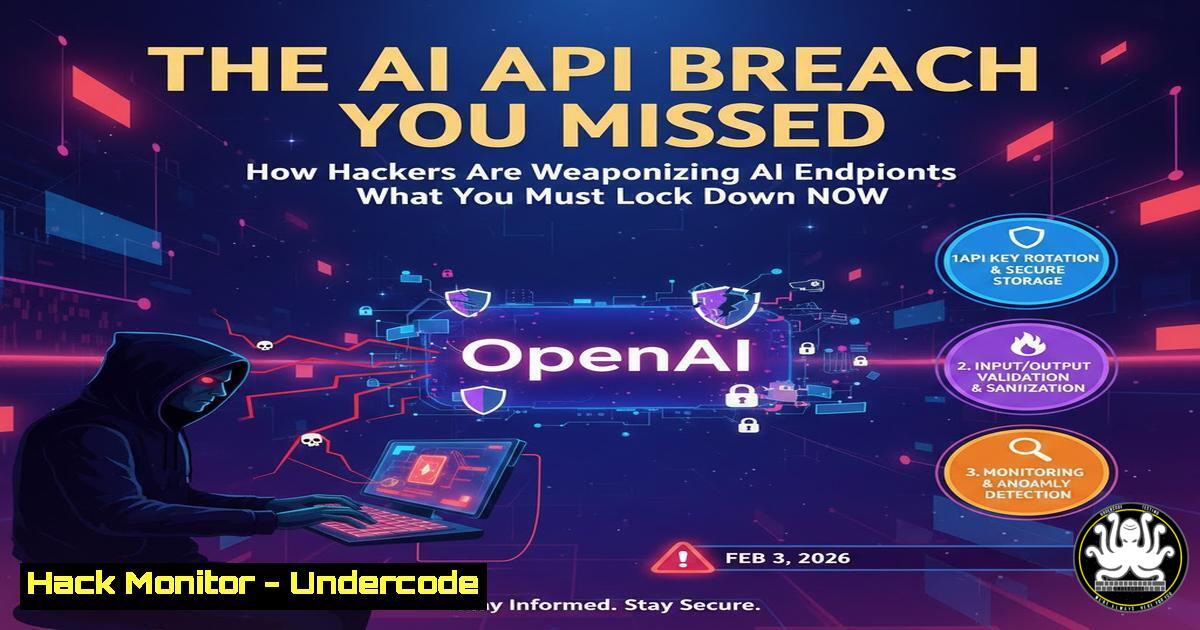
Introduction:
The integration of Artificial Intelligence (AI) APIs, like those from OpenAI, into business-critical applications has created a new, expansive attack surface. Cybersecurity professionals are now tasked with defending not just traditional networks, but also the AI pipelines that process sensitive data. This article deconstructs the multi-layered threat landscape surrounding AI APIs, providing a tactical guide to reconnaissance, hardening, and active defense for modern SOCs and penetration testers.
Learning Objectives:
- Execute comprehensive reconnaissance and vulnerability assessment against API endpoints, including AI service gateways.
- Implement hardened configurations for major cloud providers (AWS, Azure, GCP) to protect integrated AI services.
- Deploy and interpret monitoring tools to detect and mitigate novel AI-driven threat patterns.
You Should Know:
1. API Reconnaissance & Endpoint Discovery
Before an attacker can exploit an AI API, they must discover and fingerprint it. This often involves scanning for exposed endpoints, analyzing JS files in web applications, and identifying API keys leaked in source code repositories.
Step-by-Step Guide:
Step 1: Subdomain Enumeration. Use tools like `amass` or `subfinder` to find potential API hosts.
amass enum -d target-company.com -passive -o subdomains.txt
Step 2: Port & Service Scanning. Target common API ports (443, 8443) and use `nmap` scripting to fingerprint services.
nmap -sV -sC -p 443,8443 --script http-title,http-headers -iL subdomains.txt -oA api_scan
Step 3: Endpoint Probing and Fuzzing. Use `ffuf` to discover hidden API paths, especially common AI provider paths like /v1/completions, /v1/embeddings, or /v1/chat.
ffuf -w /usr/share/wordlists/api_small.txt -u https://api.target-company.com/FUZZ -H "Authorization: Bearer TEST" -mc 200,401,403
2. Exploiting Insecure API Key Management
The most common vector is the exposure of static API keys. These keys, if not properly scoped or rotated, grant direct access to AI services, leading to data exfiltration, massive financial cost (via resource exhaustion), and poisoning of AI models.
Step-by-Step Guide:
Step 1: Key Discovery. Scan public GitHub, GitLab, and Pastebin for commits containing strings like sk-, OPENAI_API_KEY, AZURE_API_KEY.
Step 2: Validation & Scope Assessment. Once a potential key is found, validate it and assess its permissions by making a minimal, authorized request.
curl https://api.openai.com/v1/models \
-H "Authorization: Bearer sk-...YOUR_KEY_HERE..."
Step 3: Exploitation & Impact. A valid key can be used to query sensitive data previously sent to the model or run up costs. Defensively, this is why strict usage limits and alerting on anomalous spend are critical.
- Hardening Cloud IAM for AI Services (AWS SageMaker Example)
AI services in the cloud inherit permissions from the provider’s IAM framework. Overly permissive roles are a primary risk.
Step-by-Step Guide:
Step 1: Audit Existing IAM Policies. Attach and audit policies for least privilege.
 AWS CLI: Get the policy for a SageMaker execution role
aws iam list-attached-role-policies --role-name SageMakerExecutionRole
aws iam get-policy-version --policy-arn arn:aws:iam::aws:policy/AmazonSageMakerFullAccess --version-id v1
Step 2: Craft a Minimal Policy. Replace broad policies (AmazonSageMakerFullAccess) with scoped ones.
{
"Version": "2012-10-17",
"Statement": [
{
"Effect": "Allow",
"Action": [
"sagemaker:CreateTrainingJob",
"sagemaker:DescribeTrainingJob"
],
"Resource": "arn:aws:sagemaker:::training-job/specific-prefix-"
}
]
}
Step 3: Enforce Key Rotation. Implement mandatory rotation using AWS Secrets Manager or Azure Key Vault triggers.
4. Implementing AI-Specific API Security Monitoring
Traditional WAFs may miss malicious API payloads crafted for AI endpoints. You need contextual monitoring.
Step-by-Step Guide:
Step 1: Deploy an API Gateway with Advanced Inspection. Use AWS API Gateway, Azure API Management, or Kong to log all requests/responses.
Step 2: Ingest Logs into SIEM. Forward logs to a SIEM like Splunk or Elasticsearch.
Step 3: Create Detections for AI Threats. Build alerts for:
Prompt Injection: Detect common injection payloads in request bodies.
Data Exfiltration: Alert on high-volume `POST` requests to `/v1/embeddings` or `/v1/completions` containing potential PII patterns.
Cost Anomaly: Trigger on a spike in token usage per hour, indicating potential credential abuse.
- Mitigating Supply Chain Attacks in AI Model Pipelines
AI models often depend on external libraries (e.g.,transformers,langchain). A poisoned package can compromise your entire pipeline.
Step-by-Step Guide:
Step 1: Enforce Software Bill of Materials (SBOM). Use `syft` or `cyclonedx` to generate an SBOM for your AI project.
syft your-ai-app:latest -o cyclonedx-json > sbom.json
Step 2: Scan Dependencies for Vulnerabilities. Integrate `trivy` or `grype` into your CI/CD pipeline.
trivy image --severity HIGH,CRITICAL your-ai-app:latest
Step 3: Implement Signed/Verified Pipelines. Use cosign for container signing and Sigstore for artifact transparency.
cosign sign --key cosign.key your-ai-app:latest
What Undercode Say:
- Key Takeaway 1: The attack surface has fundamentally shifted. Securing AI is not about securing a magic black box; it’s about applying classic security principles—least privilege, zero trust, and proactive monitoring—to the new API-driven, cloud-native, and data-intensive workflows that AI introduces. The weakest link is rarely the model itself, but the pipeline and access controls surrounding it.
- Key Takeaway 2: Offense informs defense. The penetration testing methodology for AI-integrated systems now must include API key hunting, cloud IAM auditing, prompt injection testing, and supply chain review. Red teams that fail to adapt are leaving critical vulnerabilities undiscovered, while blue teams that ignore these vectors are building castles on sand.
Prediction:
In the next 12-24 months, we will witness the first major cyber incident originating from a compromised AI API leading to a cascading, multi-organizational breach. As AI becomes middleware, its compromise will act as a force multiplier, poisoning data sets, distorting business logic, and exfiltrating intellectual property at unprecedented scale. Conversely, AI-driven defensive tools will become essential to parse the log volume and detect novel attack patterns in real-time, creating an AI vs. AI battleground within the network perimeter. The organizations that survive will be those that integrated AI security not as an afterthought, but as a first-principle design requirement.
▶️ Related Video (70% Match):
🎯Let’s Practice For Free:
IT/Security Reporter URL:
Reported By: Unitedstatesgovernment Api – Hackers Feeds
Extra Hub: Undercode MoN
Basic Verification: Pass ✅


