Listen to this Post
Introduction:
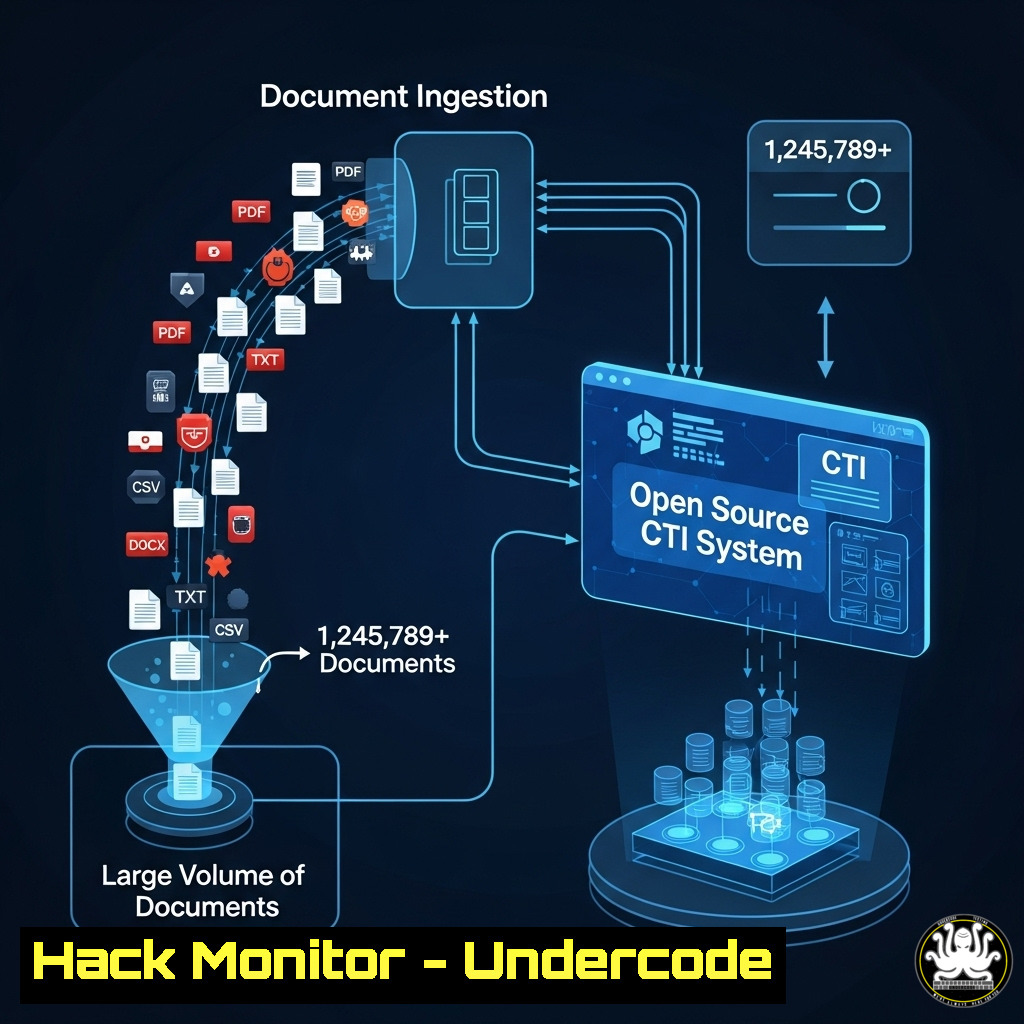
Cyber Threat Intelligence (CTI) has evolved from a niche practice to a critical defense mechanism for organizations of all sizes. Dudix-CTI exemplifies this shift, leveraging an open-source, self-hosted OpenCTI instance to process massive datasets, transforming raw data into actionable intelligence for SMEs and public bodies. This deep dive explores the technical backbone of a modern CTI operation.
Learning Objectives:
- Understand the core components and data flow of a self-hosted OpenCTI platform.
- Learn key commands for data ingestion, IOC management, and behavioral analysis within a CTI pipeline.
- Explore methods for correlating threats and automating intelligence dissemination.
You Should Know:
1. Ingesting Massive Data Volumes with OpenCTI Clients
The foundation of any CTI platform is its ability to consume data from diverse sources. OpenCTI’s Python client is instrumental for automating the ingestion of reports, leaks, and vulnerability bulletins.
 Install the OpenCTI client library
pip install pycti

Sample Python script to ingest a report (replace placeholders)
from pycti import OpenCTIApiClient

Initialize API client
client = OpenCTIApiClient(
"https://your-opencti-instance.com",
"your_api_key_here"
)

Create a new report object
report = client.report.create(
name="APT29 Analysis Q3 2024",
description="Detailed analysis of latest TTPs...",
published="2024-09-06T00:00:00.000Z",
report_class="Internal Report"
)

Add external reference (e.g., a link to the original PDF)
client.report.add_external_reference(
id=report['id'],
external_reference_id=client.external_reference.create(
source_name="Vendor Blog",
url="https://vendor.com/blog/apt29-report.pdf"
)['id']
)
print("Report ingested successfully:", report['id'])
Step-by-step guide: This script connects to your OpenCTI instance’s API using a secure key. It first creates a new ‘report’ entity within the platform, defining its metadata. It then creates an ‘external reference’ entity and links it to the report, providing a verifiable source. This process can be automated with cron jobs or CI/CD pipelines to continuously pull data from RSS feeds, GitHub repositories, or vendor blogs.
2. Managing and Enriching Indicators of Compromise (IOCs)
IOCs are the lifeblood of CTI. OpenCTI provides structured ways to store, enrich, and share them, moving beyond simple blocklists.
 Using the OpenCTI API to create and tag an IOC
import requests

api_url = "https://your-opencti-instance.com/api/v1/indicator"
api_key = "your_api_key_here"

headers = {
"Authorization": f"Bearer {api_key}",
"Content-Type": "application/json"
}

JSON data to create a new IPv4 indicator
data = {
"name": "Malicious C2 IP - 192.0.2.100",
"description": "IP associated with APT29 C2 traffic, high confidence.",
"pattern_type": "stix",
"pattern": "[ipv4-addr:value = '192.0.2.100']",
"x_opencti_main_observable_type": "IPv4-Addr",
"x_opencti_score": 90,  Confidence score
"label_ids": ["label-id-for-apt29"]  Link to APT29 threat actor
}

response = requests.post(api_url, headers=headers, json=data)
print(f"IOC created: {response.json()['id']}")
Step-by-step guide: This code snippet demonstrates the programmatic creation of an IOC. The `pattern` uses the STIX 2.1 pattern language for standardized definition. The key steps include setting a confidence `score` to help analysts prioritize and linking the indicator to a specific threat actor group via its label_ids. This contextual enrichment is what transforms a simple IP into actionable intelligence.
3. Automating Correlation with Playbooks and Taxonomies
Correlating IOCs with attacker playbooks (MITRE ATT&CK) is where CTI delivers its true value. OpenCTI’s graph-based model excels at this.
 Curl command to fetch all indicators related to a specific MITRE technique
curl -X GET \
"https://your-opencti-instance.com/api/v1/indicators?filters=%7B%22mode%22%3A%22and%22%2C%22filters%22%3A%5B%7B%22key%22%3A%22indicates%22%2C%22values%22%3A%5B%22attack-pattern--x%22%5D%7D%5D%7D" \
-H "Authorization: Bearer your_api_key_here"
Step-by-step guide: This API query fetches all indicators that `indicate` a specific MITRE ATT&CK technique (identified by its STIX ID). This is a powerful way to answer the question: “What IOCs have we seen that are associated with Credential Dumping (T1003)?” Automation scripts can run such queries after new data ingestion to automatically tag and elevate critical correlations.
4. Leveraging YARA for Malware Analysis Integration
With ~3800 malware samples analyzed, integrating YARA rules into the CTI process is essential for classifying and tracking malware families.
 Example YARA rule stored as an OpenCTI 'Note' for distribution
rule APT29_Backdoor_ComRAT_v4 {
meta:
description = "Detects ComRAT v4 backdoor used by APT29"
author = "Dudix-CTI"
date = "2024-09-01"
threat_actor = "APT29"
mitre_attck_id = "T1219"
score = 90

strings:
$s1 = "ComRATClient" fullword ascii
$s2 = {FC 48 83 E4 F0 E8 C8 00 00 00 41 51}
$s3 = "/C powershell -w hidden -nop -ep bypass" fullword ascii

condition:
(uint16(0) == 0x5A4D) and
(filesize < 2MB) and
(2 of them)
}
Step-by-step guide: This YARA rule identifies a specific malware variant. The metadata section is crucial for CTI, linking the rule to a threat actor (APT29) and a MITRE technique (T1219). This rule can be created as a `Note` in OpenCTI via its API and then pushed automatically to endpoint detection systems, enabling the entire network to hunt for this specific malware signature.
5. Hardening the OpenCTI Platform Itself
A self-hosted CTI platform is a high-value target. Securing its underlying Linux server is paramount.
 Harden the SSH configuration on the CTI server (/etc/ssh/sshd_config)
sudo sed -i 's/PermitRootLogin yes/PermitRootLogin prohibit-password/' /etc/ssh/sshd_config
sudo sed -i 's/PasswordAuthentication yes/PasswordAuthentication no/' /etc/ssh/sshd_config
sudo sed -i 's/MaxAuthTries 6/MaxAuthTries 2/' /etc/ssh/sshd_config
sudo systemctl restart sshd

Configure UFW firewall to only allow necessary ports
sudo ufw default deny incoming
sudo ufw default allow outgoing
sudo ufw allow 443/tcp comment 'OpenCTI HTTPS'
sudo ufw allow from 192.0.2.0/24 to any port 22 comment 'Admin SSH Subnet'
sudo ufw --force enable
Step-by-step guide: These commands harden remote access to the server. They disable root login with a password, enforcing key-based authentication only (PasswordAuthentication no). They also reduce the number of SSH authentication attempts (MaxAuthTries 2) to hinder brute-force attacks. The Uncomplicated Firewall (UFW) rules restrict all incoming traffic except HTTPS for the web interface and SSH only from a specific administrative network segment, drastically reducing the attack surface.
What Undercode Say:
- Democratization of High-End CTI: Dudix-CTI proves that powerful, large-scale threat intelligence is no longer the exclusive domain of well-funded SOCs. Open-source tools like OpenCTI, when properly configured and resourced, can process intelligence on par with commercial offerings.
- The Infrastructure is the Product: The value isn’t just the curated newsletter; it’s the automated, scalable backend that produces it. The planned hardware upgrade (64GB RAM, multi-core CPU) highlights that data correlation and analysis are computationally intensive tasks that define the ceiling of a CTI operation’s effectiveness.
The success of Dudix-CTI signals a maturation in the cybersecurity landscape where actionable intelligence is becoming a commodity accessible to smaller organizations. This is less about a single tool and more about a well-architected data pipeline. The focus on ingesting over 100 million documents and correlating them with 1000+ playbooks indicates a move towards behavioral and contextual analysis, far beyond simple IOC sharing. The real strategic advantage lies in the automated playbooks that connect new IOCs to known adversary behavior, enabling predictive defense rather than reactive blocking.
Prediction:
The model demonstrated by Dudix-CTI will catalyze the rise of community-driven, sector-specific CTI collectives. We will see specialized collectives emerge for healthcare, local government, and critical manufacturing, each running tailored OpenCTI instances. This will force advanced threat actors to further customize their TTPs for specific sectors, increasing the complexity of attacks but also making their campaigns more identifiable by the very specificity of their tools. The future battleground will be dominated by AI-powered correlation engines running on these distributed CTI platforms, automatically detecting campaign patterns across shared sector data before single indicators are ever published.
🎯Let’s Practice For Free:
IT/Security Reporter URL:
Reported By: Cyberflood Opencti – Hackers Feeds
Extra Hub: Undercode MoN
Basic Verification: Pass ✅


