Listen to this Post
Introduction:
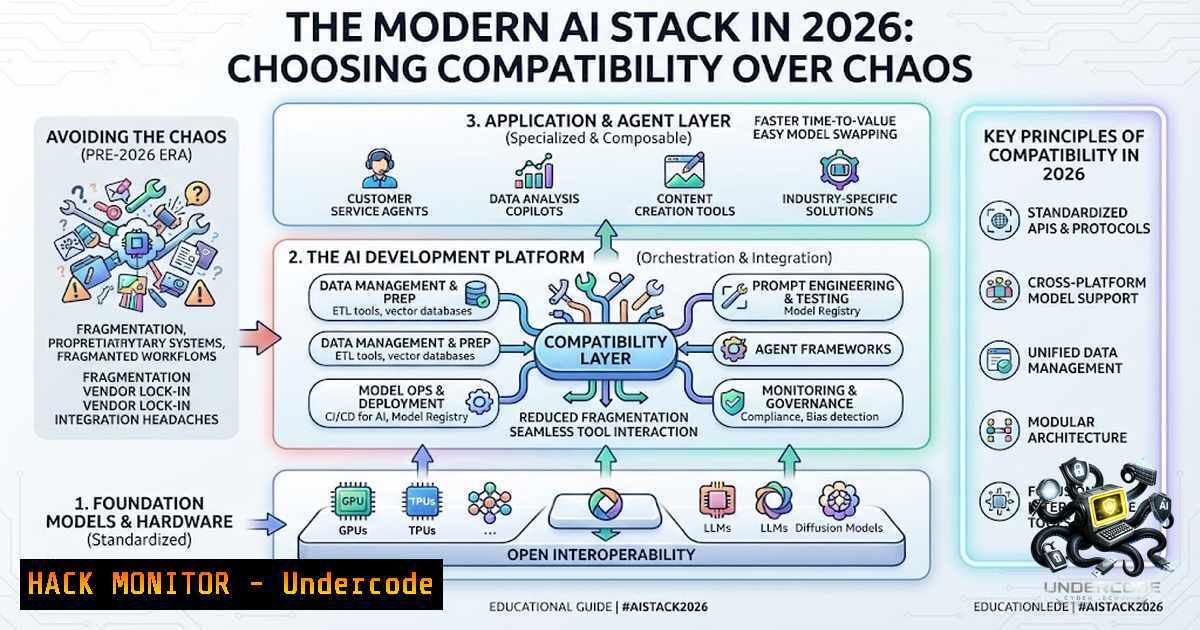
The modern AI ecosystem has evolved far beyond simply picking a large language model (LLM). In 2026, building production-grade AI systems requires a deep understanding of the entire lifecycle—from model access and retrieval to memory, security, automation, and monitoring. The biggest mistake organisations make is trying to use everything; the true competitive advantage comes from selecting a compatible, integrated stack that improves quality, latency, security, and maintainability.
Learning Objectives:
- Understand the six core layers of the 2026 enterprise AI stack and how they interconnect.
- Evaluate and select compatible tools for LLMs, agentic frameworks, RAG, and MCP.
- Implement security guardrails, observability, and persistent memory for production AI systems.
- Apply practical Linux/Windows commands and code snippets to deploy and secure AI workloads.
1. The Intelligence Layer: Choosing Your LLM Foundation
The foundation of any AI stack is the LLM itself. In 2026, organisations have a wealth of options, including proprietary models like OpenAI, Claude, and Gemini, as well as open-source alternatives such as Llama, Mistral, and Cohere. The choice isn’t just about performance; it’s about latency, cost, data privacy, and compliance. Many enterprises are turning to local deployment using tools like Ollama and vLLM for greater control and reduced data exposure.
Step‑by‑step guide to deploying an open-source LLM with vLLM on Linux:
1. Install vLLM: `pip install vllm`
2. Download a model: `huggingface-cli download meta-llama/Llama-2-7b-chat-hf`
- Start the vLLM server: `python -m vllm.entrypoints.openai.api_server –model meta-llama/Llama-2-7b-chat-hf`
4. Query the model: `curl http://localhost:8000/v1/completions -H “Content-Type: application/json” -d ‘{“model”: “meta-llama/Llama-2-7b-chat-hf”, “prompt”: “Explain AI stack security”, “max_tokens”: 100}’`
2. Agentic AI: Orchestrating Multi-Agent Workflows
Agentic AI represents the shift from simple prompt-response to autonomous systems that plan, reason, and execute complex tasks. Frameworks like LangGraph, CrewAI, and AutoGen (now AG2) are leading this charge, enabling the coordination of multiple agents with specialised roles. LangGraph excels at stateful, cyclic workflows, while CrewAI offers a role-based, collaborative approach.
Step‑by‑step guide to building a simple multi-agent system with CrewAI:
1. Install CrewAI: `pip install crewai`
- Define agents: Create agents with specific roles, goals, and backstories.
- Define tasks: Assign tasks to agents, specifying expected outputs.
- Create a crew: Assemble the agents and tasks into a sequential or hierarchical workflow.
5. Execute: `crew.kickoff()` to run the multi-agent process.
- RAG and Embeddings: Connecting Models to Trusted Knowledge
Retrieval-Augmented Generation (RAG) grounds LLM responses in verifiable, up-to-date data. This layer involves embedding models (OpenAI Embeddings, BGE, Cohere) that convert text into vectors, vector databases (Pinecone, Qdrant, Weaviate, pgvector) for similarity search, and orchestration frameworks (LangChain, Haystack, DSPy) that coordinate retrieval and generation. DSPy, in particular, is gaining traction for automatically optimising prompts and weights in RAG pipelines.
Step‑by‑step guide to setting up a basic RAG pipeline with LangChain and pgvector:
- Install dependencies: `pip install langchain langchain-community pgvector psycopg2-binary`
2. Set up PostgreSQL with pgvector: Run `CREATE EXTENSION vector;` in your database. - Load and split documents: Use
LangChain‘s document loaders and text splitters.
4. Create embeddings: `embeddings = OpenAIEmbeddings()`
5. Store in pgvector: `vectorstore = PGVector(connection_string=CONNECTION_STRING, embedding_function=embeddings)`
- Retrieve and generate: Use a `RetrievalQA` chain to combine retrieval with an LLM.
-
MCP: The Model Context Protocol for Structured Access
The Model Context Protocol (MCP) is standardising how AI agents access external tools and data sources. MCP servers for GitHub, Slack, PostgreSQL, and Google Drive give agents structured, secure access to enterprise applications. FastMCP 3.0 simplifies server creation with a single decorator, handling schema generation and validation automatically.
Step‑by‑step guide to creating a simple MCP server with FastMCP:
1. Install FastMCP: `pip install fastmcp`
- Create a server: `from mcp.server.fastmcp import FastMCP` and `mcp = FastMCP(“My Server”)`
3. Add a tool: Use the `@mcp.tool()` decorator to expose a function (e.g., querying a database).
4. Run the server: `mcp.run(transport=”stdio”)` or `mcp.run(transport=”sse”)`.
- Security and Observability: Guardrailing and Monitoring AI Systems
Security and observability are non-1egotiable in production AI. Tools like NeMo Guardrails and Presidio detect and sanitise personally identifiable information (PII), while Lakera Guard protects against prompt injections. Observability platforms like LangSmith, Langfuse, and Phoenix provide tracing, evaluation, and cost tracking. A multi-layered guardrailing approach combining toxicity detection, conversational rails, and PII redaction is essential.
Step‑by‑step guide to implementing PII detection with Presidio in Python:
1. Install Presidio: `pip install presidio-analyzer presidio-anonymizer`
- Initialize the analyzer: `from presidio_analyzer import AnalyzerEngine` and `analyzer = AnalyzerEngine()`
3. Analyze text: `results = analyzer.analyze(text=”My email is [email protected]”, language=’en’)`
4. Anonymize results: Use the `AnonymizerEngine` to replace detected entities with placeholders.
6. Memory, Automation, and Storage: Keeping Workflows Stateful
For AI agents to be truly useful, they need memory. Mem0, Zep, and MemGPT provide persistent, long-term memory layers. Short-term memory often relies on Redis, while long-term, relationship-aware memory is best served by graph databases like Neo4j. Automation tools like n8n and Airflow orchestrate these stateful workflows, while vector databases (Pinecone, Qdrant, Chroma) keep them searchable.
Step‑by‑step guide to deploying Mem0 with Docker (Linux/Windows):
- Clone the Mem0 repository: `git clone https://github.com/mem0ai/mem0.git`
2. Navigate to the Docker directory: `cd mem0/docker`
- Start the stack: `docker-compose up -d` (This starts the API server, PostgreSQL with pgvector, and Neo4j).
- Verify: Access the API at `http://localhost:8080`.
What Undercode Say:
- Compatibility Over Quantity: The key to success is not adopting every tool but selecting a cohesive stack that works well together.
- Security is Foundational: AI security cannot be an afterthought; it must be embedded from day one with guardrails and observability.
- Memory Matters: For AI to be truly intelligent and useful, persistent memory (both short-term and long-term) is critical.
- MCP is a Game-Changer: The Model Context Protocol is set to become the universal standard for connecting AI agents to enterprise data.
- Observability is Non-1egotiable: Without tracing and evaluation, AI systems are black boxes that are impossible to debug or trust.
Prediction:
- +1 The enterprise AI stack will continue to consolidate, with major cloud providers offering integrated, turnkey solutions that abstract away much of this complexity.
- +1 MCP will become the de facto standard for agent-tool interaction, accelerating the adoption of autonomous AI agents across industries.
- -1 The sheer number of tools and frameworks will lead to a “tool fatigue” that slows down innovation for smaller teams without dedicated AI engineers.
- -1 Security vulnerabilities in AI stacks (e.g., prompt injection, data leakage) will become a primary attack vector, leading to high-profile breaches.
- +1 The rise of specialised AI operations (AI Ops) roles will create new career opportunities focused on managing and securing the full AI lifecycle.
- -1 Without standardised evaluation frameworks, many AI projects will fail to move beyond pilot phases due to unpredictable behaviour and cost overruns.
▶️ Related Video (88% Match):
🎯Let’s Practice For Free:
🎓 Live Courses & Certifications:
Join Undercode Academy for Verified Certifications
🚀 Request a Custom Project:
Secure, high-velocity infrastructure and disruptive technological engineering. Contact our engineering team for high-tier development and proprietary systems:
[email protected]
💎 Smart Architecture | 🛡️ Secure by Design | ⭐ Trusted by Thousands
IT/Security Reporter URL:
Reported By: Jeneeshkumar Artificialintelligence – Hackers Feeds
Extra Hub: Undercode MoN
Basic Verification: Pass ✅


