
Listen to this Post
Introduction:
Account Takeover (ATO) attacks remain a pervasive threat in application security, often stemming from seemingly minor implementation oversights. This analysis delves into a critical vulnerability where improper session token handling in localStorage, coupled with inadequate server-side validation, allowed for instantaneous account compromise. Understanding this flaw is essential for developers and security professionals to fortify authentication mechanisms against unauthorized access.
Learning Objectives:
- Understand the critical security risks associated with storing session tokens in client-side localStorage.
- Learn how to implement robust server-side session validation to prevent token manipulation attacks.
- Master the practical steps for identifying, exploiting, and mitigating token-based ATO vulnerabilities during penetration tests.
You Should Know:
1. The Anatomy of a localStorage Token Vulnerability
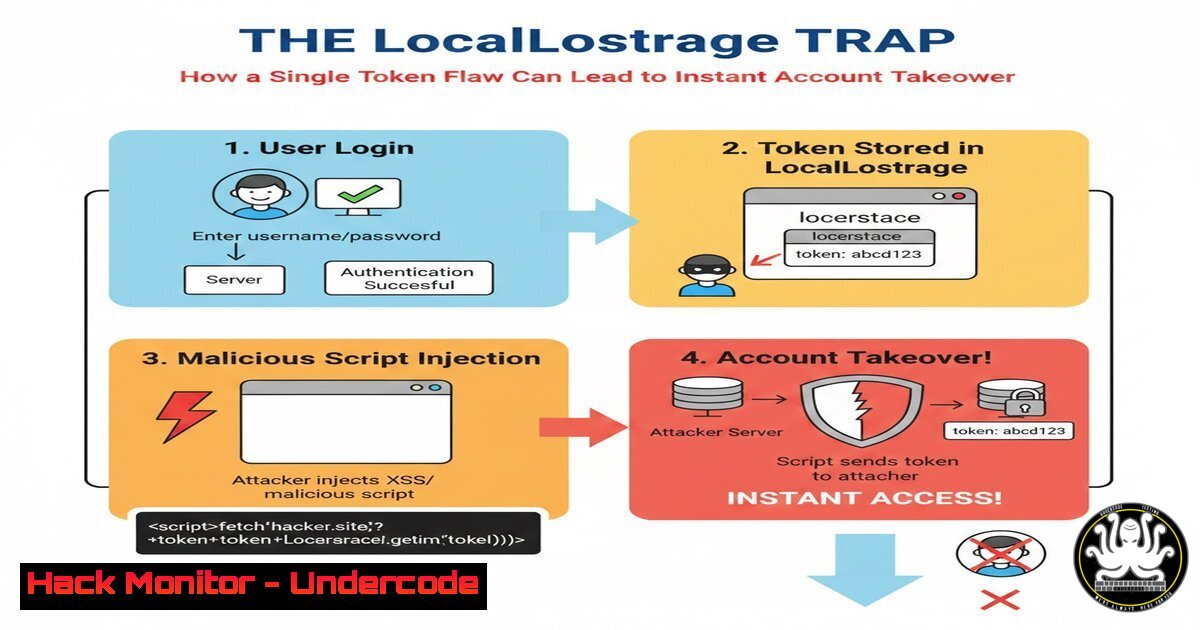
The core vulnerability lies in the client-side storage of sensitive session tokens. Unlike HTTPOnly cookies, which are inaccessible to JavaScript and protected from certain attacks, localStorage is fully readable and writable by any script running on the page. In the described scenario, the application generates a session token upon login and stores it in the browser’s localStorage. The flaw was that the server blindly accepted any token presented by the client without verifying if it was genuinely issued to and for the current user’s session. This lack of contextual validation allows an attacker to simply replace their own token with one captured from another user, thereby hijacking that user’s session.
Step-by-step guide:
- Step 1: Identify Token Storage Location. Open the target web application in your browser and log in. Access Developer Tools (F12), navigate to the “Application” or “Storage” tab, and inspect “Local Storage” for the domain. Look for key names like
token,session,authToken, oraccess_token. - Step 2: Analyze Token Structure. Note the value of the token. It may be a JWT (JSON Web Token), an opaque string, or a UUID. Copy the token for analysis.
- Step 3: Confirm the Lack of Binding. This is the critical test. Open a different browser (or an incognito window) to simulate another user’s context. Log in with a different account, capture its token from localStorage, and then replace it with the first user’s token. If the page refreshes and you are now viewing the first user’s data and session, the vulnerability is confirmed. The server is not validating the token’s context.
2. Exploiting the Flaw: A Practical ATO Walkthrough
Exploitation is straightforward due to the absence of server-side checks. An attacker does not need the victim’s password, MFA code, or any interaction. The attack can be performed manually by a low-skilled attacker or automated with simple scripts.
Step-by-step guide:
- Step 1: Acquire a Victim Token. An attacker can obtain a victim’s token through various means, such as Cross-Site Scripting (XSS) attacks, malware on the victim’s machine, or even by convincing the victim to paste a token into a malicious tool (a self-XSS social engineering attack).
- Step 2: Inject the Victim Token. The attacker logs into their own account on the vulnerable application. Using the browser’s Developer Tools, they overwrite their own `authToken` value in localStorage with the victim’s stolen token.
- Step 3: Assume the Victim’s Session. Upon refreshing the page or navigating to a protected endpoint, the application sends the victim’s token to the server. The server, failing to validate the token’s origin, returns the victim’s data, completing the account takeover. The attacker now has full access to the victim’s account, including personal data and the ability to perform privileged actions.
3. Server-Side Session Validation: The Ultimate Mitigation
The fundamental fix for this vulnerability is to move session state management to the server and implement strict validation. The server must maintain a session store (e.g., in a database or Redis cache) that maps a session token to a specific user and session metadata.
Step-by-step guide to implement proper validation:
- Step 1: Implement a Server-Side Session Store. Upon login, create a session record on the server. This record should include the user ID, a randomly generated session ID, the IP address that initiated the login, the User-Agent string, and a timestamp.
// Example Node.js code using a store (e.g., Redis) const sessionId = generateRandomToken(); const sessionData = { userId: user.id, ipAddress: req.ip, userAgent: req.get('User-Agent'), createdAt: Date.now() }; await redisClient.set(<code>session:${sessionId}</code>, JSON.stringify(sessionData)); // Send sessionId back as an HTTPOnly Cookie res.cookie('sessionId', sessionId, { httpOnly: true, secure: true, sameSite: 'strict' }); - Step 2: Validate Every Request. For every subsequent API request, the server must retrieve the session ID from the HTTPOnly cookie (not the request body) and validate it against the server-side store.
app.get('/api/profile', async (req, res) => {
const sessionId = req.cookies.sessionId;
if (!sessionId) return res.status(401).send('Unauthorized');</li>
</ul>

const sessionData = await redisClient.get(<code>session:${sessionId}</code>);
if (!sessionData) return res.status(401).send('Invalid session');

const session = JSON.parse(sessionData);
// Optional: Enhance security by re-validating IP/User-Agent
// if (session.ipAddress !== req.ip) { ... invalidate session ... }

const user = await User.findById(session.userId);
res.json(user);
});
– Step 3: Invalidate Sessions Securely. Provide a robust logout mechanism that deletes the session record from the server-side store.
4. Hardening Client-Side Storage: Alternatives to localStorage
While server-side validation is the primary defense, client-side storage practices must also be hardened. The key is to use mechanisms that minimize exposure to XSS and other client-side attacks.
Step-by-step guide:
- Step 1: Prefer HTTPOnly Cookies for Session IDs. As shown in the mitigation above, session identifiers should be stored in cookies with the `HttpOnly` flag set. This prevents JavaScript from accessing them, mitigating XSS-based token theft.
- Step 2: Use the `Secure` and `SameSite` Flags. Always set the `Secure` flag to ensure cookies are only sent over HTTPS. The `SameSite=Strict` or `SameSite=Lax` flags can help protect against Cross-Site Request Forgery (CSRF) attacks.
- Step 3: If Local Storage is Unavoidable, Encrypt. For data that must persist in localStorage (e.g., application settings, not session tokens), encrypt it using a robust library. The encryption key should not be easily extractable.
Example using OpenSSL to generate a key (for illustration, not direct browser use)
openssl rand -base64 32
5. Penetration Testing for Token Vulnerabilities
A comprehensive VAPT approach must include specific tests for token handling flaws. This goes beyond a simple token swap.
Step-by-step testing guide:
- Step 1: Reconnaissance. Map the application’s authentication flow. Use Burp Suite or OWASP ZAP to intercept login requests and responses. Identify all tokens in responses (cookies, response bodies) and where they are stored client-side (LocalStorage, SessionStorage, cookies).
- Step 2: Manipulation and Replay. Using a tool like Burp Repeater, try modifying the token sent to the server. Change one character, try an old token (replay attack), or use a token from a different user. Observe the server’s response.
- Step 3: Check for Context Binding. As performed in the original finding, swap tokens between two active sessions of different privilege levels. The test is successful if you can access a higher-privileged account’s data or functions with a lower-privileged user’s token.
- Step 4: Automated Scanning. Use Burp’s active scanner extensions that look for insecure token handling, or write custom scripts to test for session fixation and lack of invalidation.
What Undercode Say:
- The Illusion of Complexity: This case proves that catastrophic security failures are often not the result of complex, esoteric bugs, but of fundamental oversights in implementing well-understood security principles like server-side state validation.
- Shift Left, Validate Right: The responsibility for this flaw lies as much with development frameworks and early-stage architectural decisions as it does with final testing. “Shifting left” on security requires building with secure defaults, such as framework-integrated session management that handles validation correctly out-of-the-box.
This vulnerability is a stark reminder that client-side controls are never trustworthy. The server is the ultimate authority and must verify the integrity and context of every piece of data it receives, especially those governing access. While the fix is conceptually simple, its absence can lead to a total breach of user trust and data confidentiality. The elegance of the exploit—its simplicity and power—makes it a high-value finding in any VDP or penetration test.
Prediction:
The prevalence of stateless JWT tokens and the push for fully client-side applications (SPAs, PWAs) will see this class of vulnerability persist and evolve. We predict a rise in ATO attacks targeting API keys and tokens stored within mobile application configurations and PWAs, where the line between client and server is often blurred. Furthermore, as AI-assisted code generation becomes more common, it may inadvertently propagate these insecure patterns if not guided by strong security context, making manual code review and targeted penetration testing for token validation more critical than ever. The future mitigation will likely involve more sophisticated, context-aware session management APIs provided by cloud identity providers, moving the burden away from individual application developers.
🎯Let’s Practice For Free:
IT/Security Reporter URL:
Reported By: Khushimistry132 Account – Hackers Feeds
Extra Hub: Undercode MoN
Basic Verification: Pass ✅🔐JOIN OUR CYBER WORLD [ CVE News • HackMonitor • UndercodeNews ]
📢 Follow UndercodeTesting & Stay Tuned:


