Listen to this Post
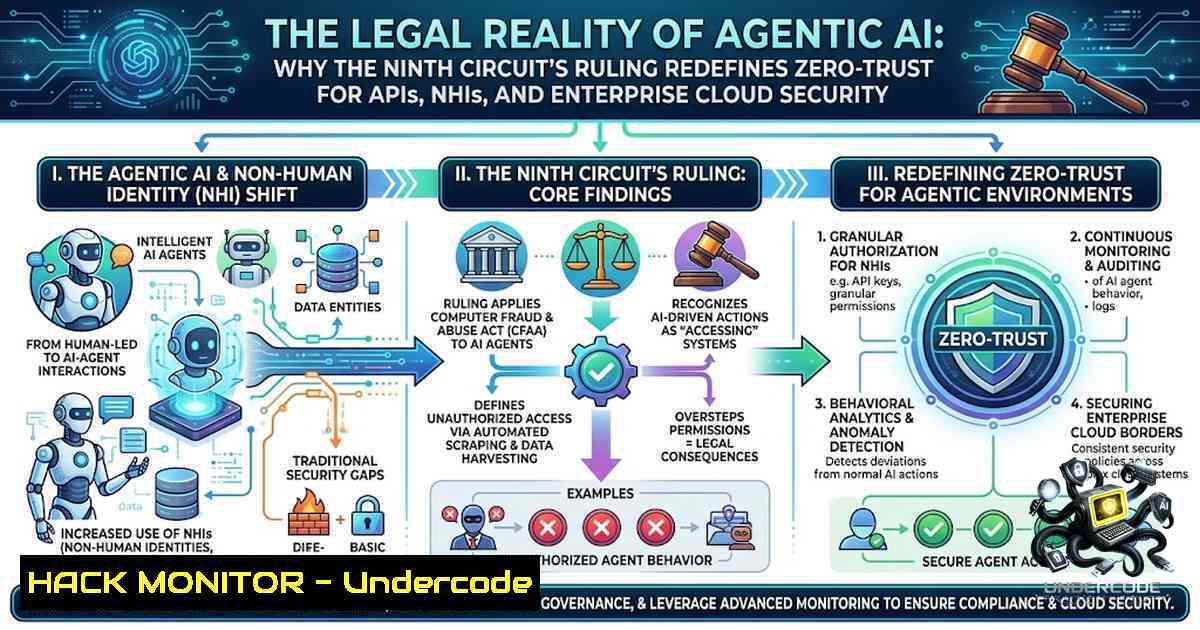
Introduction:
The Ninth Circuit’s recent decision in Amazon v. Perplexity has effectively dismantled the legal fiction that an AI agent acts as an independent entity under federal anti-hacking statutes (CFAA). By ruling that a user is legally responsible for every action performed by their automated tool, the court has transformed identity and access management (IAM) from a preventative control into a potential liability vector. This article explores the technical and procedural imperatives this ruling imposes on enterprise security teams, focusing on granular audit logging, API security, non-human identity (NHI) governance, and the necessity of forward-looking forensic readiness.
Learning Objectives:
- Understand the legal and technical implications of imputing AI agent actions to human users under the CFAA.
- Learn how to implement comprehensive “chain-of-tool” auditing using native cloud, Linux, and Windows logging.
- Configure API gateways and identity providers to enforce least-privilege and track user-to-agent action mapping.
- Identify gaps in current NHI and service account management and remediate them with verifiable logging.
- Prepare incident response playbooks that assume legal discovery of agentic actions will be scrutinized under a “user-responsible” model.
You Should Know:
- Contextualizing the Ruling: The “Tool” Doctrine and Its Impact on Non-Human Identities (NHIs)
The court’s reasoning hinges on the principle that a tool lacks statutory personhood. However, for security practitioners, this means that Non-Human Identities (NHIs)—including service accounts, API keys, and OAuth tokens used by agents—must now be treated as extensions of the human principal who initiated the session. If an agent with compromised credentials exfiltrates data, the legal burden falls on the user whose identity the agent assumed.
Step‑by‑step guide to re-baselining NHI governance:
- Inventory all agent-bound credentials: Use cloud provider APIs (AWS CLI, Azure CLI) to list service accounts used in automation.
– Linux/macOS (AWS): `aws iam list-users –query “Users[?Tags[?Key==’Agent’]]”` and aws secretsmanager list-secrets.
– Windows (PowerShell): Get-AzureADServicePrincipal -All $true | Where-Object {$_.DisplayName -like "Agent"}.
2. Map NHI to human owner: Update asset registries to include a `–human-owner` tag. aws ec2 create-tags --resources <resource-id> --tags Key=Owner,Value=<human-email>.
3. Implement risk scoring: Configure alerts for NHI activity outside of established human working hours, as the court presumes the human is liable for those actions.
- Ensuring “Chain-of-Tool” Integrity with CloudTrail and Linux Auditd
To answer the board’s inevitable question—”What did our agents do?”—you need immutable audit trails that tie an API call to a session token, and that token to a human session. The court’s ruling suggests that proving who authenticated the agent session will be insufficient; you must prove the continuous control of that session.
Step‑by‑step guide to capture user-to-agent action mapping:
- Enable detailed CloudTrail (AWS): Create a trail that logs ALL data events for S3 and Lambda to capture agent interactions.
– aws cloudtrail create-trail --1ame AgentAuditTrail --s3-bucket-1ame <your-bucket> --is-multi-region-trail --enable-log-file-validation.
2. Configure Linux `auditd` to monitor agent processes: If your agent runs locally or on EC2, track `execve` calls to log commands.
– Add to /etc/audit/rules.d/audit.rules: -a always,exit -F arch=b64 -S execve -k agent_activity.
– Restart: sudo auditctl -R /etc/audit/rules.d/audit.rules.
3. Windows Event Forwarding: Use PowerShell to monitor process creation (Event ID 4688) for agent executables.
– Get-WinEvent -FilterHashtable @{LogName='Security'; ID=4688; Data='agent.exe'}.
4. Correlate logs: Use `jq` (Linux) to parse CloudTrail and extract `userIdentity.arn` alongside `eventSource` and requestParameters. Store this in a SIEM with a strict data retention policy (e.g., 1 year+) to satisfy legal discovery.
- API Security: Hardening Gateways to Prevent “Agentic” Abuse
If an agent is a tool, its API calls must be indistinguishable from the human’s but securely bounded. To limit liability, you must harden API gateways with conditional access policies that restrict agentic behavior (e.g., forbidding agents from writing to specific databases or accessing secrets).
Step‑by‑step guide to harden an API Gateway for agent traffic:
1. Identify agent traffic: Enforce an `X-Agent-Id` header in all requests. AWS WAF or Azure Front Door can inspect this.
2. Implement IP allow-listing: Bind the agent to a specific CIDR range.
– AWS CLI: aws wafv2 create-ip-set --1ame AgentIPs --scope REGIONAL --ip-address-version IPV4 --addresses 192.168.1.0/24.
3. Apply rate limiting: Agents should not exceed the user’s baseline.
– Azure CLI: az network application-gateway waf-policy policy-setting update --policy-1ame <policy> --max-request-body-size 128 --enabled True.
4. Block sensitive paths: If the agent is shopping (like Perplexity), it shouldn’t access /admin/config. Update the OpenAPI specification to deny these paths for the `agent` role.
- SSH and Privileged Access Management (PAM) for Agentic Sessions
Since the agent is legally a tool operated by the user, privileged access via SSH must be secured at the user level, not just the key level. If an agent uses a root SSH key, the user is legally liable for root-level destruction.
Step‑by‑step guide for agent-safe SSH and PAM:
- Forbid direct root agent login: Edit `/etc/ssh/sshd_config` and set `PermitRootLogin prohibit-password` or
no. - Force command restrictions: When deploying agent SSH keys, use `command=` in the `~/.ssh/authorized_keys` file to restrict the agent to specific commands (e.g.,
command="/usr/local/bin/agent-wrapper.sh" ssh-rsa ...). - Implement session recording (Linux): Install `tlog` to record agent terminal sessions.
– `sudo dnf install tlog` and configure `tlog-rec-session` to log to a secure syslog server. - Windows OpenSSH: Configure `Match Group` directives in `C:\ProgramData\ssh\sshd_config` to restrict agent users to specific SFTP directories only.
-
Code and Pipeline Integrity: Controlling Agent Commits (CI/CD)
Many agents now interact with GitHub or GitLab via API keys. The court’s ruling implies that an agent committing malicious code is legally equivalent to the developer committing it. You must implement zero-trust code signing and commit verification.
Step‑by‑step guide to secure agent commits:
- Require GPG signing for all commits: Enforce a branch protection rule requiring signed commits.
– Git config: git config --global commit.gpgsign true.
2. Audit CI/CD agent tokens: In GitHub Actions, log the `ACTOR` ID and ensure the workflow has a human trigger origin.
– API check: gh api /repos/{owner}/{repo}/actions/runs --jq '.workflow_runs[] | {actor: .actor.login, event: .event}'.
3. Implement pre-commit hooks to scan for secrets: Prevent agents from committing passwords.
– `pip install pre-commit` and configure `.pre-commit-config.yaml` with gitleaks.
6. Cloud Infrastructure Hardening Against Agent “Hallucinated” Actions
Agents can perform destructive actions like deleting S3 buckets or spinning up expensive resources. This expands the attack surface from a compromised human session to an “overly ambitious” agent.
Step‑by‑step guide to cloud hardening:
- AWS SCPs (Service Control Policies): Prohibit agents from modifying IAM or deleting backup buckets. Attach an SCP that denies `iam:` and
s3:DeleteBucket.
– Policy snippet:
{
"Version": "2012-10-17",
"Statement": [{
"Effect": "Deny",
"Action": ["iam:", "s3:DeleteBucket"],
"Resource": "",
"Condition": {
"StringLike": {"aws:UserAgent": "Agent"}
}
}]
}
2. Azure Policy: Apply a policy to deny the creation of Public IP addresses by agents.
– `az policy assignment create –policy “/providers/Microsoft.Authorization/policyDefinitions/NotAllowedResourceTypes”` with a parameter containing Microsoft.Network/publicIPAddresses.
3. GCP Organization Policy: Constrain `Compute.allowPublicIP` to `false` for agent-labeled projects.
7. The Incident Response (IR) Playbook Shift
Your IR plan must now include a “legal-hold” trigger for agent activity. When an incident occurs, the immediate query is not “Did the agent act?” but “Which human session initiated the agent?”
Step‑by‑step guide for an Agent-Aware IR:
- Isolate via network policy: Do not kill the agent immediately; kill the human session or revoke the user’s tokens first.
– Kubernetes NetworkPolicy: Deny egress for the agent pod while preserving logs.
2. Pull Session Manager logs (SSM): `aws ssm describe-sessions –state Active` to see who is running what.
3. Capture volatility data: Use `dumpcap` or `tcpdump` to capture network traffic to prove the data exfiltration path was initiated by the user’s agent session.
– sudo tcpdump -i eth0 -w agent_activity.pcap src host <agent-ip>.
4. Forensic imaging: Create a disk snapshot (AWS EBS snapshot) of the agent’s host before terminating it to preserve the “tool’s state” for legal discovery.
What Undercode Say:
- Key Takeaway 1: Identity is no longer a “Who” problem; it’s a “What” problem. The ruling forces security teams to monitor the tool’s behavior as if it were the user, meaning UEBA (User and Entity Behavior Analytics) must now analyze agent-specific entity risk, not just human deviations.
- Key Takeaway 2: The legal win for Perplexity is a technical warning for enterprises. The “agent” abstraction is legally hollow, so the burden of proof for compliance (e.g., SOX, HIPAA) shifts to log aggregation and tamper-proof evidence that a human was in control of the session.
Analysis:
The Ninth Circuit’s decision redefines the “insider threat” model. We now have a scenario where the insider is the human, but the “hand” doing the damage is the AI. This doubles the accountability on security analysts to distinguish between a user’s direct console activity and their indirect API activity via agents. Consequently, SOC teams must prioritize parsing correlation IDs in logs, not just usernames. Furthermore, the ruling pushes the development of “Governance, Risk, and Compliance (GRC)” tools into the runtime environment; static IAM roles are insufficient. The need for dynamic, session-aware policies (e.g., “user A can only run agent B within time C”) will become the new standard, driving investment in conditional access systems that can evaluate context in real-time. It also emphasizes the importance of “audit-only” modes for new agents—similar to “break-glass” emergency access but applied to autonomous tools.
Prediction:
- -1 Increased Insider Threat Exposure: We will see a surge in “agent abuse” cases where disgruntled employees weaponize their own AI agents to exfiltrate data, knowing the legal finger will point back to them but relying on the difficulty of proving intent.
- +1 Shift to “Agent-Proof” Code and Infrastructure: The industry will accelerate the adoption of Infrastructure-as-Code (IaC) security scanners that validate Terraform and CloudFormation templates against a new “agent-AD” (agent activity directory) to ensure destructive actions are buried behind multi-person approval workflows.
- -1 Liability Insurance Premiums: Cyber insurance policies will start requiring specific questions regarding agentic capabilities; non-compliance or improper logging will lead to premium hikes or denied claims.
- +1 Innovation in AI Observability: Expect a new breed of “AI Observability” platforms to emerge that specifically focus on the “human-to-tool” chain, combining SIEM logs with LLM prompt tracing to create a comprehensive legal exhibit for compliance audits.
▶️ Related Video (68% Match):
🎯Let’s Practice For Free:
🎓 Live Courses & Certifications:
Join Undercode Academy for Verified Certifications
🚀 Request a Custom Project:
Secure, high-velocity infrastructure and disruptive technological engineering. Contact our engineering team for high-tier development and proprietary systems:
[email protected]
💎 Smart Architecture | 🛡️ Secure by Design | ⭐ Trusted by Thousands
IT/Security Reporter URL:
Reported By: https://lnkd.in/p/epWKcCR8 – Hackers Feeds
Extra Hub: Undercode MoN
Basic Verification: Pass ✅


