Listen to this Post
Introduction:
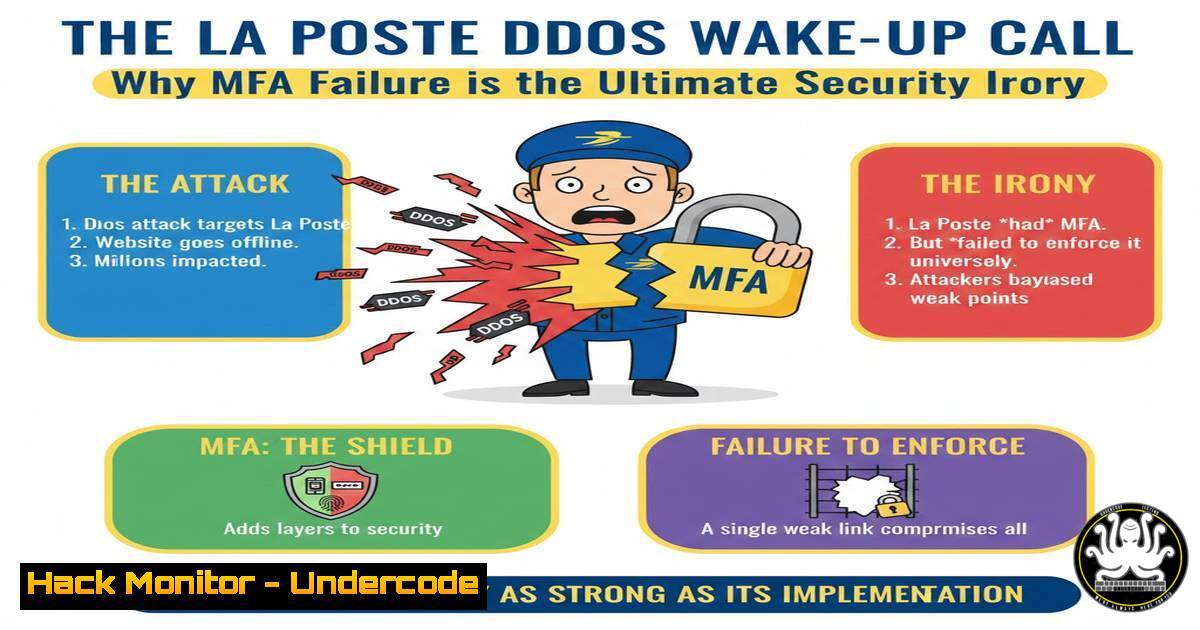
A recent Distributed Denial-of-Service (DDoS) attack targeting France’s national postal service, La Poste, has exposed a critical vulnerability far beyond temporary service disruption. The incident highlights a profound irony in modern cybersecurity: organizations can be crippled by volumetric attacks while simultaneously lacking fundamental access controls like Multi-Factor Authentication (MFA) for their own services. This juxtaposition of a sophisticated attack vector against a basic security oversight serves as a stark lesson in holistic cyber defense.
Learning Objectives:
- Understand the dual threat landscape of DDoS attacks and credential-based breaches.
- Learn to implement and enforce Multi-Factor Authentication (MFA) across critical services.
- Develop a proactive defense strategy that combines infrastructure resilience with identity and access management (IAM) hardening.
You Should Know:
- The Anatomy of a Modern DDoS Attack & The MFA Gap
The La Poste incident underscores a common but dangerous disconnect. While IT teams may fortify network perimeters, internal authentication mechanisms for customer and employee portals can remain weak. A DDoS attack, which floods systems with traffic to overwhelm them, often distracts from—or even facilitates—other exploits like credential stuffing on poorly protected login pages.
Step-by-Step Guide to Basic DDoS Mitigation & MFA Enforcement:
Step 1: Identify Critical Assets: Use tools like `nmap` to map your public-facing services. nmap -sV --top-ports 100 <your-public-ip-range>.
Step 2: Implement Network-Level Protections: Configure your firewall (e.g., `iptables` for Linux) to limit connection rates. A basic rule can be: sudo iptables -A INPUT -p tcp --dport 80 -m connlimit --connlimit-above 50 -j REJECT --reject-with tcp-reset.
Step 3: Enforce MFA on All Public Logins: For cloud services (Azure AD, AWS IAM), navigate to the security settings and disable “password-only” authentication. For on-premise web apps, integrate solutions like Duo Security or OpenOTP.
Step 4: Audit Authentication Logs: On a Linux web server, check for brute-force attempts: sudo grep "Failed password" /var/log/auth.log | awk '{print $11}' | sort | uniq -c | sort -nr.
2. Hardening Identity Providers (IdP) Against Post-DDoS Exploitation
After a DDoS event, security teams are fatigued, and systems are in a recovery state—the perfect time for attackers to launch credential-based attacks. Ensuring your Identity Provider is resilient is key.
Step-by-Step Guide to IdP Hardening:
Step 1: Implement Conditional Access Policies (Azure Example): In the Azure portal, go to Azure AD > Security > Conditional Access. Create a new policy that blocks sign-ins from unfamiliar locations or risky IPs, requiring MFA.
Step 2: Disable Legacy Authentication Protocols: Protocols like POP3, SMTP, and IMAP that don’t support MFA are major weaknesses. Use PowerShell for Microsoft 365: Set-OrganizationConfig -OAuth2ClientProfileEnabled $true.
Step 3: Configure Smart Lockout: Prevent brute-force attacks without locking out legitimate users. In Windows Server Active Directory, fine-tune account lockout policies via `secpol.msc` (Security Settings > Account Policies > Account Lockout Policy).
- Automating Security Posture Checks for MFA and Open Ports
Manual checks fail. Automation ensures continuous compliance with security baselines.
Step-by-Step Guide with Scripts:
Step 1: Check for MFA Registration (Azure AD PowerShell): Use the MSOnline module to find users without MFA registered: Get-MsolUser -All | Where-Object {$_.StrongAuthenticationMethods.Count -eq 0} | Select-Object UserPrincipalName.
Step 2: Scan for Unexpected Open Ports: Create a cron job on a Linux bastion host to run a weekly `nmap` scan and email results: 0 2 6 /usr/bin/nmap -sT -oN /var/log/weekly_scan.log <your-subnet>.
Step 3: Web Service Vulnerability Scan: Use `nikto` to scan a web portal for missing security headers and known flaws: nikto -h https://portal.yourcompany.com -output /var/log/nikto_scan.html.
- Building a Cloud WAF and DDoS Protection Layer
Leverage cloud-native services to absorb attack traffic before it reaches your applications.
Step-by-Step Guide for AWS & Azure:
Step 1 (AWS): Enable AWS Shield Advanced on your Elastic IPs and Application Load Balancers. Configure AWS WAF rules to block malicious IPs from known threat intelligence feeds.
Step 2 (Azure): Enable Azure DDoS Protection Standard on your Virtual Network. Create custom policies in Azure Front Door or Application Gateway to rate-limit requests per client IP.
Step 3: Test Your Defenses: Use a controlled testing service (like Azure’s DDoS Protection simulation) to validate your configuration without causing real disruption.
- Incident Response: Segmenting Networks During an Active DDoS
When under attack, limiting the blast radius is crucial to protect authentication systems.
Step-by-Step Guide with Network Commands:
Step 1: Identify Traffic Patterns: Use `tcpdump` to capture attack traffic for analysis: sudo tcpdump -i eth0 'dst port 443' -w attack_traffic.pcap.
Step 2: Deploy Scrubber Rules: Work with your ISP or cloud provider to redirect traffic through a DDoS “scrubbing” center.
Step 3: Isolate Critical Identity Systems: Use internal firewall rules to ensure your Active Directory or SAML IdP servers are only accessible from specific, trusted management subnets during the incident.
What Undercode Say:
The Real Vulnerability is Often Orthogonal: The most damaging exploit frequently targets a weakness unrelated to the main attack vector. A DDoS doesn’t steal data, but the chaos it creates can expose the lax MFA that does.
Compliance is Not Security: Meeting basic regulatory requirements is insufficient. Proactive hardening of authentication, even for customer-facing services like postal tracking, is a non-negotiable component of modern IT governance.
The La Poste scenario is a textbook case of security theater failing under pressure. Investing in massive bandwidth to mitigate DDoS while neglecting the simple, cost-effective control of MFA creates a brittle security posture. True resilience requires a defense-in-depth strategy where network security and identity management are equally robust, each acting as a fail-safe for the other. Organizations must audit their public services with the same rigor applied to internal systems, assuming every login portal is a primary target.
Prediction:
In the next 2-3 years, we will see a significant rise in hybrid “Smokescreen Attacks”—sophisticated campaigns that combine a large-scale, noisy DDoS with simultaneous, stealthy credential attacks on the same target. The DDoS will serve as both a distraction and a stress test, identifying which security controls (like MFA) fail under pressure. This will force a convergence of DDoS mitigation and Identity Threat Detection and Response (ITDR) teams, leading to integrated security platforms that automatically elevate authentication security during any network-based incident. Organizations that fail to unify these domains will suffer not just downtime, but catastrophic data breaches.
▶️ Related Video (80% Match):
🎯Let’s Practice For Free:
IT/Security Reporter URL:
Reported By: Blasdo Je – Hackers Feeds
Extra Hub: Undercode MoN
Basic Verification: Pass ✅


