Listen to this Post
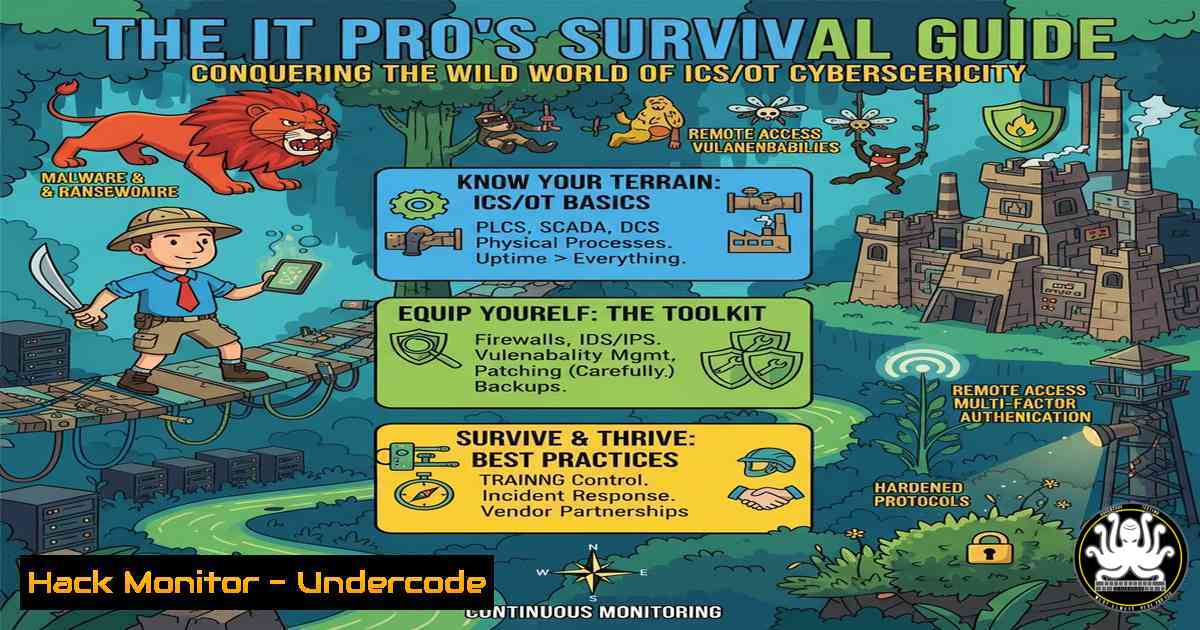
Introduction:
The convergence of Information Technology (IT) and Operational Technology (OT) is reshaping the industrial landscape, creating a critical demand for cybersecurity professionals who can bridge the two domains. For IT security experts, the world of Industrial Control Systems (ICS) and OT presents a unique set of challenges, from proprietary protocols to environments where availability and safety trump confidentiality. This guide provides a tactical roadmap for IT professionals to pivot their skills and secure the systems that run our critical infrastructure.
Learning Objectives:
- Differentiate core ICS components like PLCs and DCS from traditional IT systems.
- Apply hands-on techniques for ICS/OT network reconnaissance and protocol analysis.
- Implement key security controls aligned with the ISA/IEC 62443 framework.
You Should Know:
1. Mastering ICS Network Reconnaissance
Understanding what is on an OT network is the first step to securing it. Traditional IT scanning tools can be too aggressive and disrupt delicate industrial equipment.
`nmap -sU -T polite –script s7-info -p 102 192.168.1.50`
`nmap –script modbus-discover -p 502 192.168.1.100`
`netscan -t 10000 -r 192.168.1.0/24`
Step-by-step guide:
The `nmap` command is used here with specific, OT-safe parameters. The `-sU` flag enables UDP scanning, crucial for protocols like Siemens S7comm. `-T polite` drastically slows the scan to avoid overwhelming devices. The `–script` flag activates NSE (Nmap Scripting Engine) scripts designed to safely enumerate PLCs (s7-info for Siemens, `modbus-discover` for Modbus). Always conduct these scans during planned maintenance windows and in coordination with OT operations staff.
2. Analyzing Industrial Protocols with Wireshark
Passive network monitoring is often safer than active scanning. Wireshark can decode dozens of industrial protocols to help you understand network traffic.
`tshark -i eth1 -f “port 502” -Y “modbus” -V`
`tshark -i eth1 -f “tcp port 102” -Y “s7comm” -w ot_capture.pcap`
In Wireshark GUI: `Analyze -> Enabled Protocols -> Enable “MODBUS”, “S7COMM”, “CIP”`
Step-by-step guide:
The `tshark` command (Wireshark’s command-line interface) captures traffic on interface `eth1` with a filter for Modbus traffic (TCP port 502). The `-Y` display filter shows only Modbus packets, and `-V` provides verbose protocol details. Capturing to a file (-w) allows for offline analysis. In the GUI, enabling the specific industrial protocol dissectors is essential for them to be decoded and displayed correctly, rather than as raw TCP.
3. Hardening a Windows-based HMI
Human-Machine Interfaces (HMIs) in OT are often legacy Windows systems. Hardening them is critical.
`Get-Service | Where-Object {$_.Name -like “Spooler”} | Stop-Service -PassThru | Set-Service -StartupType Disabled`
`New-NetFirewallRule -DisplayName “Block SMB” -Direction Inbound -Protocol TCP -LocalPort 445 -Action Block`
`secedit /export /cfg C:\baseline.inf`
`reg add “HKLM\SYSTEM\CurrentControlSet\Control\FileSystem” /v NtfsDisable8dot3NameCreation /t REG_DWORD /d 1 /f`
Step-by-step guide:
These PowerShell and Command Prompt commands form a basic hardening regimen. The first command finds and disables the Print Spooler service, a common attack vector. The second creates a Windows Firewall rule to block inbound SMB traffic, preventing lateral movement. `Secedit` exports the current security policy for analysis, and the `reg` command disables legacy 8.3 filename creation, mitigating a specific persistence technique. Always test these changes in a non-production environment first.
4. Interacting with a PLC via CLI
Understanding how controllers are programmed is key. Tools like `python-pycomm3` allow for scripted interaction.
`python3 -m pip install pycomm3`
`python3 -c “from pycomm3 import LogixDriver; with LogixDriver(‘192.168.1.50’) as plc: print(plc.get_tag_list())”`
`python3 -c “from pycomm3 import LogixDriver; with LogixDriver(‘192.168.1.50’) as plc: print(plc.read(‘MyTag’))”`
Step-by-step guide:
This Python code uses the `pycomm3` library to communicate with Allen-Bradley ControlLogix/CompactLogix PLCs. The first command installs the library. The second script establishes a connection and retrieves a list of all available program tags, which is invaluable for asset inventory. The third script reads the current value of a specific tag named ‘MyTag’. This demonstrates how an attacker (or auditor) can extract logic and data from a controller.
5. Implementing ISA/IEC 62443 Network Segmentation
The 62443 standard mandates a “defense-in-depth” architecture, most often achieved through segmentation.
`iptables -A FORWARD -i eth_it -o eth_ot -p tcp –dport 44818 -j DROP`
`iptables -A FORWARD -i eth_ot -o eth_it -m state –state ESTABLISHED,RELATED -j ACCEPT`
`iptables -P FORWARD DROP`
`netsh advfirewall firewall add rule name=”Allow HMI to PLC” dir=in action=allow protocol=TCP localport=44818 remoteip=192.168.1.10`
Step-by-step guide:
These `iptables` commands for Linux-based firewalls create a basic segmentation policy. The first rule explicitly blocks any traffic originating from the IT network (eth_it) destined for the OT network (eth_ot) on the EtherNet/IP port. The second rule allows return traffic from the OT to IT side only for already established connections. The default policy for the FORWARD chain is set to DROP. The Windows `netsh` command creates a specific allow rule, a “pinprick” firewall policy that only permits necessary communication from a specific HMI IP.
6. Building a Virtualized OT Home Lab
Gaining hands-on experience is non-negotiable. You can build a lab using free virtualization software and simulated devices.
`git clone https://github.com/thiagoralves/OpenPLC_v3.git`
`docker run -d –name scada-ics –network host sath89/openvpn-tunnel<h2 style="color: yellow;">vmware ––-vmx –-allow-unsupported-plcs ./siemens_s7_plc.vmx`
Step-by-step guide:
This setup uses OpenPLC, an open-source software PLC. The `git clone` command downloads the project. After navigating into the directory, you can follow its build instructions (often ./install.sh) to set it up on a virtual machine. Docker can be used to run pre-built container images of SCADA systems or networking tools. Using VMware or VirtualBox, you can create an isolated network to host these VMs, simulating a real OT environment without the cost of physical hardware.
7. Monitoring for OT-Specific Threats
Security monitoring requires OT-contextualized alerts. Simple command-line log analysis can detect anomalies.
`grep -i “program download” /var/log/plc_comm.log`
`tail -f /var/log/firewall.log | grep “DPT:102″`
`cat network_capture.pcap | tshark -r – -Y “cip.connection_manager.request” | wc -l`
Step-by-step guide:
These commands are for post-incident analysis or real-time monitoring of log files. The first `grep` searches for “program download” events in a PLC communication log, a high-severity action that should be rare. The `tail -f` command monitors a firewall log in real-time for packets destined for the Siemens S7 port (102), providing a live alert. The final command reads a packet capture and uses a Wireshark filter to count all CIP connection requests, establishing a baseline for normal activity.
What Undercode Say:
- Mindset Shift is Non-Negotiable: The greatest tool in your arsenal isn’t a specific command, but an engineering-focused mindset that prioritizes system safety and availability over pure confidentiality.
- Emulation Over Aggression: The standard “spray and pray” penetration testing methodology of IT will fail, and likely cause an outage, in OT. Patience and passive reconnaissance are paramount.
The journey from IT to OT security is less about learning new tools and more about re-learning first principles. The commands and techniques listed are merely the implementation of a deeper understanding: that these systems control the physical world. A mistyped `nmap` switch in a data center might crash a server; the same error in a power plant could have catastrophic consequences. Success hinges on your ability to collaborate with, and earn the trust of, the operational engineers who have spent their careers running these environments. Your goal is not to conquer OT with IT dogma, but to fuse the two disciplines into a resilient, modernized defense.
Prediction:
The skills gap in ICS/OT cybersecurity will widen dramatically over the next three to five years, creating a premium for professionals who have taken the initiative to cross-train. As state-sponsored threat actors increasingly target critical infrastructure, the ability to defend these systems will become a matter of national security. We predict a surge in accredited, hands-on certification programs and the eventual integration of OT security fundamentals into core IT security curricula, moving it from a niche specialty to a mandatory competency.
🎯Let’s Practice For Free:
IT/Security Reporter URL:
Reported By: Mikeholcomb Ten – Hackers Feeds
Extra Hub: Undercode MoN
Basic Verification: Pass ✅


