Listen to this Post
Introduction:
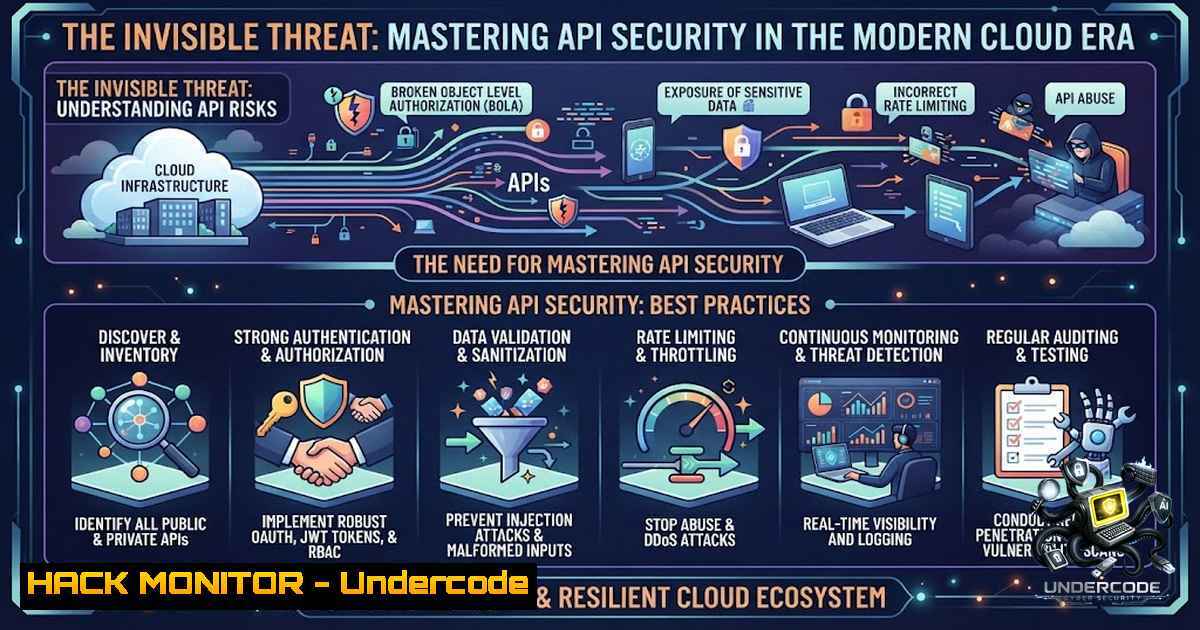
In the hyper-connected digital ecosystem, Application Programming Interfaces (APIs) have become the backbone of modern software, yet they represent one of the largest and most overlooked attack surfaces for enterprise security. While organizations invest heavily in perimeter defenses and endpoint protection, the silent flow of data between services through APIs often remains unguarded, exposing critical vulnerabilities that can lead to catastrophic data breaches. This article dives deep into the tactical implementation of API security, cloud hardening, and AI-driven threat detection, translating complex theoretical risks into actionable, technical procedures for security professionals.
Learning Objectives:
- Understand the OWASP API Security Top 10 and how to map these risks to specific attack vectors in cloud-1ative environments.
- Implement advanced authentication, authorization, and rate-limiting techniques using NGINX, AWS API Gateway, and custom middleware.
- Leverage Linux and Windows command-line tools to audit, test, and harden API endpoints against injection, broken object level authorization (BOLA), and mass assignment attacks.
You Should Know:
- Hunting for Broken Object Level Authorization (BOLA) with Burp Suite and Custom Scripts
BOLA (API1:2023) remains the most critical API vulnerability, allowing attackers to manipulate object identifiers to access unauthorized data. To combat this, we must move beyond simple perimeter checks and implement robust, automated testing. Start by capturing a legitimate API request using a proxy like Burp Suite. Focus on requests that include sequential or predictable IDs (e.g.,/api/v1/users/12345/profile). By intercepting this request and altering the ID to a different user’s ID, we can test for authorization flaws.
A proactive approach involves automating this testing using a combination of `curl` and a simple bash script to iterate through a range of user IDs. For example, a Linux security analyst can use the following command to perform a brute-force BOLA test:
for id in $(seq 1 1000); do curl -s -o /dev/null -w "%{http_code} %{url_effective}\n" -H "Authorization: Bearer $API_TOKEN" "https://api.target.com/v1/users/$id/profile" | grep -v 403; done
On Windows, PowerShell can achieve a similar audit using Invoke-WebRequest. To mitigate this, ensure that all object-level access checks are performed server-side. Avoid exposing internal identifiers in URLs; instead, use UUIDs or hashed IDs. Additionally, implement a strict role-based access control (RBAC) policy that validates user permissions against the requested resource, independent of the ID passed in the request.
- Hardening API Gateways: Rate Limiting and Throttling Configuration
A poorly configured API gateway is an open door to denial-of-service and brute-force attacks. Effective rate limiting is not just about preventing abuse but also about ensuring service availability. In an NGINX environment, the `limit_req` and `limit_conn` directives provide granular control. To configure rate limiting for a specific API route, edit your NGINX configuration file (/etc/nginx/nginx.conf) to define a shared memory zone for tracking requests:http { limit_req_zone $binary_remote_addr zone=mylimit:10m rate=10r/s; server { location /api/v1/ { limit_req zone=mylimit burst=20 nodelay; proxy_pass http://api_backend; } } }For cloud-1ative environments like AWS, you can implement usage plans and API keys to throttle requests. Use the AWS CLI to set up a usage plan:
aws apigateway create-usage-plan --1ame "StrictLimit" --throttle burstLimit=20,rateLimit=10
Combining these techniques with a Web Application Firewall (WAF) that monitors for anomalous traffic patterns is critical. The objective is to create a multi-layered defense where rate limiting serves as the first line of defense against automated attacks, forcing attackers to slow down and making their activity more detectable by security monitoring tools.
3. Exploiting and Mitigating Mass Assignment Vulnerabilities
Mass assignment, also known as auto-binding, occurs when an API automatically binds input parameters to internal object properties without proper filtering. Attackers can exploit this by adding unexpected parameters to a request (e.g., isAdmin=true) to escalate privileges. To test for this, intercept a POST or PUT request. If the request body is JSON, add a parameter like `{“isAdmin”: true, “role”: “superuser”}` and send it to the endpoint.
If the API uses a framework like Spring Boot or Django REST Framework, it might automatically map these properties. As a red team exercise, using `curl` to test this is straightforward:
curl -X PUT -H "Content-Type: application/json" -d '{"username":"attacker", "role":"admin"}' https://api.target.com/v1/users/update
To mitigate, developers must implement allow-lists for properties that can be updated. In Java Spring, use `@JsonIgnore` or Data Transfer Objects (DTOs) to explicitly define which fields are acceptable. Additionally, implementing a strict schema validation library like JSON Schema ensures that any input that deviates from the expected structure is automatically rejected. A good practice is to use a middleware layer that filters incoming requests before they hit the business logic.
4. API Secrets Management with HashiCorp Vault
Hardcoded API keys and database credentials in configuration files are a ticking time bomb. HashiCorp Vault provides a secure and dynamic way to manage secrets. Installing Vault on a Linux server is the first step. After installation, start the Vault server in development mode for testing:
vault server -dev
Once Vault is running, you can store a static secret using the CLI:
vault kv put secret/api-config api-key=ABC123XYZ
Then, to retrieve the secret in your application script, use the Vault API. This approach ensures that secrets are never stored in plain text on disk. For Windows-based CI/CD pipelines, you can use the Vault PowerShell module to interact with the vault. The key takeaway is to implement dynamic secrets—credentials that are generated on-the-fly and have a limited lease duration. This dramatically reduces the blast radius if a token is compromised, as secrets can be revoked and rotated automatically through policies.
5. AI-Driven Anomaly Detection in API Traffic
With the proliferation of AI, attackers are using machine learning to craft more sophisticated attacks, but we can use the same technology to defend our APIs. By implementing an anomaly detection system like the Elastic Stack (ELK) with machine learning capabilities, we can analyze API access logs for behavioral deviations. Start by ingesting your NGINX or AWS CloudFront logs into Elasticsearch. Enable the machine learning job for “API Anomaly Detection” to identify spikes in request rates, unusual geolocations, or patterns of failed authentication.
A simple way to prepare logs for analysis is to use `jq` on Linux to parse and filter JSON logs, extracting only relevant fields like timestamp, client_ip, uri, and status_code. For example:
cat api.log | jq 'select(.status >= 400) | {time: .timestamp, ip: .client_ip, error: .status}'
On Windows, you can use PowerShell to achieve similar filtering. The goal is to build a baseline of normal traffic and then set up alerts for when the AI model detects a statistically significant deviation, indicating a potential brute-force or credential-stuffing campaign in progress.
What Undercode Say:
- Key Takeaway 1: Zero Trust is a Requirement, Not a Buzzword. The old castle-and-moat security model fails when APIs are involved. Every request must be authenticated, authorized, and encrypted, regardless of its origin. It is imperative to treat every API call as if it comes from an untrusted network.
- Key Takeaway 2: Continuous Testing and Automation are the Pillars of Resilience. Manual security reviews are insufficient. By integrating tools like OWASP ZAP and custom BOLA scripts into the CI/CD pipeline, security becomes a proactive part of the development lifecycle rather than a reactive fire drill.
- My analysis emphasizes that the shift towards microservices necessitates a security paradigm shift. We are no longer just defending a perimeter; we are defending hundreds of individual data pathways. The complexity of modern API ecosystems means that human oversight alone cannot catch every misconfiguration. By embedding security into the infrastructure as code (IaC) and using AI to monitor runtime behavior, we create a self-healing security posture. This is not just about blocking attacks but about understanding the behavioral signatures of malicious actors and adapting defenses in real-time. The future of API security is probabilistic, not deterministic.
Prediction:
+1: Organizations that adopt dynamic secrets management and AI-driven monitoring will experience a 60% reduction in successful API-based data breaches within the next two years, moving security left in the development lifecycle.
+1: The integration of AI and ML in API security will mature to a point where automated threat hunting becomes standard, drastically reducing the Mean Time to Detect (MTTD) and Remediate (MTTR).
-1: As defenders adopt AI, attackers will leverage generative AI to craft more nuanced, evasive payloads that bypass traditional rule-based WAFs, leading to a temporary arms race.
-1: The rapid adoption of serverless architectures without corresponding security expertise will lead to a surge in “shadow API” vulnerabilities, where developers spin up insecure endpoints that are invisible to legacy security tools.
+1: Standardization around GraphQL and gRPC security best practices will emerge, driven by community collaboration, which will simplify the hardening process for modern applications.
▶️ Related Video (86% Match):
🎯Let’s Practice For Free:
🎓 Live Courses & Certifications:
Join Undercode Academy for Verified Certifications
🚀 Request a Custom Project:
Secure, high-velocity infrastructure and disruptive technological engineering. Contact our engineering team for high-tier development and proprietary systems:
[email protected]
💎 Smart Architecture | 🛡️ Secure by Design | ⭐ Trusted by Thousands
IT/Security Reporter URL:
Reported By: Karen Cupp – Hackers Feeds
Extra Hub: Undercode MoN
Basic Verification: Pass ✅


