Listen to this Post
Introduction:
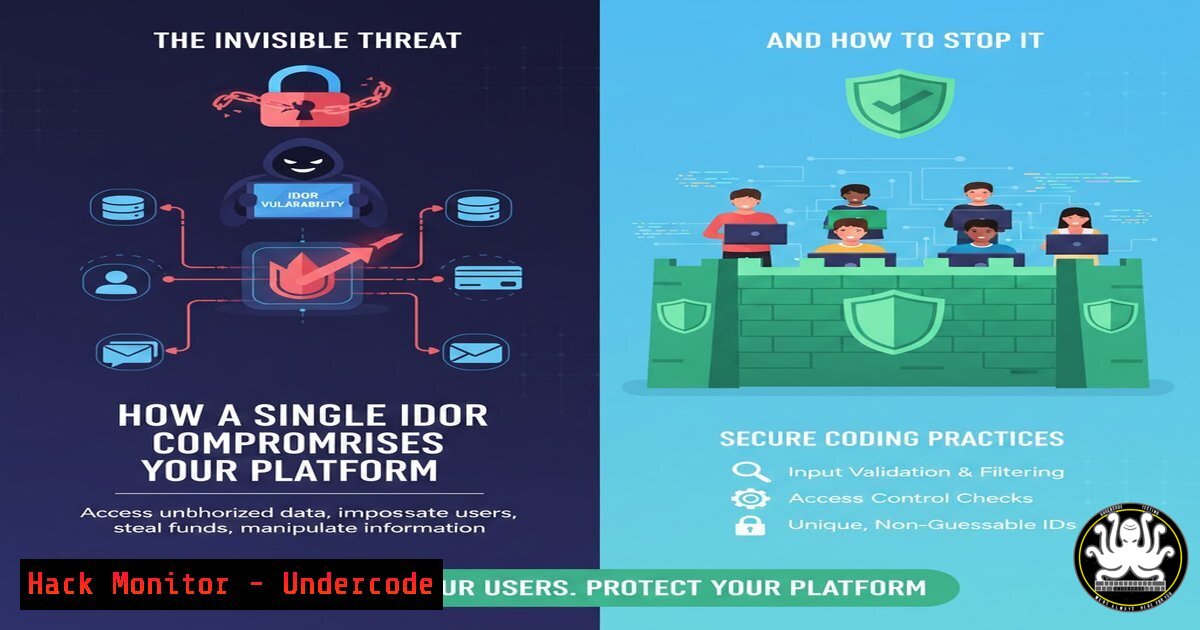
In the world of web application security, Insecure Direct Object Reference (IDOR) vulnerabilities are among the most common and damaging flaws, often leading to massive data breaches. As highlighted by a recent successful bug bounty report on HackenProof, where a researcher uncovered an IDOR allowing unauthorized modification of user financial transactions, these bugs provide attackers with a direct path to bypass authorization. Understanding IDOR is not just for hunters; it’s a critical necessity for every developer and security professional tasked with protecting sensitive data.
Learning Objectives:
- Understand the fundamental mechanics of an Insecure Direct Object Reference (IDOR) vulnerability.
- Learn practical methodologies for hunting and testing for IDOR flaws in web applications and APIs.
- Implement robust server-side authorization controls to prevent IDOR attacks.
You Should Know:
- Deconstructing the IDOR: More Than Just a Broken Access Control
At its core, an IDOR occurs when an application uses user-supplied input (like an ID in a URL or POST parameter) to directly access an object without performing proper authorization checks. The recent HackenProof case—”Unauthorized Modification of Another User’s Top-Up Order”—is a textbook example. The application likely used a sequential order ID (e.g.,/api/order/update/12345) and failed to verify if the authenticated user owned order 12345 before processing the modification.
Step-by-step guide explaining what this does and how to use it:
Step 1: Identify Direct Object References. While browsing an application, note any parameters that seem to reference database objects: id, uid, order, invoice, file. These appear in URLs (/user/profile?id=1001), form fields, or API endpoints (GET /api/v1/invoices/5678).
Step 2: Manipulate the Reference. As a basic test, change the parameter’s value. If you are user A with object ID 1001, try accessing 1002. Use browser developer tools, proxy interceptors like Burp Suite, or simple cURL commands.
Linux/Windows cURL Example:
 Test for IDOR on a user endpoint
curl -H "Authorization: Bearer YOUR_TOKEN" https://target.com/api/user/102/profile
 Try changing 102 to 103, 104, etc., and observe the response.
Step 3: Analyze the Response. A successful IDOR is indicated by retrieving, modifying, or deleting data that does not belong to your account. The server returns a `200 OK` with another user’s data instead of a 403 Forbidden.
- Advanced IDOR Hunting: Parameter Mining and Mass Testing
Modern applications don’t always use simple sequential IDs. They might employ UUIDs, hashes, or complex strings. The vulnerability principle remains the same if the object reference is predictable or enumerable.
Step-by-step guide explaining what this does and how to use it:
Step 1: Decode and Analyze. Capture a reference like file=Zjdmcml2X2lkcw==. This is often just a base64-encoded string. Decode it to see the original value.
Linux Command:
echo "Zjdmcml2X2lkcw==" | base64 --decode
 Output might be: '7friv_ids'
Step 2: Predict and Re-encode. If the decoded value is predictable (e.g., user_102), change it (user_103), re-encode it, and submit the new parameter.
Linux Command:
echo -n "user_103" | base64
 Submit the new encoded value
Step 3: Automate with Fuzzing. For large-scale testing, use tools like Burp Intruder or `ffuf` to fuzz parameter values.
Linux ffuf Example:
ffuf -w /usr/share/wordlists/id_numbers.txt -u 'https://target.com/api/order/FUZZ' -H 'Cookie: SESSION=YOUR_COOKIE' -mr "success"
- Exploiting IDOR in API Endpoints and Stateful Actions
The HackenProof report involved modifying an order, not just viewing it. This is a state-changing IDOR, which is critical. Test all HTTP methods: GET (read), POST (create), PUT/PATCH (update), DELETE.
Step-by-step guide explaining what this does and how to use it:
Step 1: Intercept a Legitimate Request. Use Burp Suite to capture a request where you update your own profile or order.
Step 2: Change the Object ID and Replay. In the intercepted request, change the referencing parameter to another user’s object ID and send it.
Step 3: Verify the Impact. Check if the action was performed on the target object. For a top-up order, you would check if the victim’s order balance or status was altered.
4. The Developer’s Shield: Implementing Server-Side Authorization
The only foolproof mitigation is mandatory server-side authorization checks. Never trust client-side references.
Step-by-step guide explaining what this does and how to use it:
Step 1: Use Indirect References. Map a random, session-specific token to the real database ID on the server. The client only handles the token.
Step 2: Implement Access Control Checks. For every request, verify the authenticated user has permission for the requested object.
Pseudocode Example:
def update_order(request, order_id):
current_user = request.user
order = Order.objects.get(id=order_id)

CRITICAL SERVER-SIDE CHECK
if order.user_id != current_user.id:
raise PermissionDenied("Unauthorized access to this order.")

Proceed with update logic
...
Step 3: Leverage Established Frameworks. Use built-in capabilities of frameworks like Django (@permission_required), Spring Security (@PreAuthorize), or Node.js (middleware like acl) to enforce policies globally.
- Proactive Defense: Integrating IDOR Scans into SDLC and Bug Bounty
Shifting security left and engaging external researchers are powerful strategies.
Step-by-step guide explaining what this does and how to use it:
Step 1: Use SAST/DAST Tools. Integrate Static and Dynamic Application Security Testing tools into CI/CD pipelines. Configure them with rules to detect missing authorization checks (CWE-639).
Step 2: Conduct Rigorous Code Reviews. Make authorization logic a key part of peer review checklists. Ask: “Does this function validate the user owns this object?”
Step 3: Establish a Bug Bounty Program. As demonstrated in the source post, platforms like HackenProof and YesWeHack connect you with skilled researchers like yahya ibrahimi who can find flaws internal teams might miss. This is a cornerstone of responsible disclosure and continuous security improvement.
What Undercode Say:
- IDOR is a Primary Attack Vector: It is not a minor issue. A single IDOR on a critical function (like financial transactions or admin actions) can lead to catastrophic data loss, fraud, and compliance failures. Treat every object reference as a potential threat.
- Automated Tools Are Not Enough: While fuzzing and scanners can find low-hanging fruit, discovering complex IDORs—especially those involving encoded parameters or non-sequential IDs—requires the persistent, analytical mind of a human hunter. This underscores the immense value of skilled security researchers and thorough manual testing.
The successful triage of the “Unauthorized Modification of Another User’s Top-Up Order” is a microcosm of modern AppSec. It shows that even specific, state-changing IDORs are prevalent and that platforms embracing responsible disclosure through bug bounty programs significantly enhance their security posture. The researcher’s methodology—likely involving parameter manipulation, session analysis, and impact verification—is a repeatable blueprint for both attackers and defenders.
Prediction:
In the next 2-3 years, as applications become more interconnected via APIs and microservices, the attack surface for IDOR vulnerabilities will expand exponentially, moving beyond web UIs into GraphQL APIs, gRPC services, and serverless functions. However, we will simultaneously see a major rise in the adoption of standardized, declarative authorization frameworks (like Open Policy Agent) and the integration of AI-powered code analysis tools that can more reliably flag missing authorization checks during development. The bug bounty ecosystem will mature further, with automated triage and payout systems for common flaws like IDOR, allowing human experts to focus on more novel, complex vulnerability chains. The future belongs to platforms that seamlessly blend automated guards, secure-by-design frameworks, and crowdsourced human ingenuity.
▶️ Related Video (72% Match):
🎯Let’s Practice For Free:
IT/Security Reporter URL:
Reported By: Yahyaibr Bugbounty – Hackers Feeds
Extra Hub: Undercode MoN
Basic Verification: Pass ✅


