
Listen to this Post
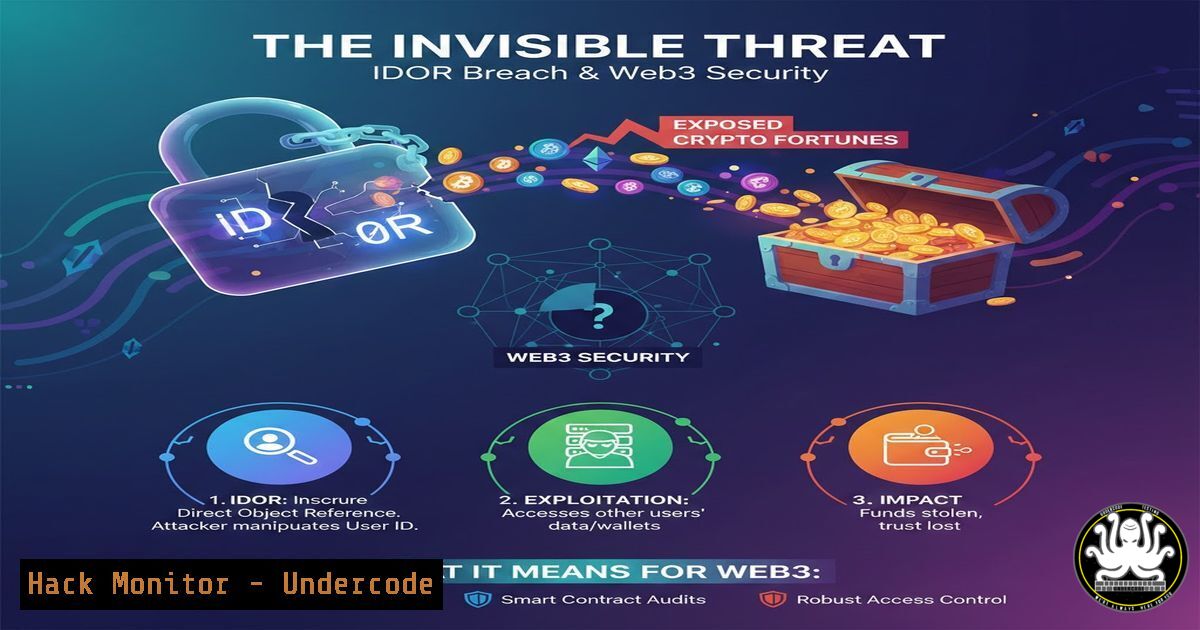
Introduction:
In the rapidly evolving landscape of Web3, where decentralized finance and digital asset ownership are paramount, a classic vulnerability has re-emerged with devastating consequences. A recent security write-up detailed a critical Insecure Direct Object Reference (IDOR) vulnerability within a major bug bounty platform’s API, leading to the exposure of sensitive Personally Identifiable Information (PII) and, most critically, users’ cryptocurrency wallet details. This incident underscores a stark reality: foundational application security flaws do not disappear with new technology paradigms; they become more dangerous.
Learning Objectives:
- Understand the mechanics and impact of Insecure Direct Object Reference (IDOR) vulnerabilities in API endpoints.
- Learn methodologies for discovering and testing for IDOR bugs in modern web and API applications.
- Implement robust authorization controls and secure coding practices to prevent object-level authorization failures.
You Should Know:
1. Decoding the IDOR Vulnerability in API Endpoints
An Insecure Direct Object Reference occurs when an application provides direct access to objects (like database records or files) based on user-supplied input, without verifying the user is authorized for the requested object. In this case, the `/api/user/findById/{userId}` endpoint accepted a user ID parameter and returned the full profile object for that ID, regardless of who made the request.
Step-by-step Guide:
- Reconnaissance: Map all API endpoints, especially those with predictable parameters like
/findById,/getUser,/download?file_id=,/api/orders/{orderId}. Use tools like Burp Suite’s `Target` > `Site map` orOWASP Amass. - Parameter Identification: Identify parameters that reference database objects. Common parameters include:
id,uid,user_id,account,number,file. - Testing for IDOR: As an authenticated user (e.g., your own account ID is
1001), capture a legitimate request to the endpoint.
Burp Suite Manipulation: Send the request to Burp Repeater. Change the parameter value to another likely valid identifier (e.g.,1000,1002,999).
cURL Command Example:
 Legitimate request for your own data
curl -X GET 'https://api.target.com/v1/user/1001' -H "Authorization: Bearer <YOUR_TOKEN>"

Testing for IDOR by changing the object reference
curl -X GET 'https://api.target.com/v1/user/1002' -H "Authorization: Bearer <YOUR_TOKEN>"
4. Analyze Response: If the second request returns data for user 1002, a horizontal IDOR exists. If you can access data for a user with higher privileges (e.g., adminId=1), it’s a vertical privilege escalation.
- The Amplified Impact: PII and Crypto Wallet Exposure in Web3
The severity of an IDOR is dictated by the data it exposes. In a Web3 context, the impact escalates from traditional data breaches. Exposed PII (names, emails, KYC data) is serious, but linked cryptocurrency wallet addresses and transaction details present a direct financial threat. Attackers can map identities to wallets, track transaction histories, and perform targeted social engineering or physical attacks for seed phrase extraction.
Step-by-step Guide (Post-Exploitation Analysis):
- Data Enumeration: Once an IDOR is found, systematically increment/decrement IDs to enumerate all records. Automate this with a script.
import requests
import json</li>
</ol>

headers = {'Authorization': 'Bearer <YOUR_TOKEN>'}
base_url = 'https://api.target.com/v1/user/'

for user_id in range(1000, 1100):
response = requests.get(f'{base_url}{user_id}', headers=headers)
if response.status_code == 200:
data = response.json()
print(f"[+] Found User ID: {user_id}")
print(f" Email: {data.get('email')}")
print(f" Wallet: {data.get('walletAddress')}")
 Write to file for later analysis
2. Wallet Intelligence: Take discovered wallet addresses and query blockchain explorers (Etherscan, BscScan) to assess holdings and transaction volume, quantifying the breach’s financial scope.
3. Impact Report: Document the flow: IDOR → PII Exposure → Wallet Address Disclosure → On-Chain Analysis → Financial and Reputational Risk.3. Proactive Hunting: Methodology for Finding IDOR Flaws
A systematic approach is key. Move beyond random guessing.
Step-by-step Guide:
- Static Analysis (Code Review): Look for patterns where object identifiers are taken directly from the client and used in database queries without authorization checks.
// VULNERABLE CODE PATTERN
app.get('/api/user/:id', (req, res) => {
const userId = req.params.id; // User-controlled input
db.query('SELECT  FROM users WHERE id = ?', [bash], (err, result) => {
res.json(result[bash]); // No check if req.user.id == userId
});
});</li>
</ol>

// SECURE CODE PATTERN
app.get('/api/user/:id', authenticate, (req, res) => {
const requestedId = req.params.id;
if (req.user.id !== parseInt(requestedId) && !req.user.isAdmin) {
return res.status(403).send('Forbidden');
}
// Proceed with query...
});
2. Dynamic Testing with Burp Suite & Plugins: Use the `Autorize` extension to automatically test for authorization flaws. Configure it with a low-privilege session, and it will re-issue high-privilege requests, flagging any where the low-privilege user receives a
200 OK.
3. Test State-Changing Requests: IDOR isn’t just for GETs. Test POST, PUT, DELETE requests (e.g., changing another user’s email, deleting their resource). Always use a test account you control.4. Beyond Basics: Testing GUIDs and Hashed IDs
Applications often use complex identifiers like UUIDs or hashed values. This is not security.
Step-by-step Guide:
- Identify the Pattern: If IDs are long strings (e.g.,
d5f7a8c3-1a4b-4e7f-a2c3-9b8e7f5a2c1d), they are likely UUIDs. If they are fixed-length alphanumeric strings, they may be hashed or encoded. - Test for Predictability: Create two objects (e.g., user profiles) sequentially. Are the IDs sequential or predictable? Analyze the structure.
- Decode/Manipulate: A Base64-encoded `id` like `MjA=` decodes to
20. Test this.Example of decoding a suspected Base64 ID echo "MjA=" | base64 -d Outputs: 20 Now test with ID 19 and 21 echo "MTk=" | base64 -d echo "MjE=" | base64 -d
- Exploit Regardless: Even if you can’t predict another ID, if you can obtain one (e.g., from a shared link, a system message), you can reference it directly. The flaw is the lack of authorization check on that reference.
5. Mitigation and Hardening: Implementing Proper Object-Level Authorization
Prevention requires a consistent, centralized authorization model.
Step-by-step Guide:
- Adopt a Standard Framework: Use established libraries (e.g., Casbin, Spring Security) that enforce policy-based access control.
- Implement Access Control Checks: Always validate the requesting user’s permissions against the object they are trying to access.
Pseudo-code for secure access def get_user_profile(requested_user_id): current_user = get_authenticated_user() Business Logic Check: Can current_user view requested_user_id's profile? if not current_user.is_admin and current_user.id != requested_user_id: raise PermissionDenied("Unauthorized access attempt.") Only then, fetch from database return User.objects.get(id=requested_user_id) - Use Indirect Reference Maps: Avoid exposing real database keys. Use a per-user or per-session mapping.
Real DB ID: 1002 -> Presented to User: u_9f8s7d
Server-side code maps `u_9f8s7d` back to `1002` for the current user only.
- Mandatory Logging and Alerting: Log all authorization failures (
WARNlevel) and set alerts for multiple failures from a single source, which could indicate automated probing.
What Undercode Say:
- The “Old” is the New “Critical”: This case proves that OWASP Top 10 classics like IDOR remain among the highest-impact vulnerabilities, especially when layered onto new technologies like Web3 where financial stakes are immediate and tangible.
- Authorization is a Process, Not a Parameter: Security cannot be bolted on via “secure” parameters (GUIDs, hashes). It must be a core, logical process that validates every data access request against the authenticated user’s context and role.
Prediction:
The convergence of traditional web vulnerabilities with the high-value asset environment of Web3 and DeFi will lead to a surge in targeted, sophisticated attacks focusing on API endpoints. Regulatory bodies will soon mandate stricter cybersecurity frameworks specifically for crypto platforms, moving beyond financial audits to include penetration testing and secure SDLC requirements. Furthermore, we will see a rise in insurance claims and litigation related to digital asset losses from such breaches, pushing the industry towards adopting formal authorization security models (like Relationship-Based Access Control) as a standard, not an afterthought. The platforms that proactively integrate security into their blockchain architecture will survive; those that don’t will face existential threats.
▶️ Related Video (72% Match):
🎯Let’s Practice For Free:
IT/Security Reporter URL:
Reported By: Rupesh Rs – Hackers Feeds
Extra Hub: Undercode MoN
Basic Verification: Pass ✅🔐JOIN OUR CYBER WORLD [ CVE News • HackMonitor • UndercodeNews ]
📢 Follow UndercodeTesting & Stay Tuned:
- Identify the Pattern: If IDs are long strings (e.g.,
- Static Analysis (Code Review): Look for patterns where object identifiers are taken directly from the client and used in database queries without authorization checks.


