Listen to this Post
Introduction:
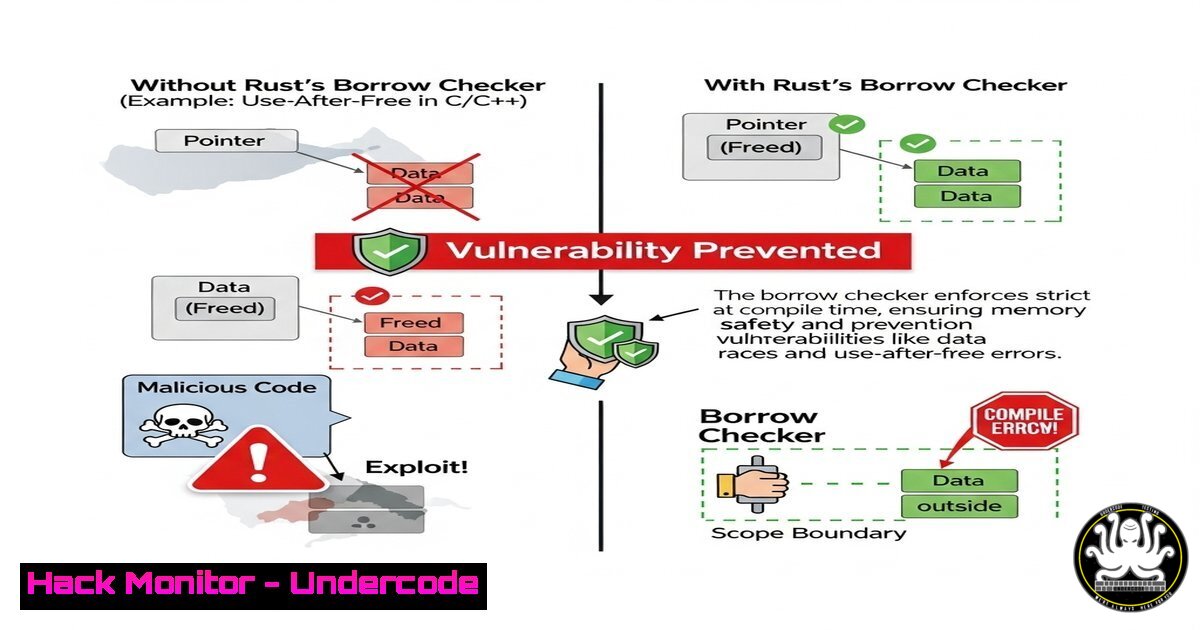
In the relentless battle against cyber threats, memory safety vulnerabilities remain a primary attack vector for exploits. Rust’s compile-time borrow checker enforces strict ownership rules that proactively prevent these critical flaws, fundamentally shifting security left in the software development lifecycle.
Learning Objectives:
- Understand how Rust’s ownership model prevents common vulnerabilities like buffer overflows and use-after-free errors.
- Differentiate between single-threaded (
Rc) and multi-threaded (Arc) reference counting and their security implications. - Implement thread-safe data sharing using Rust’s `Mutex` and `RwLock` to prevent race conditions.
You Should Know:
1. The Foundation of Memory Safety: Ownership
Rust’s ownership is defined by three core rules: Each value has a single owner, there can only be one mutable reference, and multiple immutable references are allowed. This is enforced at compile time.
fn main() {
let s1 = String::from("Secure Data");
let s2 = s1; // Ownership moves to s2

// println!("{}", s1); // This line would cause a compile-time error!
println!("{}", s2); // This is allowed
}
Step‑by‑step guide: This code demonstrates ownership transfer. Attempting to use `s1` after moving its value to `s2` is caught by the compiler, preventing a use-after-free error—a common source of security vulnerabilities in C/C++.
2. Sharing Data Safely Across Threads with `Arc>`
Sharing mutable state between threads requires atomic reference counting (Arc) and a mutual exclusion lock (Mutex) to ensure thread safety.
use std::sync::{Arc, Mutex};
use std::thread;

fn main() {
let counter = Arc::new(Mutex::new(0));
let mut handles = vec![];

for _ in 0..10 {
let counter = Arc::clone(&counter);
let handle = thread::spawn(move || {
let mut num = counter.lock().unwrap();
num += 1;
});
handles.push(handle);
}

for handle in handles {
handle.join().unwrap();
}

println!("Result: {}", counter.lock().unwrap());
}
Step‑by‑step guide: This pattern is crucial for secure concurrent programming. `Arc` allows the `Mutex` to be shared atomically across threads. The `Mutex` ensures that only one thread can access the mutable data at a time, preventing data races which can lead to unpredictable behavior and exploitation.
3. Immutable Data Sharing with `Arc`
For shared, immutable data across threads, `Arc` (Atomic Reference Counter) is both efficient and thread-safe.
use std::sync::Arc;
use std::thread;

fn main() {
let config_data = Arc::new(vec!["api_endpoint", "auth_token"]);
let mut handles = vec![];

for i in 0..3 {
let data = Arc::clone(&config_data);
let handle = thread::spawn(move || {
println!("Thread {}: {:?}", i, data);
});
handles.push(handle);
}

for handle in handles {
handle.join().unwrap();
}
}
Step‑by‑step guide: `Arc` safely allows multiple threads to read the same immutable data. Its atomic reference counting ensures the reference count is updated safely across CPU cores, preventing count corruption. This is safe because the data is immutable.
4. The Pitfall of `Rc` in Concurrent Environments
The single-threaded reference counter `RcSync, making it unsafe for cross-thread use. The compiler will prevent this mistake.
use std::rc::Rc;
use std::thread;

fn main() {
let data = Rc::new(5);
// This will NOT compile - Rc is not thread-safe.
// let handle = thread::spawn(move || {
// println!("{}", data);
// });
// handle.join().unwrap();
}
Step‑by‑step guide: Attempting to send an `Rc` to another thread will result in a compile-time error. This proactive prevention stops developers from accidentally introducing non-atomic operations into a multi-threaded context, which could lead to corrupted reference counts and memory unsafety.
5. Read-Write Locks for Performance-Critical Security
For data that is read often but written to rarely, `RwLock` can offer better performance than a `Mutex` while maintaining safety.
use std::sync::{Arc, RwLock};
use std::thread;

fn main() {
let log_file = Arc::new(RwLock::new(vec![]));

let reader_log = Arc::clone(&log_file);
let reader_handle = thread::spawn(move || {
let log = reader_log.read().unwrap(); // Acquires a read lock
println!("Log contents: {:?}", log);
});

let writer_log = Arc::clone(&log_file);
let writer_handle = thread::spawn(move || {
let mut log = writer_log.write().unwrap(); // Acquires a write lock
log.push("New log entry");
});

reader_handle.join().unwrap();
writer_handle.join().unwrap();
}
Step‑by‑step guide: `RwLock` allows multiple concurrent readers or a single writer. This is essential for building secure, high-performance applications where configuration or log data needs to be frequently read without being blocked by a full mutex, while still ensuring writes are exclusive and safe.
- The `Send` and `Sync` Traits: The Compiler’s Gatekeepers
The `Send` marker trait indicates ownership can be transferred across threads. The `Sync` trait indicates it is safe to reference from multiple threads. Most of Rust’s types are automatically `Send` and `Sync` if their components are.
use std::thread;

fn is_send<T: Send>() {}
fn is_sync<T: Sync>() {}

fn main() {
is_send::<i32>(); // Compiles - i32 is Send
is_sync::<i32>(); // Compiles - i32 is Sync

// is_send::<std::rc::Rc<i32>>(); // Would not compile - Rc is not Send/Sync
// is_sync::<std::cell::RefCell<i32>>(); // Would not compile - RefCell is not Sync

println!("Basic types are thread-safe by default.");
}
Step‑by‑step guide: Understanding these compiler-inferred traits is key to understanding Rust’s concurrency model. The compiler uses these traits to prove that your concurrent code is free from data races before it even runs. This is a monumental shift from runtime detection (e.g., thread sanitizers) to compile-time proof.
7. Unsafe Rust: Bypassing the Guardrails Responsibly
The `unsafe` keyword allows you to perform actions the compiler cannot verify, such as dereferencing raw pointers. Its use should be minimal and carefully audited.
fn main() {
let mut num = 5;

let r1 = &num as const i32;
let r2 = &mut num as mut i32;

unsafe {
println!("r1 is: {}", r1);
println!("r2 is: {}", r2);
r2 = 10;
println!("num is now: {}", num);
}
}
Step‑by‑step guide: This demonstrates how to use `unsafe` blocks to work with raw pointers. In secure software development, `unsafe` should be encapsulated within a safe abstraction that is thoroughly tested and reviewed. The goal is to keep the `unsafe` surface area as small as possible, letting the borrow checker guarantee the safety of the rest of the application.
What Undercode Say:
- Rust’s compile-time enforcement is the most effective tool currently available for eliminating memory corruption vulnerabilities at scale.
- The strict concurrency model forces developers to think correctly about shared state from the outset, turning potential runtime exploits into compile-time errors.
The paradigm shift Rust introduces is not merely syntactic but fundamental. It moves the responsibility for preventing critical security vulnerabilities from the runtime environment and security auditor—where bugs are expensive and dangerous to fix—to the compiler, where they are cheap and safe to fix. This compile-time governance of memory and concurrency rules has the potential to eradicate entire classes of vulnerabilities that have plagued software for decades, making it one of the most significant advancements in secure systems programming.
Prediction:
The adoption of memory-safe languages like Rust will become a central tenet of national cybersecurity strategy and software liability frameworks. Within a decade, writing new critical systems software in non-memory-safe languages will be viewed as professional malpractice, significantly reducing the attack surface available to nation-states and cybercriminals. The economic and security impact will be measured in billions of dollars saved and countless critical infrastructure attacks prevented.
🎯Let’s Practice For Free:
IT/Security Reporter URL:
Reported By: Sonia K01451n5k4 – Hackers Feeds
Extra Hub: Undercode MoN
Basic Verification: Pass ✅


