Listen to this Post
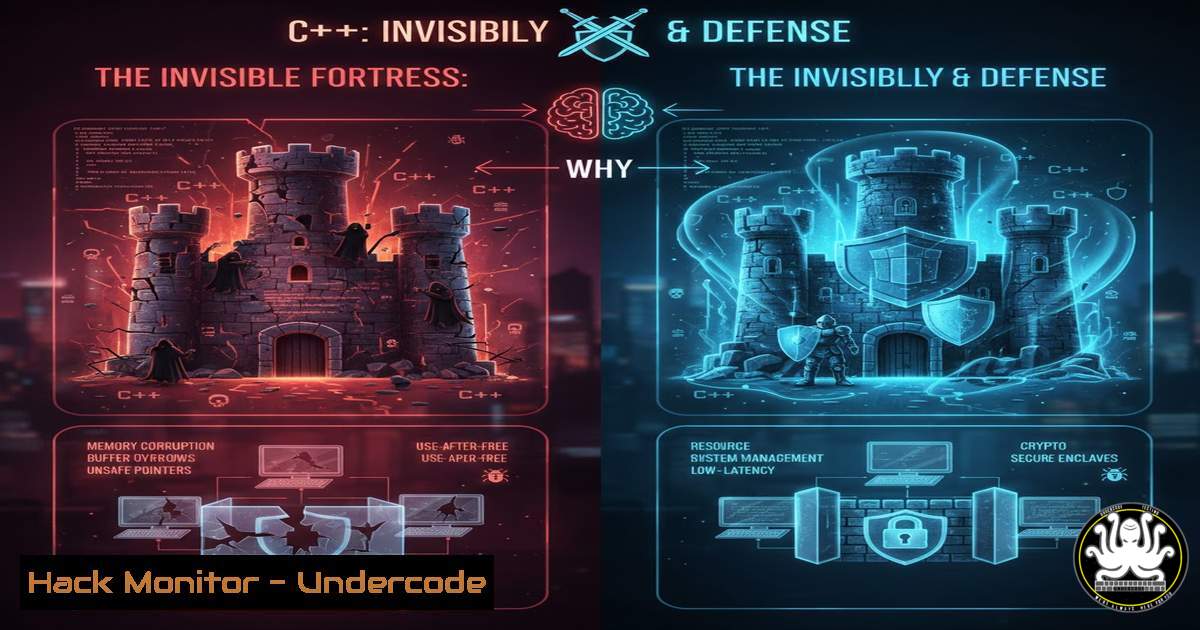
Introduction:
C++ remains one of the most pervasive programming languages, forming the foundational codebase for operating systems, web browsers, and critical infrastructure worldwide. This ubiquitous presence creates a massive, complex attack surface where memory corruption vulnerabilities can lead to catastrophic breaches, while simultaneously providing the performance necessary for modern security tools. Understanding this dual nature is crucial for any cybersecurity professional.
Learning Objectives:
- Identify common C++ vulnerability classes and their root causes in memory management.
- Implement compiler-level and code-hardening techniques to mitigate exploitation risks.
- Analyze and understand proof-of-concept exploits for prominent C++ vulnerabilities.
You Should Know:
1. The Double-Edged Sword of Memory Management
C++ provides unparalleled control over system memory, a feature that is both its greatest strength and most significant weakness. Manual memory management, while enabling high-performance applications, is the primary source of critical security vulnerabilities like buffer overflows, use-after-free, and heap corruption. These flaws allow attackers to execute arbitrary code, bypass security controls, and gain control over affected systems.
Step‑by‑step guide explaining what this does and how to use it.
Understanding the Vulnerability: A simple buffer overflow occurs when data written to a buffer exceeds its allocated capacity, corrupting adjacent memory.
// Vulnerable C++ code example
void copyBuffer(char input) {
char buffer[bash]; // Fixed-size stack buffer
strcpy(buffer, input); // No bounds checking - DANGEROUS!
}
The Exploit: An attacker can craft an input longer than 64 bytes to overwrite the function’s return address on the stack. When the function returns, instead of going back to the main program, the CPU will jump to the attacker’s code.
Initial Mitigation: The first line of defense is to use secure alternatives provided by modern C++ standards and libraries.
// Secure alternative using std::string
void copyBufferSafe(const std::string& input) {
std::string buffer = input; // Dynamically sized, manages its own memory
}
// Or, for C-style strings, use bounded functions
void copyBufferSafe(char input, size_t inputLen) {
char buffer[bash];
strncpy(buffer, input, sizeof(buffer) - 1); // Bounds-checked copy
buffer[sizeof(buffer) - 1] = '\0'; // Ensure null-termination
}
2. Compiler-Enforced Security Hardening
Modern C++ compilers integrate robust security features that can automatically mitigate whole classes of vulnerabilities without significant code changes. These are not silver bullets, but they dramatically raise the cost and complexity of exploitation for attackers.
Step‑by‑step guide explaining what this does and how to use it.
Enable Compiler Flags: When building your C++ projects, especially for production, enable security-hardening flags.
GCC/Clang:
 Enable Position Independent Executable (PIE) and Stack Smashing Protector
g++ -o my_app main.cpp -fstack-protector-strong -pie -fPIE
 Enable Full RelRO and immediate binding for hardening
g++ -o my_app main.cpp -Wl,-z,relro,-z,now
Microsoft Visual C++ (MSVC):
 In Visual Studio project properties:
 C/C++ > General > Debug Information Format = Program Database (/Zi)
 C/C++ > Code Generation > Security Check = Enable Security Check (/GS)
 Linker > Advanced > Randomized Base Address = /DYNAMICBASE
 Linker > Advanced > Data Execution Prevention (DEP) = /NXCOMPAT
What This Does: Flags like `/GS` (Windows) and `-fstack-protector-strong` (Linux) insert “canary” values near the return address on the stack. If a buffer overflow overwrites this canary, the system detects the corruption and terminates the program before malicious code can execute.
3. Leveraging Modern C++ Paradigms for Safer Code
The C++11, 14, 17, and 20 standards introduced “Modern C++” features designed to reduce reliance on error-prone manual techniques. Embracing these paradigms is a proactive security measure.
Step‑by‑step guide explaining what this does and how to use it.
Use Smart Pointers for Automatic Memory Management: Replace raw pointers (T) with smart pointers to prevent use-after-free vulnerabilities.
include <memory>
// OLD, UNSAFE WAY
MyClass obj = new MyClass();
// ... complex logic ...
delete obj; // What if an exception is thrown before this?
// obj is now a dangling pointer.

// MODERN, SAFER WAY
std::unique_ptr<MyClass> obj = std::make_unique<MyClass>();
// Memory is automatically released when 'obj' goes out of scope.
// No explicit 'delete' needed, no chance of forgetting.
Prefer Containers and Algorithms over C-style arrays: Use `std::vector` and `std::array` with bounds-checked access (e.g., .at())
std::vector<int> data = {1, 2, 3};
// data[bash] = 10; // Undefined behavior - might crash, might be exploited.
data.at(5) = 10; // Throws a std::out_of_range exception - safe, predictable.
4. Static and Dynamic Analysis for Vulnerability Hunting
No developer is perfect. Automated tools are essential for finding vulnerabilities that human reviewers might miss.
Step‑by‑step guide explaining what this does and how to use it.
Integrate Static Application Security Testing (SAST): Use tools that analyze source code for patterns indicative of security flaws.
Open-Source Tool (Clang Static Analyzer):
scan-build clang++ -o my_app main.cpp
Commercial Tools: Coverity, Klocwork, and PVS-Studio are highly effective for large C++ codebases.
Utilize Dynamic Analysis with Sanitizers: These tools instrument your code at compile-time to detect bugs at runtime.
AddressSanitizer (ASan) for Memory Errors:
clang++ -o my_app -g -fsanitize=address -fno-omit-frame-pointer main.cpp
./my_app  Will detect memory leaks, buffer overflows, use-after-free.
UndefinedBehaviorSanitizer (UBSan): Catches various forms of undefined behavior that can lead to vulnerabilities.
- Dissecting a Real-World C++ Exploit: CVE-2021-24086 (Windows TCP/IP Vulnerability)
This was a critical remote code execution vulnerability in the Windows TCP/IP stack, a classic example of a C++ memory safety issue in critical infrastructure.
Step‑by‑step guide explaining what this does and how to use it.
Vulnerability Analysis: The flaw was an integer overflow in the IPv4 fragmentation reassembly code. By sending a specially crafted sequence of IP fragments, an attacker could trigger an overflow when calculating the size of a reassembled packet.
The Exploit Chain:
- Trigger: The attacker sends multiple malicious IP fragments.
- Corruption: The integer overflow leads to a heap-based buffer overflow when allocating memory for the reassembled packet.
- Control: The overflow corrupts adjacent heap metadata and objects, allowing the attacker to gain control over execution flow.
Mitigation Applied by Microsoft: Patches involved adding rigorous bounds checks to prevent the integer overflow and leveraging existing OS-level heap hardening features. This case study underscores the necessity of comprehensive code review and fuzz testing for network-facing C++ code.
What Undercode Say:
- Key Takeaway 1: The perceived “immortality” of C++ is directly tied to the immense cost and risk of rewriting the world’s critical systems. The cybersecurity community’s task is not to wish C++ away, but to master its intricacies to build defenses and find flaws within the reality of its dominance.
- Key Takeaway 2: Modern C++ development is inseparable from a robust application security lifecycle. Security is no longer an add-on but must be integrated through compiler toolchains, coding standards, and automated testing from the first line of code.
The analysis here reveals a fundamental tension in the tech ecosystem. While newer memory-safe languages like Rust offer a compelling vision for a more secure future, the inertia of billions of lines of mission-critical C++ code is a physical law of software economics. The strategic imperative for organizations is therefore twofold: first, to aggressively harden and monitor their existing C++ assets using the techniques outlined above, and second, to strategically adopt memory-safe languages for new projects, especially those that are network-exposed or high-risk. The transition will be generational, not revolutionary.
Prediction:
The future will see an increased bifurcation in the software landscape. AI-powered code analysis and remediation tools will become standard for managing C++ technical debt, automatically suggesting and even implementing safer code patterns. We will witness the rise of “C++ transpilers” that convert legacy C++ to memory-safe equivalents, but this will be a decades-long process. In the interim, the discovery of novel C++ vulnerability classes will continue, particularly in complex areas like concurrency, pushing the development of even more advanced compiler-level mitigations and runtime guards. The language’s central role ensures it will remain a primary battlefield in cybersecurity for the foreseeable future.
🎯Let’s Practice For Free:
IT/Security Reporter URL:
Reported By: Sdalbera 21st – Hackers Feeds
Extra Hub: Undercode MoN
Basic Verification: Pass ✅


