Listen to this Post
Introduction:
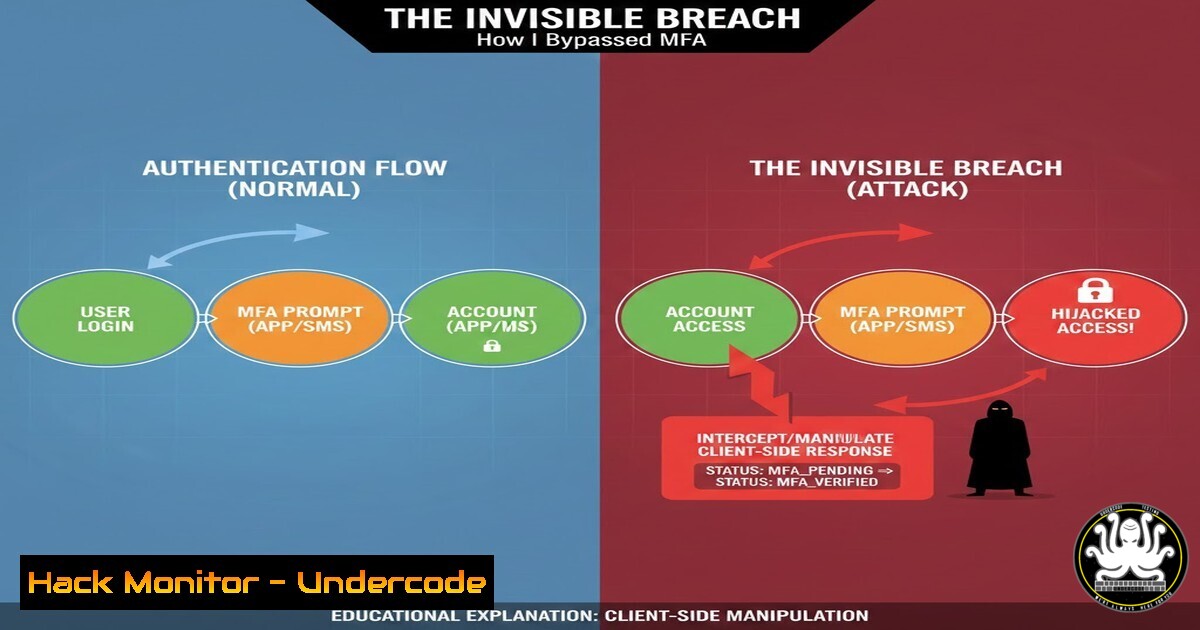
In an era where Multi-Factor Authentication (MFA) is hailed as a cornerstone of security, a devastating flaw can render it utterly useless. This article dissects a critical authentication bypass vulnerability rooted not in complex cryptography, but in a fundamental architectural failure: trusting the client-side application with authentication decisions. We explore how simple response manipulation using tools like Burp Suite can lead to a complete system compromise, bypassing email-based MFA entirely.
Learning Objectives:
- Understand the critical risk of placing authentication state logic on the client-side.
- Learn the practical methodology for discovering and exploiting response manipulation vulnerabilities.
- Master the server-side remediation techniques to eliminate this trust boundary flaw.
You Should Know:
1. Anatomy of a Broken Trust Boundary
The vulnerability existed in a standard MFA flow. After submitting valid credentials, the user would receive a 4-digit code via email. The critical flaw was not in the code generation or delivery, but in the initial credential verification step.
The application’s API endpoints behaved as follows:
`POST /api/login` with valid credentials returned: `HTTP 200 OK` with body {"verify":"true"}.
The same request with invalid credentials returned: `HTTP 401 Unauthorized` with body {"code":"invalid_credentials"}.
The client-side JavaScript code evaluated these responses. If it received a `200` status and a `verify:true` JSON value, it would proceed to the MFA code input screen. The system’s fatal error was trusting that this response came from the server unaltered.
2. Step-by-Step Exploitation Using Burp Suite
This attack exploits the mutable space between the server response and the client’s JavaScript interpreter. An intercepting proxy like Burp Suite is used to manipulate the traffic.
Step-by-Step Guide:
- Intercept Traffic: Configure your browser to use Burp Suite as a proxy. Navigate to the application’s login page.
- Submit Invalid Credentials: Enter a wrong username and password to trigger the failure condition. Send this request.
- Intercept the Response: In Burp’s “Proxy” > “Intercept” tab, the server’s `401` response will be captured before it reaches your browser.
- Manipulate the Response: Change the HTTP status code from `401` to
200. Then, alter the response body from `{“code”:”invalid_credentials”}` to{"verify":"true"}. - Forward the Response: Send this forged response to the browser.
- Observing the Bypass: The client-side JavaScript, seeing a `200 OK` and
verify:true, will be fooled into believing the credentials were valid. It will then automatically advance the user to the MFA code entry screen, effectively bypassing the credential check entirely.
3. Automating the Attack with Python and `mitmproxy`
While Burp is manual, this attack can be scripted for scalability. Using mitmproxy, a Python-powered proxy, attackers can automate response modification.
Example `mitmproxy` Add-on Script:
from mitmproxy import http

def response(flow: http.HTTPFlow) -> None:
 Target the specific login endpoint
if flow.request.pretty_url.endswith("/api/login"):
 Check if the original response was a 401 (auth failure)
if flow.response.status_code == 401:
 Change status to 200 OK
flow.response.status_code = 200
 Replace the entire response body
flow.response.text = '{"verify":"true"}'
print("[+] Authentication bypass injected!")
How to Use:
1. Install mitmproxy: `pip install mitmproxy`
2. Save the script as `bypass.py`.
- Run the proxy with the script: `mitmproxy -s bypass.py`
4. Configure a victim application’s traffic to flow through this proxy to test for the flaw or demonstrate impact.
4. Server-Side Remediation: Implementing Authoritative Session State
The fix must eliminate client-side control over authentication state. The server must maintain and validate a session’s authenticated status.
Step-by-Step Implementation Guide:
- Generate a Secure Session Token: Upon successful verification of both credentials and the subsequent MFA code, generate a cryptographically random session token (e.g., using `/dev/urandom` or a secure library).
- Store Server-Side State: Store this token in a server-side session store (e.g., Redis, database) linked to the user’s privileges and a server-managed “isAuthenticated” flag.
- Send Token to Client: Send the token to the client only as a secure, HttpOnly cookie. Do not include it in JSON responses for JavaScript to parse.
- Validate on Every Request: For any privileged API endpoint, the server must:
Read the session token from the cookie.
Query the server-side session store to verify the token exists and the `isAuthenticated` flag is true.
Only then process the request. The client-side application should have zero ability to influence this check.
- Hardening the Authentication Flow: Beyond the Basic Fix
Remediation requires a defense-in-depth approach.
Use Framework Built-Ins: Leverage established session middleware (e.g., Express-session, Django Sessions, Spring Security) instead of rolling your own.
Implement Idempotent Login Endpoints: Ensure the `/api/login` endpoint, once it returns a failure (401), does not create any server-side state that could be manipulated.
Audit Client-Side Logic: Statically analyze front-end code (JavaScript/TypeScript) for patterns like `if (response.verify === true)` or `if (response.status == 200)` that gate navigation to authenticated areas.
6. Proactive Detection: Testing Your Own Applications
To test for this vulnerability in your own or client applications, integrate these checks into your penetration testing process.
Burp Suite Active Scan: Use the “JSON Parameter Analysis” and “Response Status” modification checks in Burp Scanner.
Custom `grep` Commands for Code Review: In your source code repository, search for risky patterns:
 Find client-side checks on HTTP status or specific JSON fields
grep -r "status.==.200" ./src --include=".js" --include=".ts"
grep -r "verify.true" ./src --include=".js" --include=".ts"
grep -r ".isAuthenticated" ./src --include=".js" --include=".ts"
API Fuzzing with ffuf: Use a tool like `ffuf` to test for unexpected state changes by sending invalid credentials with modified response replay attacks.
What Undercode Say:
- The Client is a War Zone, Not a Fortress. Any security decision made or influenced by code running in an untrusted environment (the user’s browser) is inherently vulnerable. Authentication, authorization, and integrity checks must be the sole purview of the server.
- Response Manipulation is a Low-Skill, High-Impact Attack. This vulnerability does not require advanced reverse engineering or zero-day exploits. It is easily discoverable with standard tools and exploitable by modifying two simple values, making it a prime target for both automated scanners and novice attackers.
This case is not an edge case; it is a symptomatic failure of a “distributed trust” model in web apps. The remediation is not a patch but an architectural paradigm shift. As applications become more dynamic with SPA frameworks like React and Angular, the temptation to let the client manage application state—including authentication state—increases. This creates an attractive attack surface. The persistence of such flaws highlights a gap in secure development training, where the abstract principle of “server-side validation” is taught but its catastrophic violation in real code is not rigorously hunted.
Prediction:
The prevalence of client-side authentication logic flaws will surge with the adoption of more complex, stateful single-page applications (SPAs) and the integration of third-party authentication widgets. As developers rush to implement sleek, app-like experiences, foundational security boundaries will be overlooked. In the next 3-5 years, we will see this class of vulnerability being massively exploited by botnets for credential stuffing attacks at scale, as it bypasses traditional rate-limiting on login endpoints. Furthermore, the rise of AI-assisted code generation could inadvertently propagate these vulnerable patterns if security context is not explicitly provided. The mitigation will be driven by security-focused frameworks that bake in server-side session validation by default and the wider adoption of backend-for-frontend (BFF) patterns that explicitly exclude sensitive logic from the client bundle.
▶️ Related Video (80% Match):
🎯Let’s Practice For Free:
IT/Security Reporter URL:
Reported By: Zlatanh Critical – Hackers Feeds
Extra Hub: Undercode MoN
Basic Verification: Pass ✅


