Listen to this Post
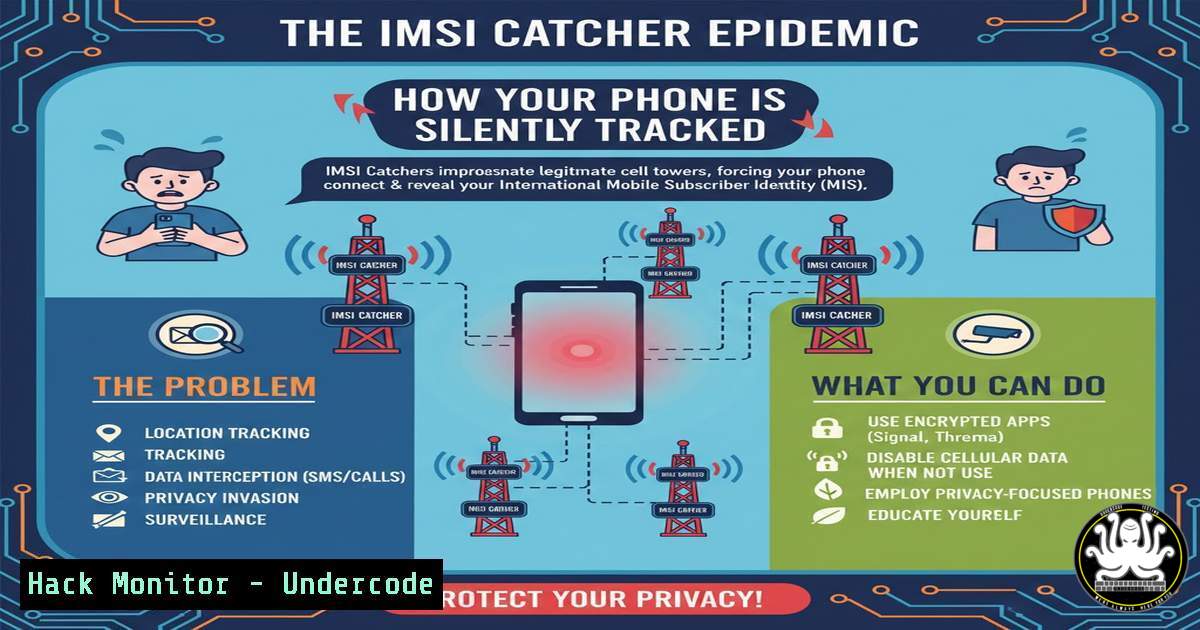
Introduction:
In the shadows of our connected world, a silent war for digital privacy is being waged. While users worry about software viruses and phishing emails, a more insidious hardware-level threat—IMSI catchers and “Stingray” devices—intercepts cellular communications directly from the airwaves. This article deconstructs these surveillance tools and provides a technical arsenal for detection and mitigation, moving beyond theoretical risks to practical defense.
Learning Objectives:
- Understand the technical operation and threat model of IMSI catchers and cellular surveillance systems.
- Learn actionable methods to detect potential cell-site simulator activity on personal and organizational devices.
- Implement layered technical and procedural countermeasures to harden communications against interception.
You Should Know:
- The Anatomy of a Digital Predator: How IMSI Catchers Work
An IMSI catcher is a rogue, portable base station that exploits a fundamental trust mechanism in cellular networks. Your phone continuously searches for the strongest signal from a legitimate cell tower to maintain service. An IMSI catcher broadcasts a more powerful signal, tricking nearby phones into connecting to it as if it were a real tower. Once connected, it performs a “handshake” that forces the device to transmit its unique International Mobile Subscriber Identity (IMSI) number—a permanent identifier for your SIM card. Some advanced devices can then downgrade encryption, intercept calls and SMS, or pinpoint a device’s location with alarming precision.
Step-by-step guide to the attack chain:
- Deployment: An attacker positions the device within range of a target, often in a vehicle or briefcase.
- Spoofing: The device spoofs the identity (MCC, MNC, LAC) of a legitimate local cell tower.
- Luring: It broadcasts a stronger signal, causing target phones to automatically “re-select” to it.
- Interrogation: It requests identity information (IMSI, IMEI) from connected devices.
- Exploitation: Depending on its capabilities, it may then passively log data or actively intercept traffic.
-
From Suspicion to Detection: Technical Signs of an Active IMSI Catcher
Your phone’s status menus hold the first clues. Detection relies on identifying anomalies in network behavior that a legitimate carrier would not produce.
Step-by-step guide for manual detection:
Check for Network Anomalies (Android):
- Enable Developer Options (tap Build Number 7 times in Settings > About Phone).
- Navigate to Settings > System > Developer Options > Networking.
- Select “Show Cellular Network Info” or a similar status display.
- Watch for rapid, unexpected changes in the Cell ID or Location Area Code (LAC) while stationary, or if your phone shows an unusual network generation (e.g., stuck on 2G/GSM in a 5G area).
Check for Network Anomalies (iOS):
- Enter Field Test Mode by dialing `300112345` and pressing Call.
- Observe the “serving cell info” for the Cell ID and Freq Band Indicator.
- Note the values, then enable Airplane Mode and disable it. If you reconnect to a cell with a different Cell ID but identical signal strength and frequency, a simulator may be present.
Use Dedicated Detection Apps:
Install apps like SnoopSnitch (Android, requires root and specific Qualcomm chipsets) or Cell Spy Catcher to analyze radio fingerprints and cross-reference cell tower data with known legitimate databases.
- Hardening Your Device: The First Line of Technical Defense
Proactive configuration changes can prevent your device from falling victim to the most common attacks.
Step-by-step guide for device hardening:
Disable 2G/GSM Fallback (Critical): This legacy protocol has weak or no encryption and is a primary attack vector.
Android 12+: Go to Settings > Network & Internet > SIMs > Allow 2G. Toggle this setting OFF.
iOS 15+: Go to Settings > Cellular > Cellular Data Options > Voice & Data. Ensure “5G Auto” or “LTE” is selected. There is no direct 2G toggle, but choosing LTE/5G minimizes 2G use.
Prevent Wi-Fi-Based Tracking:
Disable “Wi-Fi Scanning” and “Bluetooth Scanning” for location services (Settings > Location > Location Services > System Services on iOS; Settings > Location > Improve Accuracy on Android).
Utilize Encrypted Communication Apps: Standard calls (CSFB/VoLTE) and SMS are vulnerable. Mandate the use of Signal or WhatsApp (with end-to-end encryption enabled) for sensitive voice and text communication, which encrypts data before it reaches the cellular radio layer.
4. Network-Level Analysis and Operational Security (OpSec)
For high-risk individuals or organizations, monitoring the radio frequency (RF) environment is necessary.
Step-by-step guide for advanced monitoring:
- Acquire an SDR (Software-Defined Radio): A HackRF One or RTL-SDR dongle can be used to scan the spectrum.
- Use Analysis Software: Use GNU Radio with dedicated open-source tools like GR-GSM or Kraken to passively monitor GSM signals.
- Identify Suspicious Signals: Look for base stations broadcasting unusual power levels, on non-standard frequencies, or with anomalous system information messages. A sudden appearance of a new, strong cell tower is a major red flag.
- Implement Procedural Controls: For sensitive meetings, use Faraday bags to physically block all RF signals from devices. Establish protocols where devices are powered down completely, not just in airplane mode.
-
The Legal and Supply Chain Frontier: Understanding the Broader Ecosystem
Technical measures are incomplete without understanding the context. IMSI catchers are sold to law enforcement and military but frequently leak to criminal and hostile state networks. Legislation governing their use is often outdated or non-existent. Furthermore, the product promoted in the source post represents a concerning trend: the commoditization of counter-surveillance. Purchasing such “solutions” from unverified vendors carries significant risks, including the device itself being compromised, acting as a beacon, or providing false assurance.
What Undercode Say:
The Threat is Localized but Accessible: IMSI catchers are a proximity-based threat, requiring an attacker to be within a few hundred meters to a few kilometers. However, the technology has become commodity-level, putting high-value targets at consistent risk.
Encryption Alone is Not a Shield: While using encrypted apps like Signal is crucial, the initial lure and handshake with an IMSI catcher can still reveal your identity, location, and metadata. Defense requires a multi-layered approach focused on preventing the initial connection.
The original post leverages legitimate fear to market a specific hardware solution. While the threat is real, a holistic security posture—combining device configuration, communication app discipline, user awareness, and RF situational awareness—is more effective and less risky than relying on a single, opaque device. True digital sovereignty comes from knowledge and verifiable, open-source practices, not from proprietary black boxes.
Prediction:
The proliferation and miniaturization of IMSI catcher technology will continue, driving its integration into autonomous surveillance systems and the Internet of Things (IoT). In response, the next frontier will be the widespread deployment of network-based detection by mobile carriers, using Machine Learning (ML) to identify rogue base station signaling anomalies. Furthermore, we will see a stronger push for identity protection at the protocol level, such as the integration of SUPI (Subscription Permanent Identifier) protection in 5G networks, though legacy device support will remain a critical vulnerability for years to come. The privacy arms race is escalating from the application layer down to the physical radio layer.
▶️ Related Video (72% Match):
🎯Let’s Practice For Free:
IT/Security Reporter URL:
Reported By: Priyank Gada – Hackers Feeds
Extra Hub: Undercode MoN
Basic Verification: Pass ✅


