Listen to this Post
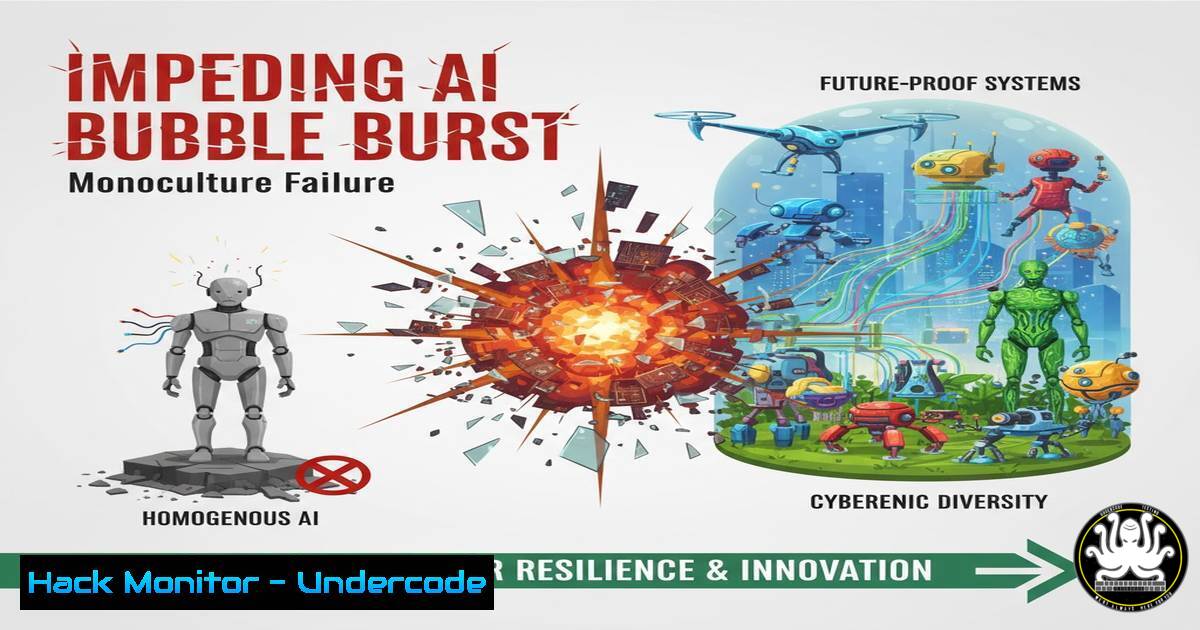
Introduction:
The breakneck speed of Large Language Model (LLM) development masks a critical systemic vulnerability: a lack of true cybernetic diversity. Drawing from cybernetics principles, this article argues that the very factors driving AI’s rapid ascent—efficient, homogenous training on centralized data—are sowing the seeds for its potential downfall. We will explore the technical imperatives for building resilient, self-regulating AI systems that can withstand entropy and adversarial threats.
Learning Objectives:
- Understand the cybernetic principles of Requisite Variety and entropy as they apply to AI and cybersecurity.
- Identify the technical vulnerabilities inherent in homogenous, closed-loop AI systems.
- Implement strategies to inject diversity and resilience into AI development and IT operations.
You Should Know:
- The Law of Requisite Variety and Why Your AI is Fragile
The core cybernetic principle, Ashby’s Law of Requisite Variety, states that for a system to be stable, the controller must have at least as much variety as the system it is controlling. In cybersecurity terms, your defense must be as complex and adaptable as the attacks you face. Homogenous LLMs, trained on similar datasets with similar architectures, possess low internal variety. This makes them inherently fragile against the high-variety threats of the real world, such as sophisticated prompt injection attacks or data poisoning.
Step-by-step guide explaining what this does and how to use it:
Conceptualize: View your AI model not as a static product but as a “controller” in a cybernetic system. Its environment is the user input, which includes malicious actors.
Assess Variety: Audit your training data for homogeneity. Use tools like `pandas` in Python to analyze data sources and `scikit-learn` to measure feature diversity.
import pandas as pd
from sklearn.decomposition import PCA
from sklearn.preprocessing import StandardScaler

Load your training dataset
data = pd.read_csv('training_data.csv')
features = data.drop('target', axis=1)

Standardize and apply PCA to see data spread/variety
scaler = StandardScaler()
scaled_features = scaler.fit_transform(features)
pca = PCA(n_components=2)
principal_components = pca.fit_transform(scaled_features)

Plot the results - a tight cluster indicates low variety
plt.figure(figsize=(8,6))
plt.scatter(principal_components[:, 0], principal_components[:, 1])
plt.title('PCA of Training Data - Visualizing Variety')
plt.xlabel('Principal Component 1')
plt.ylabel('Principal Component 2')
plt.show()
Action: Actively seek out and incorporate diverse, edge-case data to increase your model’s internal variety, making it a more robust controller.
2. Combatting Entropy in AI and IT Systems
Glenn Wilson’s comment correctly links closed systems to entropy—the natural progression towards disorder. An LLM that is not continuously updated with new, diverse information and corrective feedback will experience “conceptual drift,” becoming less accurate and more vulnerable over time. This is analogous to an unpatched server: a static target for exploitation.
Step-by-step guide explaining what this does and how to use it:
Monitor: Implement continuous monitoring for model performance decay and emerging adversarial tactics. In Linux, use cron jobs to run regular integrity checks.
`0 2 /usr/bin/python3 /path/to/your/model_monitor.py` Run a monitoring script daily at 2 AM
Feedback Loop: Establish a robust, human-in-the-loop feedback system to label incorrect or malicious outputs. This injects the necessary “energy” to fight entropy.
Automate Patching: For IT systems, automate your patch management. On a Windows server using PowerShell, you can automate update checks:
 Script to check for and install pending updates
Install-Module PSWindowsUpdate -Force
Get-WUInstall -AcceptAll -AutoReboot
3. Hardening AI APIs Against Exploitation
The primary interface to an LLM is often an API. A homogenous model with predictable failure modes presents a low-variety attack surface. Adversaries can use this to their advantage, crafting prompts that lead to data leakage, unauthorized actions, or model hijacking.
Step-by-step guide explaining what this does and how to use it:
Implement Strict Input Sanitization: Treat all API inputs as potentially hostile. Use regular expressions and input validation libraries.
from flask import Flask, request, abort
import re

app = Flask(<strong>name</strong>)

@app.route('/chat', methods=['POST'])
def chat_endpoint():
user_input = request.json.get('message')
 Basic example: Check for excessive length and suspicious patterns
if len(user_input) > 1000 or re.search(r'(?i)(password|ssh-rsa|curl |wget )', user_input):
abort(400, description="Invalid input detected.")
 ... process input
Use API Gateways: Deploy an API gateway (e.g., AWS API Gateway, Kong) to enforce rate limiting, authentication, and schema validation before requests even reach your model.
Deploy Web Application Firewalls (WAF): Configure a WAF with custom rules to detect and block common prompt injection patterns.
4. Building a Diverse AI Red Team
You cannot defend against threats you cannot imagine. A homogenous development team will produce a homogenous model. A dedicated, diverse “Red Team” for AI is essential to stress-test your systems.
Step-by-step guide explaining what this does and how to use it:
Assemble the Team: Include members with diverse backgrounds—not just AI engineers, but also security experts, ethicists, and domain specialists.
Conduct Adversarial Simulation: Systematically attempt to jailbreak, poison, and extract data from your own models. Use frameworks like Microsoft’s Counterfit or IBM’s Adversarial Robustness Toolbox.
`pip install counterfit`
counterfit --help
counterfit scan -t my_ai_endpoint
Iterate and Mitigate: Document every successful attack and use it to retrain and harden your model, effectively increasing its internal variety.
5. The Infrastructure: Ensuring Underlying System Resilience
A resilient AI model is useless if it runs on fragile infrastructure. The principles of cybernetic diversity must extend to your cloud and on-premise environments.
Step-by-step guide explaining what this does and how to use it:
Embrace Multi-Cloud/Hybrid Strategies: Avoid vendor lock-in and single points of failure. Use infrastructure-as-code (Terraform, Ansible) to maintain consistent, repeatable deployments across environments.
 Example Terraform snippet for multi-cloud load balancer config
resource "aws_lb" "app_aws" { ... }
resource "google_compute_backend_service" "app_gcp" { ... }
Implement Zero-Trust Architecture: Assume breach. Enforce strict identity verification, micro-segmentation, and least-privilege access controls for every user and service account accessing your AI systems.
Automate Incident Response: Use SOAR (Security Orchestration, Automation, and Response) platforms to automatically contain and remediate threats, reducing the time an attacker has to operate.
What Undercode Say:
- Diversity is a Security Control: In the context of AI, diversity in data, teams, and architecture is not an ethical nice-to-have; it is a fundamental technical control for managing systemic risk and adhering to Ashby’s Law.
- The Bubble is a Risk, Not a Certainty: The “AI bubble” will only burst for organizations that treat LLMs as static, closed systems. Those that embed continuous learning, adversarial testing, and cybernetic principles into their lifecycle will build the resilient systems of the future.
The current trajectory of mass-producing similar LLMs creates a systemic risk akin to a monoculture in agriculture—a single novel threat could devastate the entire ecosystem. However, this is not a foregone conclusion. The organizations that will thrive are those that recognize AI as a dynamic, cybernetic system. They will invest in the “messy” and resource-intensive work of fostering internal variety through diverse data, red teams, and adaptive infrastructure. The future of secure, trustworthy AI depends not on making models bigger and faster, but on making them more nuanced, resilient, and ultimately, more intelligent in the truest sense of the word.
Prediction:
The failure to integrate cybernetic principles will lead to a significant, public “AI Chernobyl” event within the next 3-5 years—a catastrophic failure of a major LLM due to a lack of requisite variety, such as a cascading failure from a sophisticated prompt injection attack or large-scale data poisoning. This event will trigger a market correction, shifting investment and focus from raw parameter count and speed to provable resilience, explainability, and built-in adaptive security, fundamentally altering the AI development landscape. Regulatory frameworks will emerge, mandating diversity audits and adversarial testing for critical AI systems.
🎯Let’s Practice For Free:
IT/Security Reporter URL:
Reported By: Harishjose On – Hackers Feeds
Extra Hub: Undercode MoN
Basic Verification: Pass ✅


