
Listen to this Post
Introduction:
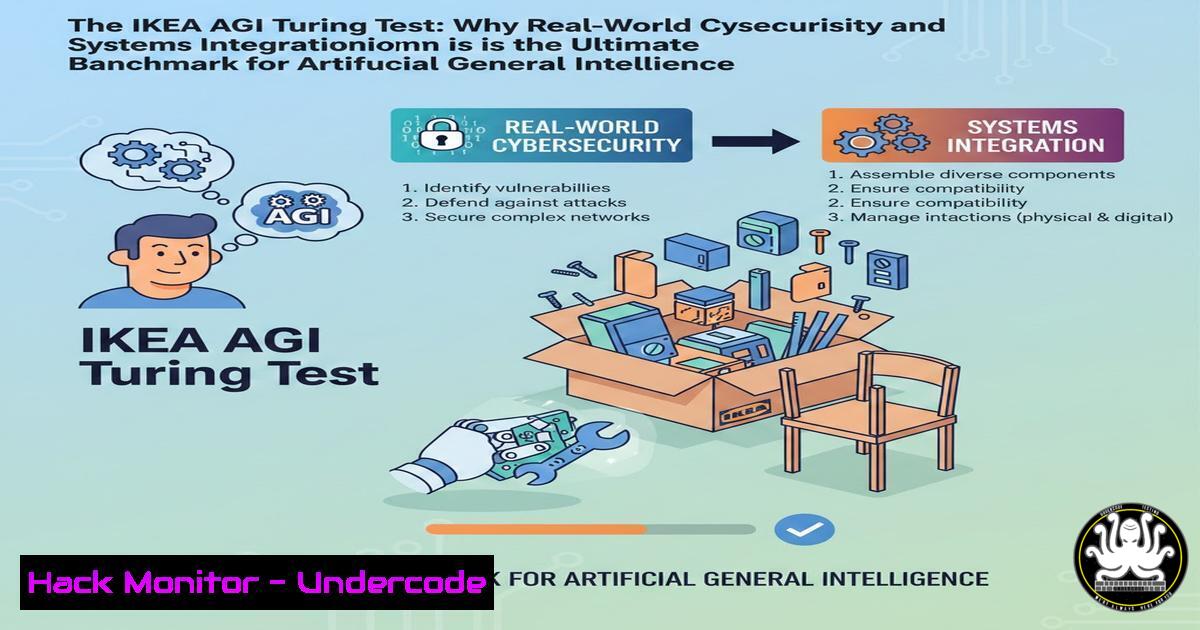
The provocative “IKEA Turing Test” proposed by industry expert Rob Tiffany moves beyond theoretical chatbots and benchmarks Artificial General Intelligence (AGI) against a chaotic, multi-modal real-world task. This test is not merely about reasoning but about integrating perception, action, decision-making, and error correction in an unpredictable physical environment—a scenario ripe with cybersecurity, IoT, and systems engineering challenges. Achieving this requires a secure, robust fusion of AI, robotics, and IoT, exposing the monumental gap between narrow AI and true autonomous intelligence.
Learning Objectives:
- Deconstruct the IKEA AGI Test into its core technical domains: robotic control systems, computer vision, natural language processing, and secure IoT orchestration.
- Understand the critical cybersecurity vulnerabilities inherent in deploying integrated AI-physical systems, from sensor manipulation to command injection.
- Explore the tools, frameworks, and code required to simulate or attempt components of this test in a lab environment.
You Should Know:
1. The Robotic Control & Sensor Integration Layer
The agent must physically interact with boxes, tools, and furniture parts. This requires a robotic system with actuators, coupled with a suite of sensors (LiDAR, cameras, force-torque). The control stack, often built on ROS (Robot Operating System) or similar frameworks, must be hardened against exploitation.
Step-by-Step Guide:
A basic simulated setup in ROS involves creating a robot model and programming simple pick-and-place logic, which is vulnerable to command injection if not properly secured.
 On a Ubuntu/ROS Melodic system
sudo apt-get install ros-melodic-ros-tutorials
 Launch a basic simulation environment
roscore &
rosrun turtlesim turtlesim_node
 A simple Python script to control movement is susceptible to unsanitized input
 Secure practice: Validate all motion topics and use ROS namespaces to isolate systems.
What this does: This sets up a minimal robotic simulation. The cybersecurity angle is paramount: an unsecured ROS master node (default port 11311) exposed on a network can allow an attacker to send malicious velocity commands, causing physical damage. Mitigation involves ROS 2’s built-in security features (DDS-Security), network segmentation, and rigorous input validation for all topic subscriptions.
2. Computer Vision for Unstructured Environment Parsing
The agent must “spread out all the furniture components” and “read the paper instructions.” This involves object detection/segmentation in a cluttered scene (using YOLO or Segment Anything Model) and visual language understanding (multimodal LLMs like GPT-4V or open-source alternatives).
Step-by-Step Guide:
Using a pre-trained model to identify parts and text in a simulated environment.
 Simplified Python pseudocode using OpenCV and Tesseract
import cv2
import pytesseract
from ultralytics import YOLO

Load a pre-trained model for part detection
model = YOLO('yolov8n.pt')
image = cv2.imread('cluttered_floor.jpg')
results = model(image, conf=0.5)
for box in results[bash].boxes:
x1, y1, x2, y2 = box.xyxy[bash]
cv2.rectangle(image, (int(x1), int(y1)), (int(x2), int(y2)), (0,255,0), 2)

Use OCR to read any visible instructions
text = pytesseract.image_to_string(image)
print(f"Extracted text: {text}")
What this does: This code detects objects and extracts text. The vulnerability lies in adversarial attacks—subtly modified instructions or part labels could cause the AI to misinterpret steps. Defenses include training with adversarial examples, digital watermark verification of instructions, and cross-referencing extracted text with a secure database.
3. Secure Task Planning & API Orchestration
The initial step, “independently order a piece of furniture from IKEA,” requires autonomous web navigation and API interaction. This involves an AI agent using tools like Selenium or Playwright, which must manage authentication, payments, and session security without exposing sensitive data.
Step-by-Step Guide:
Automating a browser action with Playwright, incorporating error handling.
from playwright.sync_api import sync_playwright

with sync_playwright() as p:
browser = p.chromium.launch(headless=False)
context = browser.new_context(ignore_https_errors=False)  Enforce HTTPS
page = context.new_page()
try:
page.goto("https://www.ikea.com")
 ... navigation logic to find and add item to cart
 SECURITY CRITICAL: Never hardcode credentials. Use environment variables.
 Implement secure secret management (e.g., HashiCorp Vault, AWS Secrets Manager).
login_env_var = os.getenv('IKEA_TEST_USER')
except TimeoutError:
 Error handling for network-based failures
print("Navigation failed.")
finally:
context.close()
browser.close()
What this does: This automates a browser task. The security risks are massive: credential leakage, session hijacking, and being flagged as a bot. Mitigations include using dedicated API keys if available, running in isolated environments, and implementing human-like delay patterns to avoid detection.
- IoT Integration and Edge Actuation for “Chasing the Garbage Truck”
The final, humorous step involves dynamic response to a real-world event (missed pickup). This requires integration with municipal IoT systems (smart bins, truck GPS) via APIs or MQTT/CoAP protocols, and the ability to replan a physical path.
Step-by-Step Guide:
Subscribing to a simulated MQTT topic for garbage truck location and triggering an alert.
 On the agent's edge device, subscribe to a topic
mosquitto_sub -h iot-broker.example.com -t "city/garbage-truck/gps" -v

Sample listener script (Python with paho-mqtt)
import paho.mqtt.client as mqtt
def on_message(client, userdata, msg):
if msg.topic == "city/garbage-truck/gps":
coords = msg.payload.decode()
if calculate_distance(coords, home_coords) < 100:  Truck is 100m away
trigger_alert("Take bin out NOW!")
 SECURITY: Use TLS encryption (port 8883) and client certificates for authentication.
What this does: It listens for real-time IoT data. This system is vulnerable to MQTT broker exploits, message spoofing (sending a false “truck is here” signal), and DoS attacks. Hardening requires TLS v1.3, unique client certificates per device, and payload integrity verification via digital signatures.
- Vulnerability Exploitation and Mitigation in Integrated AI Systems
The entire integrated system presents a massive attack surface. A threat actor could exploit any layer—poisoning the training data for part recognition, jamming LiDAR signals, or injecting malicious commands into the task planner—to cause failure or physical harm.
Step-by-Step Guide:
Demonstrating a simple command injection in a poorly written robotic control interface.
 VULNERABLE CODE - A function that processes sensor data to command actuator
def process_sensor_command(raw_sensor_input):
 DANGER: Executing unsanitized input
exec(f"move_actuator({raw_sensor_input})")

SECURE CODE - Use an allowlist and parameterized commands
def process_sensor_command_secure(raw_sensor_input):
allowed_commands = {'up', 'down', 'left', 'right'}
if raw_sensor_input in allowed_commands:
move_actuator(raw_sensor_input)
else:
log_security_event(f"Invalid command attempt: {raw_sensor_input}")
What this does: The vulnerable code allows arbitrary code execution. The secure version validates input. For a system attempting the IKEA test, a comprehensive DevSecOps pipeline, hardware-enforced security (Trusted Platform Modules), and continuous penetration testing of the integrated stack are non-negotiable.
What Undercode Say:
- The Test is a Security Stress Test: Each step of the IKEA AGI Test is a proxy for a complex, multi-vector cybersecurity challenge. Building such a system securely is arguably harder than building the AI itself.
- AGI’s Greatest Hurdle is Trust, Not Intelligence: Before an AGI agent can be deployed in a human environment, it must achieve a level of operational technology (OT) security and resilience that current IT-centric models are not designed for. The “garbage truck chase” scenario perfectly illustrates the need for secure, real-time decision-making under uncertainty.
Prediction:
The first entity to credibly demonstrate a system approximating the IKEA Turing Test will not be an AI lab, but likely a well-funded interdisciplinary consortium combining top robotics, cybersecurity, and AI talent. This achievement will trigger a seismic shift in cybersecurity priorities, moving focus from data and network protection to the security of autonomous, physical action. It will birth a new industry of “AGI Security” focused on preventing catastrophic action failures, adversarial physical exploits, and securing the AI-to-actuator pipeline, ultimately becoming the primary bottleneck for the safe deployment of all advanced autonomous systems.
▶️ Related Video (70% Match):
🎯Let’s Practice For Free:
IT/Security Reporter URL:
Reported By: Robtiffany Introducing – Hackers Feeds
Extra Hub: Undercode MoN
Basic Verification: Pass ✅


