Listen to this Post
Introduction:
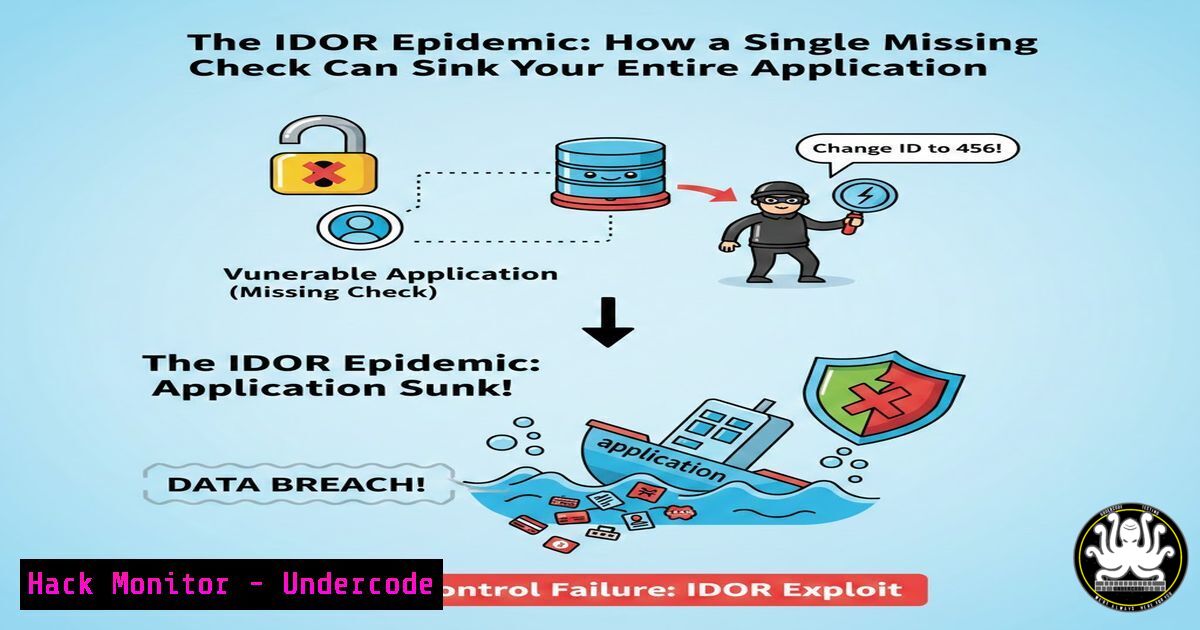
Insecure Direct Object Reference (IDOR) remains one of the most pervasive and damaging vulnerabilities in modern web applications. As demonstrated by a recent security finding shared by a penetration tester, this flaw allows attackers to bypass authorization and directly access resources by manipulating identifiers like IDs in URLs or API requests. In an era of API-driven architectures and microservices, understanding and mitigating IDOR is not optional—it’s a fundamental requirement for secure development.
Learning Objectives:
- Understand the core mechanics of IDOR vulnerabilities and how to identify them in both web and API contexts.
- Learn practical, hands-on techniques for manually testing and automating the discovery of IDOR flaws.
- Implement robust mitigation strategies, including access control validation, using indirect reference maps, and adopting secure-by-design principles.
You Should Know:
1. Decoding IDOR: The Hidden Authorization Bypass
An IDOR occurs when an application exposes a direct reference to an internal object, such as a database key, a file path, or a UUID, without verifying the authenticated user has permission to access the requested object. Attackers exploit this by simply changing a parameter value (e.g., from `/user/profile?id=456` to /user/profile?id=457). The vulnerability stems from trusting client-provided input for authorization decisions.
Step‑by‑step guide explaining what this does and how to use it.
Step 1: Map the application. Identify all endpoints that use parameters like id, uid, account, file, document, or invoice.
Step 2: As an authenticated user (e.g., user_a), request a resource you own. Capture the request: GET /api/v1/invoices/1001.
Step 3: Using the same session, change the object reference. Try sequential (1002), predictable (UUIDs), or parameter pollution (/api/v1/invoices/1001?user_id=1002).
Step 4: Observe the response. A successful retrieval of another user’s data (HTTP 200) indicates a classic IDOR. A 403 Forbidden suggests proper controls.
2. Manual Hunting: Beyond Simple Integer Swapping
Modern applications use complex identifiers, but the core flaw remains. Testing must evolve.
Testing Hashed/Encoded IDs: Decode Base64 or URL-encoded parameters. A parameter like `?doc=MjAyNA==` might decode to 2024.
Testing UUIDs/GUIDs: While random, they are often exposed. If you find one user’s invoice UUID (/api/invoice/cf2c6e8b-8b6f-4b3d-9a2f-1e3b4c5d6e7f), check if other endpoints use predictable or leakable UUIDs.
Testing Mass Assignment: Changing a `POST` parameter like `”user_id”: 456` to `”user_id”: 457` during a profile update can lead to account takeover.
3. Automated Discovery with FFUF and Custom Wordlists
Manual testing is foundational, but automation scales. The tool `ffuf` (Fuzz Faster U Fool) is excellent for this.
 Fuzz for numeric IDOR
ffuf -w /usr/share/seclists/Fuzzing/4-digits-0000-9999.txt:FUZZ -u "https://target.com/api/user/FUZZ/details" -H "Authorization: Bearer <YOUR_TOKEN>" -mr "email" -fs 0

Fuzz for document IDs (hex, alphanumeric)
ffuf -w /usr/share/seclists/Fuzzing/alphanum-case-5000.txt:FUZZ -u "https://target.com/download?file=FUZZ" -H "Cookie: session=<YOUR_COOKIE>" -mc 200 -fs 0
Explanation: These commands fuzz the parameter with a wordlist. The `-mr “email”` flag looks for responses containing “email”, indicating a user object. `-fs 0` filters out responses of size 0.
- Exploiting IDOR in APIs: Chaining with Business Logic Flaws
APIs are prime targets. An IDOR in a `GET` request might be low severity, but chaining it with a `PUT` or `DELETE` is critical.
Scenario: `GET /api/users/123/address` is vulnerable (View). Check if `PUT /api/users/124/address` allows modification (Edit/Delete). Capture a legitimate `PUT` request for your profile and replay it with another user’s ID.
Tool: Use Burp Suite’s “Engagement tools” -> “Find references” to search for all instances of a user ID across captured traffic, then test each associated endpoint.
5. The Developer’s Arsenal: Mitigation Strategies That Work
Fixing IDOR is about enforcing authorization on every access.
Implement Proper Access Control: Never trust client input. Use server-side session/context to identify the user. Every database query must include the user’s authorization context.
// Secure Example (Laravel-like)
$invoice = Invoice::where('id', $request->id)
->where('user_id', auth()->id()) // Critical Check
->firstOrFail();
Use Indirect Reference Maps: Replace direct database keys with random, per-user maps.
 Instead of /file/real_file_id.pdf
 Use /file/mapped_token
user_file_map = {
'user_123': {'abc1de': 'real_file_1001.pdf', 'xyz2pd': 'real_file_1002.pdf'}
}
Adopt UUIDs + Mandatory Access Control: Use random, non-sequential UUIDs as public identifiers, but still validate access on the backend.
Regular Testing: Implement automated security tests in CI/CD that scan for IDOR using tools like `OWASP ZAP` or Burp Suite Enterprise.
What Undercode Say:
- The Simplicity is the Danger: IDOR’s exploit complexity is often trivial, making it a favorite for bug bounty hunters and a high-risk finding in penetration tests. Its impact is directly proportional to the value of the exposed data.
- It’s a Design & Implementation Failure: IDOR is not a “bug” in the traditional sense; it’s a systemic failure to integrate authorization checks with data retrieval logic across the entire application layer.
Prediction:
The rise of complex API ecosystems and microservices will exacerbate the IDOR problem, increasing the attack surface exponentially. We will see a surge in automated botnets specifically scanning for and exploiting mass IDOR vulnerabilities in APIs to scrape sensitive data at scale. Consequently, the shift-left security movement will mandate the integration of dynamic access control testing into the software development lifecycle (SDLC), and technologies like fine-grained authorization frameworks (e.g., Open Policy Agent) will become standard to centralize and enforce access logic, moving beyond ad-hoc, per-endpoint checks.
▶️ Related Video (82% Match):
🎯Let’s Practice For Free:
IT/Security Reporter URL:
Reported By: Mokhtar Emad – Hackers Feeds
Extra Hub: Undercode MoN
Basic Verification: Pass ✅


