Listen to this Post
Introduction:
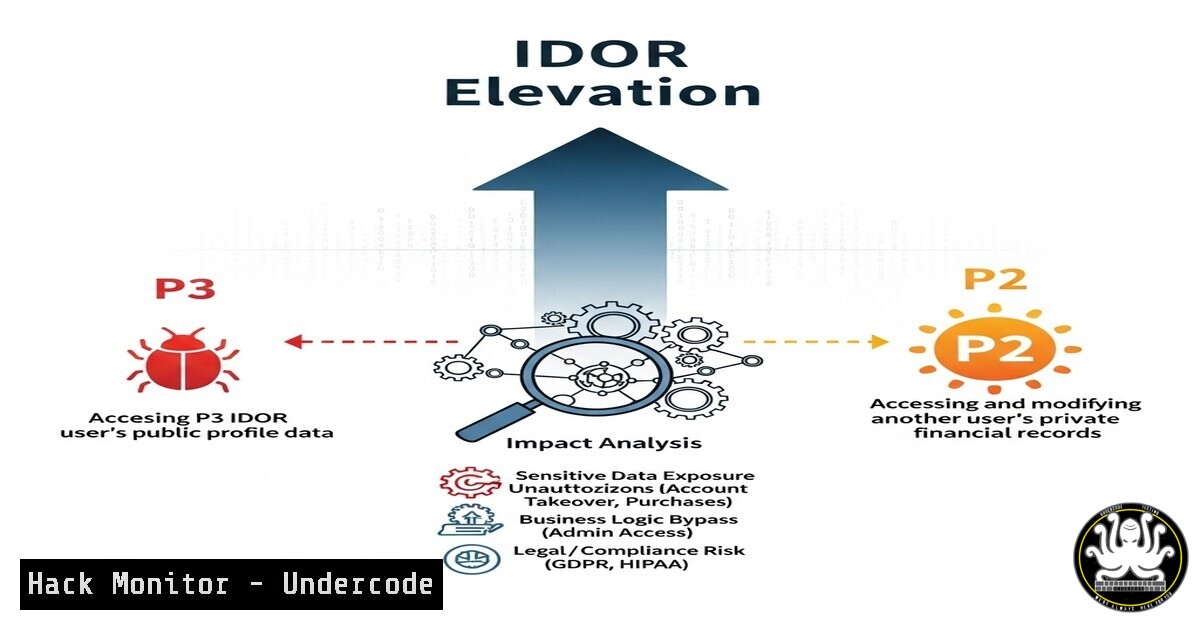
Insecure Direct Object Reference (IDOR) vulnerabilities remain a pervasive threat in web applications, allowing attackers to bypass authorization and access unauthorized data. A recent case study from a bug bounty submission demonstrates how a seemingly minor view-only IDOR was reclassified to a higher severity after revealing its potential for unauthorized cross-team data modification, highlighting the critical importance of comprehensive impact assessment in application security.
Learning Objectives:
- Understand the mechanisms and business impact of Insecure Direct Object Reference (IDOR) vulnerabilities.
- Learn practical techniques for testing and identifying IDORs across various endpoints.
- Develop skills for effectively communicating the real-world risk of a vulnerability to triage teams.
You Should Know:
1. Endpoint Analysis with Burp Suite
Intercepting application traffic is the first step to uncovering hidden parameters vulnerable to IDOR.
 Using Burp Suite to proxy traffic
1. Configure your browser to use Burp Suite as a local proxy (e.g., 127.0.0.1:8080).
2. Turn Intercept "on" in Burp's Proxy tab.
3. Browse the target application normally; all HTTP/S requests will be captured for manual review.
4. Look for requests containing object identifiers (e.g., <code>user_id=123</code>, <code>project_id=555</code>).
This process allows you to systematically capture every API call and parameter the application uses. By analyzing these requests, you can identify parameters that reference database objects, which are prime candidates for IDOR testing.
2. Manual IDOR Testing Methodology
Once a potential parameter is identified, the core test is to change its value and observe the response.
 Testing a user profile endpoint
Original Request: GET /api/v1/profile?user_id=12345
Modified Request: GET /api/v1/profile?user_id=12346

Testing a project update endpoint (POST)
Original: POST /projects/update { "proj_id": "team_a_100", "name": "New Name"}
Modified: POST /projects/update { "proj_id": "team_b_101", "name": "Hacked Name"}
This manual manipulation verifies if the application checks whether the authenticated user has the right to access or modify the object with the given ID. A successful attack returns another user’s data (for GET) or changes it (for POST/PUT).
3. Automating IDOR Discovery with ffuf
For endpoints with predictable identifiers, automation can help find accessible objects.
 Fuzzing for user profiles with ffuf
ffuf -w user_ids.txt -u https://target.com/api/user/FUZZ/profile -H "Authorization: Bearer YOUR_TOKEN" -mc 200

Example wordlist (user_ids.txt)
10000
10001
10002
...25000
This command fuzzes the ID parameter, checking for HTTP 200 responses, which indicate successful access. Always ensure you have explicit permission before running such tests.
4. Bypassing Common IDOR Defenses
Applications often use GUIDs or hashed IDs instead of sequential integers. These can sometimes be found elsewhere.
 Example of finding GUIDs from other user-accessible data
1. Scrape user listings or project directories that are public.
2. Extract the obscure identifiers (e.g., 7c4cc4c8-9c6b-43e0-b348-4f2288f67e7a).
3. Test these IDs in privileged endpoints.
Even non-sequential IDs are not a guarantee of security if they are exposed elsewhere and the application lacks robust access control checks on the backend.
5. Testing for Mass Assignment IDOR
Some endpoints accept an array of IDs, potentially leading to mass data retrieval or deletion.
 Testing a batch endpoint
POST /api/batch_get_users
{"user_ids": [123, 456, 789]}

Modify to include unauthorized IDs
POST /api/batch_get_users
{"user_ids": [123, 456, 789, 1000001]}
This type of vulnerability can have a catastrophic impact, allowing an attacker to exfiltrate or modify vast amounts of data in a single request.
6. Exploiting IDOR in Referral Functionality
Referral endpoints often leak information about other users.
 Common referral endpoint
GET /api/referral/status?ref_code=USER432_REFCODE

Modifying the ref_code parameter
GET /api/referral/status?ref_code=ADMIN001_REFCODE
By manipulating the referral code, an attacker can often view the referral status and personal information of other users, violating confidentiality.
7. Leveraging IDOR for Privilege Escalation
The most critical IDORs allow changes to user attributes, leading to privilege escalation.
 Example of a role change vulnerability
POST /admin/update_user_role
{"user_id": 12345, "new_role": "administrator"}

An attacker changes their own user_id to a victim's
POST /admin/update_user_role
{"user_id": 00001, "new_role": "administrator"}
If the application does not validate that the requester has the right to assign roles, a low-privilege user could make themselves or another user an admin.
What Undercode Say:
- Context is King: A bug’s severity is not just about technical mechanics but its business context. A “view-only” IDOR affecting low-value data is a P3; the same bug allowing modification of cross-team corporate projects is a P2.
- Communication is a Skill: Effectively communicating the realistic business impact—unauthorized cross-team access, reputational damage, data integrity loss—is often necessary for proper triage and remediation. Technical proof must be paired with a clear narrative of risk.
This case exemplifies a common triage dilemma. Platforms often initially rate bugs based on a narrow technical checklist. The researcher’s persistence in demonstrating the broader attack surface—that the same parameter vulnerable to information disclosure was also vulnerable to unauthorized modification—was key to the re-evaluation. This underscores that a vulnerability’s true risk is a product of its technical capability and its environmental context.
Prediction:
The increasing complexity of multi-tenant SaaS platforms and microservices architectures will create a new wave of complex IDOR variants. We will see a rise in “chainable” IDORs, where a low-severity IDOR in one service leaks an identifier that is the key to a high-severity IDOR in a more critical internal API. Automated detection of these vulnerabilities will become integral to SAST and DAST tools, and bug bounty programs will increasingly reward researchers for demonstrating chained attack scenarios.
🎯Let’s Practice For Free:
IT/Security Reporter URL:
Reported By: Sheraz Khalid – Hackers Feeds
Extra Hub: Undercode MoN
Basic Verification: Pass ✅


