Listen to this Post
Introduction:
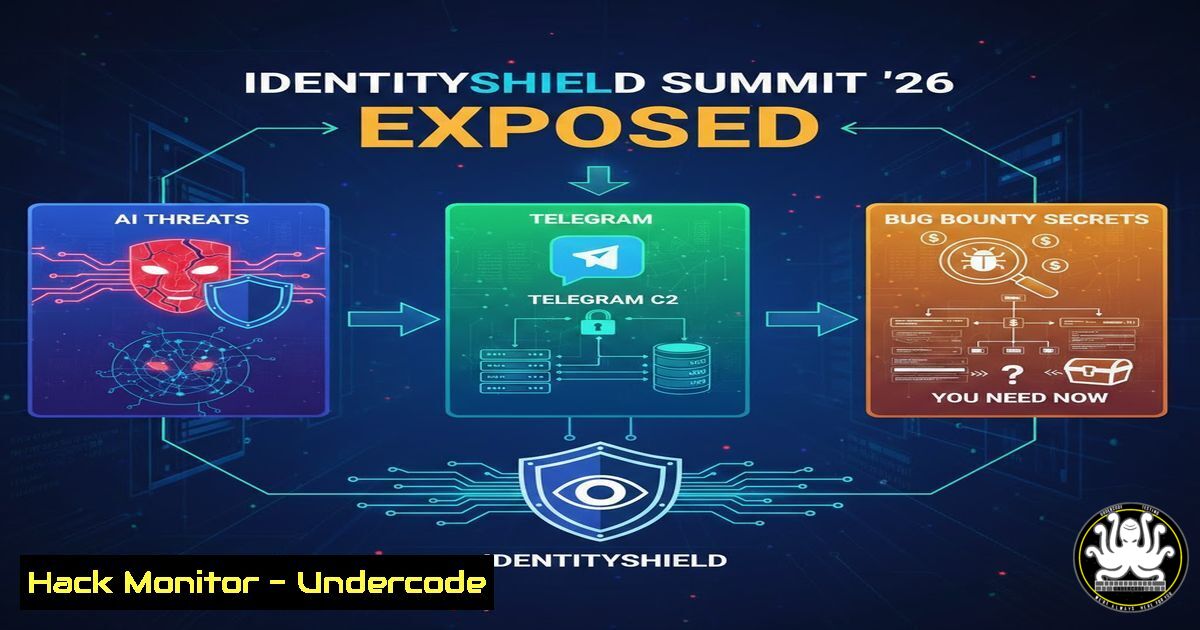
The digital battleground is evolving at a breakneck pace, fueled by artificial intelligence and sophisticated adversarial techniques. Insights from the IdentityShield Summit ’26 reveal a critical shift towards AI-enabled attacks and defense, emphasizing that tomorrow’s cybersecurity professional must master a blend of cutting-edge tools, legal frameworks, and proactive hunting methodologies. This article distills the summit’s key technical sessions into actionable intelligence and hardening steps.
Learning Objectives:
- Understand and mitigate emerging attack vectors like AI-powered insiders and Telegram-based Command & Control (C2).
- Implement advanced reconnaissance methodologies for bug bounty programs and penetration testing.
- Harden systems against high-impact vulnerabilities through practical configuration and code review practices.
You Should Know:
- The New Insider Threat: AI Agents and the DPDP Act
The traditional model of insider threats—oblivious, negligent, malicious—has evolved. We now face “AI Agentic Security” challenges, where AI agents acting on behalf of users can become negligent or malicious insiders themselves, compounded by data privacy regulations like India’s Digital Personal Data Protection (DPDP) Act.
Step‑by‑step guide:
Audit AI Tool Usage: Enumerate all AI-powered tools (e.g., code assistants, analytics platforms) with access to sensitive data.
Linux Command: Use `lsof` and audit logs to track processes accessing key data stores. `sudo lsof /var/lib/mysql` (if using MySQL).
Policy Enforcement: Implement Data Loss Prevention (DLP) rules that apply to both human and API-driven AI tool access.
Implement Responsible AI Governance:
- Create an inventory of all Large Language Model (LLM) integrations.
- Enforce strict input/output filtering to prevent data exfiltration via prompts.
- Log all AI interactions for audit trails, ensuring compliance with DPDP’s purpose limitation and storage limitation principles.
2. Advanced Reconnaissance: Beyond Basic Subdomain Enumeration
The bug bounty workshop emphasized a systematic approach to reconnaissance, moving beyond simple scans to build a comprehensive attack surface map.
Step‑by‑step guide:
- Passive Enumeration: Use tools like
subfinder,amass, and `assetfinder` to gather subdomains without direct interaction.
`subfinder -d target.com -silent | tee subdomains.txt`
- Active Probing & Resolution: Feed the list into `httpx` to probe for live HTTP/HTTPS servers and retrieve titles, status codes, and technologies.
`cat subdomains.txt | httpx -silent -title -tech-detect -status-code -o live_targets.txt`
3. Reverse WHOIS & ASN Lookups: Identify related domains by searching for the target’s registration email or phone number across databases. Use tools like `whois` and `amass` for ASN enumeration.
`amass intel -org “Target Corp”`
`amass enum -active -asn 12345 -src -ip -d target.com -oA amass_scan`
4. Port Scanning & Service Fingerprinting: Use `nmap` with advanced scripts on discovered IPs.
`nmap -sV -sC -p- -iL discovered_ips.txt -oA full_nmap_scan`
3. Telegram as a Stealth Command & Control Channel
Attackers are abusing legitimate cloud APIs like Telegram Bot API for resilient, low-cost C2 infrastructure, bypassing traditional blocklists.
Step‑by‑step guide (Defensive Analysis):
Detection via Network Monitoring:
- Identify Traffic: Look for consistent outbound TLS connections to `api.telegram.org` on port 443 from unexpected hosts or users.
2. Wireshark Filter: `tls.handshake.extensions_server_name contains “api.telegram.org”`
- Endpoint Detection: Use EDR tools to flag processes making network connections that also exhibit keylogging or memory dumping behaviors.
Mitigation & Hardening:
- Web Proxy/NGWF Policy: Block outbound connections to `api.telegram.org` from all non-business-critical systems. Allow-listing is key.
- Script Analysis: Deobfuscate and analyze malware samples (e.g., Python, PowerShell) to extract the Telegram Bot token. Use this token to shut down the C2 channel via Telegram API.
- Honeypot Deployment: Deploy low-interaction honeypots that mimic infostealer behavior to gather new C2 IPs and domains.
4. Implementing a Local AI-Powered Security Code Reviewer
Shifting security left requires automated, intelligent code analysis. A local AI reviewer avoids sending proprietary code to external APIs.
Step‑by‑step guide:
- Choose a Local LLM: Select a model like
CodeLlama,DeepSeek-Coder, or `StarCoder` that can be run locally via Ollama or LM Studio.
2. Setup Ollama (Linux/Mac):
curl -fsSL https://ollama.com/install.sh | sh
ollama pull codellama:7b
3. Create a Security-Focused Prompt Wrapper: Develop a script that sends code snippets to the local LLM with a security-centric prompt.
 Example script: secure_review.sh
CODE_SNIPPET=$(cat $1)
PROMPT="Analyze the following code for security vulnerabilities (SQLi, XSS, Command Injection, Insecure Deserialization, Hardcoded Secrets). Provide specific line numbers and remediation:\n\n$CODE_SNIPPET"
echo "$PROMPT" | ollama run codellama:7b
4. Integrate with CI/CD: Call this script as a pre-commit hook or within your GitHub Actions/GitLab CI pipeline to block commits with critical findings.
5. Hardening Against High-Impact Vulnerabilities
The closing session stressed that most breaches exploit known, unpatched vulnerabilities or misconfigurations.
Step‑by‑step guide (Cloud & OS Hardening):
Linux (Ubuntu/CentOS) Immediate Actions:
Kernel Hardening: `sudo sysctl -w kernel.kptr_restrict=2` (restricts kernel pointer leaks)
Disable Uncommon Protocols: `sudo sh -c ‘echo “install dccp /bin/true” >> /etc/modprobe.d/disable-protocols.conf’` (Repeat for sctp, rds, tipc).
Audit SUID/SGID Files: find / -type f -perm /6000 2>/dev/null. Review each for necessity.
Windows Hardening (PowerShell Commands):
Enable LSA Protection: `New-ItemProperty -Path “HKLM:\SYSTEM\CurrentControlSet\Control\Lsa” -Name “RunAsPPL” -Value 1 -PropertyType DWORD -Force`
Disable NTLMv1: `Set-ItemProperty -Path “HKLM:\SYSTEM\CurrentControlSet\Control\Lsa” -Name “LmCompatibilityLevel” -Value 5`
Cloud (AWS/Azure) Critical Checks:
- Ensure S3 buckets/GCS containers have no public `READ` or `WRITE` ACLs.
2. Enforce MFA for all root/admin users programmatically.
- Ensure all security groups and NSGs follow the principle of least privilege; deny all by default.
What Undercode Say:
- The Perimeter is Now Behavioral: Defense can no longer rely on blocking malicious IPs or domains. Attackers use legitimate services (Telegram, Cloud APIs) as infrastructure. Security must focus on detecting anomalous behavior in users, processes, and AI agents.
- AI is the Double-Edged Sword of Our Time: It powers both hyper-efficient, automated attacks (AI-driven recon, phishing) and our most promising defense systems (local code reviewers, behavioral analytics). The side that implements it more responsibly and pervasively will gain the upper hand.
Prediction:
The convergence of AI, quantum computing, and geopolitical tensions will accelerate cyber conflict, moving it from the background to a primary vector of state and corporate competition. We will see a rise in “AI supply chain attacks,” where training data or foundational models are poisoned to create systemic vulnerabilities. Regulations like the DPDP Act will force a structural shift in how data is managed, making Privacy by Design a non-negotiable component of all cybersecurity architecture. Organizations that fail to integrate AI into both their defensive toolkit and their threat model will be overrun within the next 3-5 years.
▶️ Related Video (74% Match):
🎯Let’s Practice For Free:
IT/Security Reporter URL:
Reported By: Vedant Jogi – Hackers Feeds
Extra Hub: Undercode MoN
Basic Verification: Pass ✅


